18 GHz Test Coaxial Cables: Precision Essentials for RF Engineers
Published on 2/27/2026 • Updated on 2/27/2026
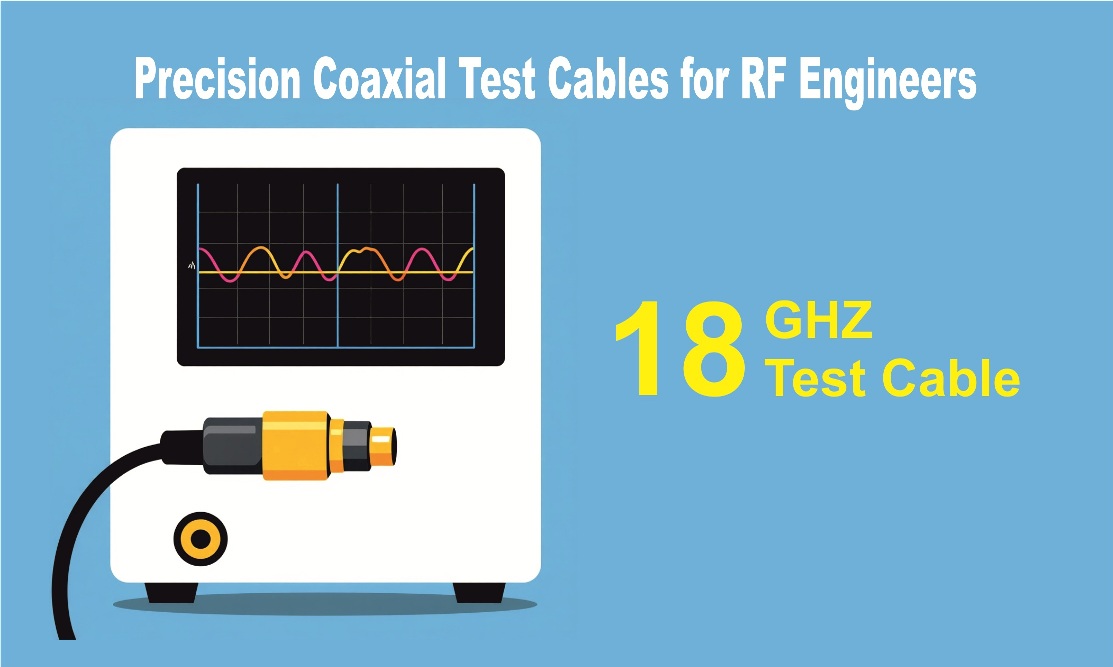
At their core, 18 GHz coaxial cables feature a rugged center conductor often silver-plated copper surrounded by a dielectric insulator (such as PTFE or low-loss foam PE), a braided shield, and a protective jacket. This construction minimizes attenuation, typically below 2 dB/m at 18 GHz, while supporting VSWR (Voltage Standing Wave Ratio) as low as 1.2:1. Connectors like 2.92 mm (K-type) or 2.4 mm ensure phase stability and repeatability, vital for vector network analyzer (VNA) setups in labs or field tests.
Why 18 GHz specifically? This frequency range covers key uses in satellite communications, 5G backhaul, automotive radar (77 GHz down-converted testing), and military avionics. For instance, in phased-array antenna validation, these cables handle high-power signals up to 50W without melting or degrading, thanks to low thermal resistance.
Choosing the right cable involves balancing flexibility, durability, and performance. Armored versions resist crushing in rugged environments, while phase-stable models maintain electrical length during flexing essential for dynamic tests. Cost-wise, expect $50-250 per meter, depending on length, specification and order quantity.
Challenges include insertion loss from bends (minimize radius to 25-50 mm) and connector wear; regular calibration with torque wrenches extends life. Emerging trends integrate these cables with automated test equipment (ATE) for 6G R&D, pushing toward 40 GHz+ capabilities.
In summary, 18 GHz test coaxial cables bridge the gap between lab precision and real-world reliability, empowering engineers to innovate in high-stakes RF domains.
- Semi-Flexible Coax Cable Assemblies
- Semi-Rigid Coax Cable Assemblies
- SMA Male to SMA Male Using RG405 Flexible RF Cable, DC-18GHz
- RG393/RG400/RG401/RG402/RG405 RPSMA Reverse Polarity to SMA Male Coax Cable Assembly
- 50 Ohm vs 75 Ohm N Type Connectors - What’s the Difference?
- N female to N male coaxial cable assembly with RG316, RG58, RG214, RG178 Cable options
- SMA Male to SMA Female Bulkhead Connector, RG316 Cable Assembly
- SMA (m) - RG316 Coaxial Cable - N (f) connector cable assembly
- SMA(m) right angle-RG316 Coaxial Cable-SMA(m) connector cable assembly
- Buy N Type Coaxial Cable Assembly