RG58 TNC to N-Type Male Coaxial Cable Assembly
Published on 12/16/2025 • Updated on 7/31/2026
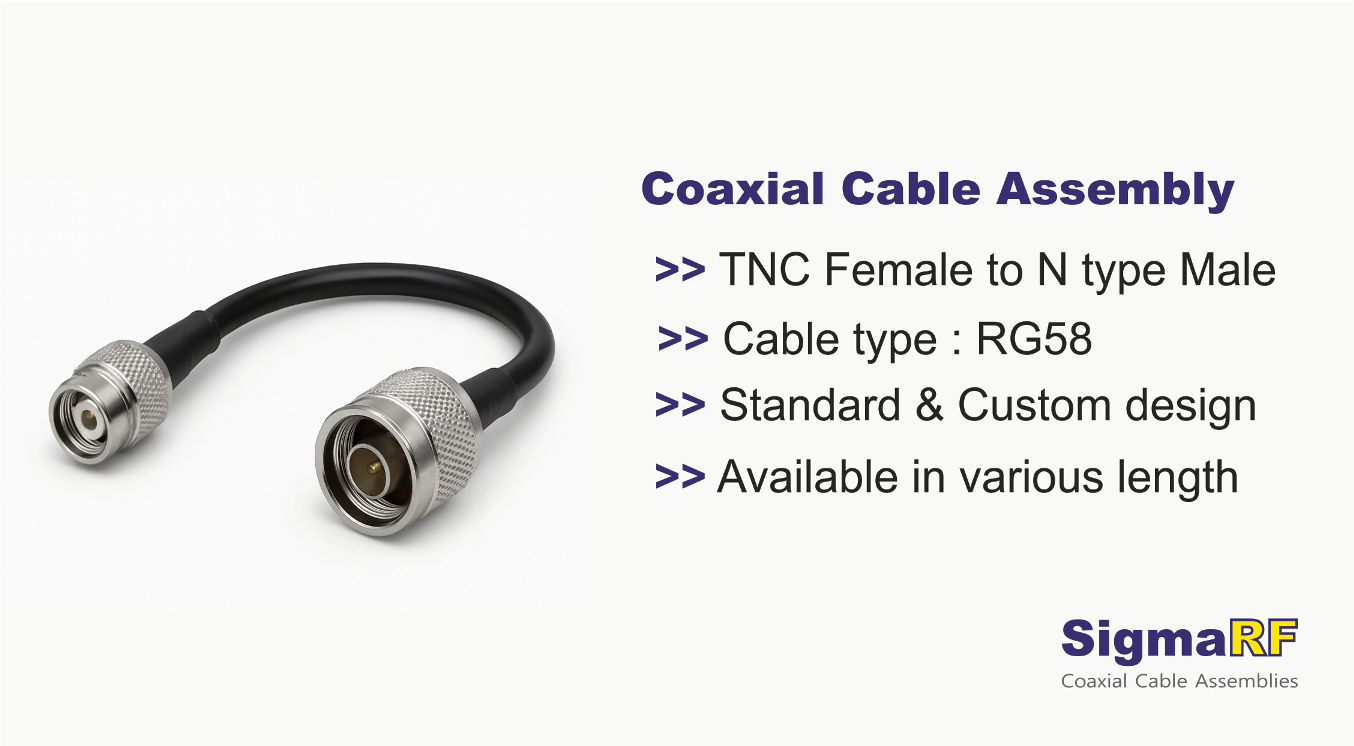
It shows up everywhere for a reason: telecom racks, broadcast facilities, military and tactical gear, ham radio installations, industrial telemetry and monitoring. Both connector families are threaded, so the mating stays put under vibration. The RG58 cable between them is compact and flexible enough to route through equipment racks and around mobile antenna mounts without a fight. And the whole assembly costs a fraction of what low-loss or precision alternatives run, which matters when a site needs forty of them.
On This Page
The RG58 Cable: What You're Getting
RG58 is one of the oldest and most widely deployed 50 ohm coaxial cables in existence, and its construction is a study in getting the basics right. A copper center conductor (stranded for flexibility in most variants, solid in some), a polyethylene (PE) dielectric holding the 50 ohm geometry, a tinned copper braid shield providing EMI protection, and a PVC jacket. Overall diameter is about 0.195 inches (4.95 mm), which is what gives it the routing flexibility that larger low-loss cables cannot match.
The stranded center conductor deserves a mention. It trades a small amount of RF performance for a large amount of flex life, which is exactly the right trade for cables that get routed, re-routed, coiled, and moved. If your application flexes the cable regularly (mobile installations, portable test setups, frequently reconfigured racks), stranded RG58 outlasts solid-conductor alternatives by a wide margin.
Operating temperature range is −40 to +80 °C, which covers outdoor base station cabinets, vehicle installations, and indoor lab environments alike.
Honest numbers on attenuation, because this is where RG58 has to be specified with open eyes:
| Frequency | Typical Attenuation | Practical Meaning |
|---|---|---|
| 100 MHz | ~4.5 dB/100 ft (~0.15 dB/m) | Excellent, use freely |
| 400 MHz | ~9.5 dB/100 ft (~0.31 dB/m) | Very usable for moderate runs |
| 1 GHz | ~20 to 24 dB/100 ft (~0.7 dB/m) | Keep runs short |
| Above 1 GHz | Rises steeply | Use a low-loss cable instead |
The practical translation: at VHF and UHF, RG58 is comfortable on runs of several meters. At 1 GHz, a 3-meter assembly costs you about 2 dB, which is fine for a jumper and too much for a long feed. This is why RG58 is described as a cable for moderate-frequency, general-purpose RF work rather than a do-everything cable, and specifying it honestly is how you stay happy with it.
The Frequency Question: Cable Limit vs Connector Limit
Here is a point that confuses buyers of mixed assemblies like this one, so let's settle it clearly. The TNC and N-Type connectors on this assembly are each rated to 11 GHz. The RG58 cable between them is practical to about 1 GHz. Which number governs?
The cable does. An assembly is only as capable as its most limited element, and above 1 GHz the RG58's attenuation makes the assembly increasingly lossy even though the connectors would happily pass the signal. The connectors' 11 GHz rating is still valuable: it means the connector interfaces are never the bottleneck, the VSWR at the interfaces stays clean across the usable band, and the same connector types can be reused on higher-grade cable when your requirements grow.
The TNC End
TNC (Threaded Neill-Concelman) is exactly what its name says: the BNC connector's threaded sibling. Where BNC uses a quarter-turn bayonet that can rattle loose under vibration, TNC uses a 7/16-28 UNEF threaded coupling that stays torqued. That single change makes TNC the standard choice in mobile radio, avionics, telemetry, and any installation that lives on a vehicle or near machinery.
- 50 ohm impedance, rated to 11 GHz
- VSWR 1.3:1 maximum at the interface
- Brass body with nickel plating; gold-plated center contacts for low, repeatable contact resistance
- Threaded coupling maintains constant contact pressure through vibration and thermal cycling
- Available in male and female on SigmaRF assemblies, so the assembly matches your equipment rather than the other way around
The gold contact detail matters more than it sounds for test bench use. Test cables get mated constantly, and gold-on-gold contact interfaces hold their contact resistance over hundreds of cycles where bare or nickel surfaces would oxidize and drift.
The N-Type Male End
The N-Type is the larger, more rugged of the two connectors, and it is the reason this assembly is so common on antenna and infrastructure work. Base station antennas, outdoor access points, amplifiers, filters, and RF instruments overwhelmingly present N-Type ports, and the N-Type Male on this assembly mates directly to all of them.
- 50 ohm impedance, rated to 11 GHz
- 5/8-24 UNEF threaded coupling, larger and more robust than TNC
- O-ring seal at the mating interface for weather resistance (IP67-capable when properly mated and sealed)
- 1500 V peak voltage rating, comfortable margin for transmit applications at this power class
- Rated for 500+ mating cycles
The O-ring is worth a note for outdoor installs: it seals the mating interface, but the assembly's long-term outdoor survival still depends on wrapping the mated pair with self-amalgamating tape and providing a drip loop. The connector gives you the sealing capability; the installation practice realizes it.
Every SigmaRF assembly is terminated by precision crimping or soldering with controlled dimensions at the interface, then swept on a VNA. Typical return loss on these assemblies is better than 20 dB across the usable band (VSWR under 1.22:1), which means the connector interfaces contribute essentially nothing to the system's total mismatch.
Key Specifications
| Parameter | Details |
|---|---|
| Cable type | RG58, 50 ohm, ~0.195" (4.95 mm) OD |
| Center conductor | Stranded copper (solid available) |
| Dielectric | Polyethylene (PE) |
| Shielding | Tinned copper braid |
| Usable frequency | To ~1 GHz (cable limit); connectors rated to 11 GHz |
| Attenuation (typical) | ~4.5 dB/100 ft @ 100 MHz; ~20 to 24 dB/100 ft @ 1 GHz |
| Connector 1 | TNC, male or female, nickel-plated brass, gold contacts, 7/16-28 UNEF coupling |
| Connector 2 | N-Type Male, 5/8-24 UNEF coupling, O-ring sealed, 1500 V peak, 500+ mating cycles |
| Interface VSWR | 1.3:1 max (TNC); return loss better than 20 dB typical on tested assemblies |
| Operating temperature | −40 to +80 °C |
| Testing | Every assembly VNA-swept for VSWR and insertion loss before shipment |
Where This Assembly Fits
Telecom equipment racks Broadcast facilities Military and tactical radio Ham radio stations Mobile and vehicle antennas Industrial telemetry and SCADA Test benches and labs VHF / UHF base stations
The common thread across all of these: frequencies at or below 1 GHz, runs measured in single-digit meters, environments with vibration or frequent reconnection, and a preference for cost-effective reliability over squeezing the last tenth of a dB.
When to Choose Something Else
Honest guidance keeps assemblies matched to jobs. Skip this assembly and ask us about alternatives when:
- ✗ Your frequency is above 1 GHz. Wi-Fi at 2.4 or 5 GHz, cellular bands, GPS: step up to RG316, LMR-195, or LMR-240 depending on run length.
- ✗ The run is long. Anything over about 10 meters at UHF and above deserves LMR-400-class cable; RG58's attenuation adds up fast.
- ✗ You're in a dense EMI environment. RG58's single braid delivers roughly 55 to 65 dB of shielding effectiveness. Fine for general use; for high-isolation work, choose a double-braid RG or foil-plus-braid low-loss construction.
- ✗ You need higher power. RG58's power handling drops with frequency; transmit applications above roughly 50 W at UHF should move to a larger cable.
Not sure which cable your application actually needs? Our coaxial cable selection guide walks through the decision step by step, from frequency and loss budget to shielding and environment.
Customization Options
- ✓ Any length, cut and terminated to your specification, from short jumpers to full reels
- ✓ Gender combinations: TNC male or female at one end, N-Type male or female at the other
- ✓ Right-angle connector options where enclosure clearance is tight
- ✓ Labels and heat-shrink marking for cable identification, port mapping, or branding
- ✓ Prototype to production: one-off engineering samples through bulk production runs, with consistent termination quality across the batch
Frequently Asked Questions
What frequency can an RG58 TNC to N-Type assembly handle?
Practically, up to about 1 GHz, which is the RG58 cable's useful limit. The TNC and N-Type connectors are each rated to 11 GHz, so the connector interfaces are never the bottleneck, but above 1 GHz the cable's attenuation rises steeply and a low-loss cable such as RG316 or LMR-195 is the better choice.
What is the difference between TNC and BNC?
TNC is the threaded version of BNC. BNC uses a quarter-turn bayonet coupling that is fast to connect but can loosen under vibration; TNC uses a 7/16-28 UNEF threaded coupling that maintains constant contact pressure. TNC also performs better at higher frequencies (rated to 11 GHz versus BNC's practical 4 GHz) because the threaded interface holds tighter geometry.
Is RG58 good for outdoor use?
Yes, within limits. The −40 to +80 °C temperature range covers most climates, and the N-Type's O-ring seal provides weather resistance at the mating interface. For long-term outdoor installations, wrap mated connectors with self-amalgamating tape, provide a drip loop, and protect the cable jacket from continuous direct UV where possible. For permanently exposed infrastructure runs, a UV-stable outdoor-jacketed low-loss cable is the more durable choice.
How much signal does a 3-meter RG58 assembly lose?
Approximately 0.45 dB at 100 MHz, 1 dB at 400 MHz, and 2 to 2.2 dB at 1 GHz, plus roughly 0.2 to 0.3 dB total for the two connector interfaces. For most sub-GHz applications with a few meters of cable, the total loss is comfortably manageable.
Can I get this assembly in custom lengths and genders?
Yes. SigmaRF builds these assemblies to any length with TNC male or female on one end and N-Type male or female on the other, with optional right-angle connectors, labeling, and heat-shrink marking. Every assembly is VNA-tested for VSWR and insertion loss before it ships, from single prototypes to production quantities.
Order Your RG58 TNC to N-Type Assembly
Built to your length and gender specification, precision-terminated, and individually VNA-tested before shipment. Need a different cable for higher frequencies or longer runs? Our engineers will point you to the right construction for the job.
Standard Assemblies Custom Assemblies Talk to an Engineer- Why Cheap RF Cable Assemblies Fail: Construction Shortcuts and How to Spot Them
- Solving Antenna Range Loss on an IoT Device: A Worked Diagnostic Example
- SMA Mating Cycles: How Many Connections Can an SMA Survive?
- RG58 Attenuation: Datasheet Specs vs Real-World Loss
- VNA Testing for Cable Assemblies: How VSWR and Insertion Loss Verification Works
- How a Custom Coaxial Cable Assembly Is Built, Step by Step
- Cellular Repeater and DAS Cable Selection: In-Building Coverage Guide
- Wi-Fi HaLow (802.11ah): Sub-GHz Wi-Fi and Its Antenna/Cable Needs
- RF Interconnects for Test Labs: Building a Reliable VNA Bench
- Direct-to-Cell Satellite and IoT: What It Means for Ground Hardware