Silver vs Tin Plating for RF Coaxial Cables: Which Is Better?
Published on 7/27/2026 • Updated on 8/1/2026
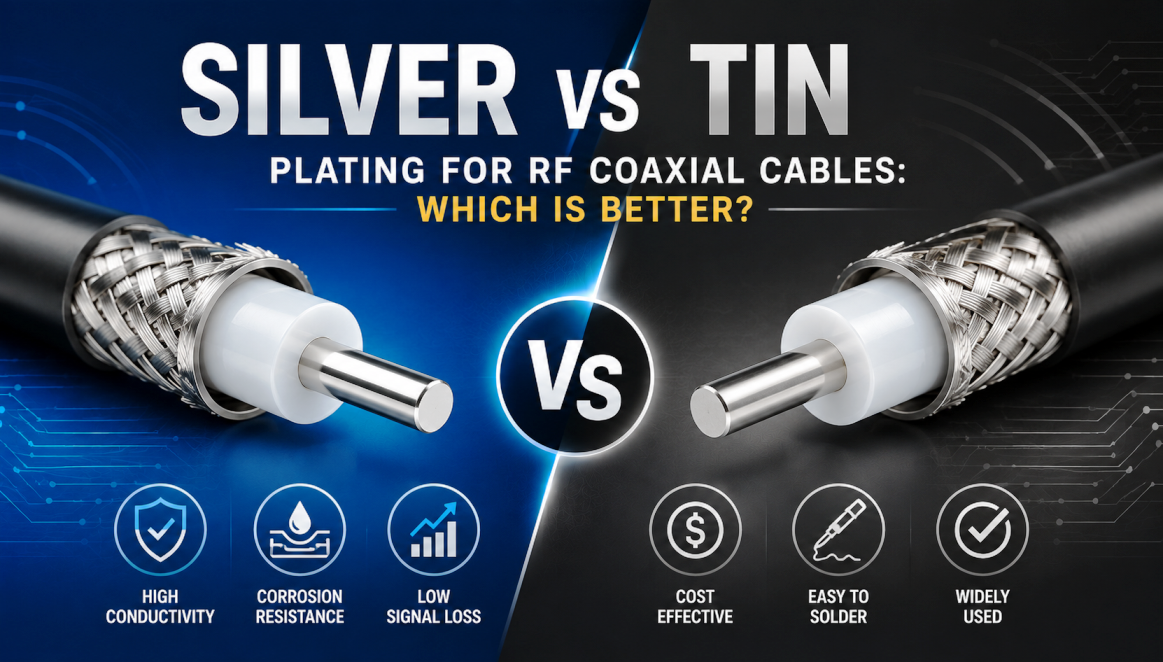
When you order an RF cable assembly, the datasheet will say something like "silver-plated copper" or "tin-plated copper" and it is easy to skim past. Do not. That plating is what your RF signal actually travels through. The copper underneath barely gets a look-in.
This is a plain-English guide to why plating matters, what silver and tin each do well, and how to decide which one your project needs. You do not need a physics degree to work this out, but a couple of paragraphs on how RF actually flows through a wire will make every decision later feel obvious.
On This Page
- Why the Plating Matters More Than the Copper
- The Skin Effect, in Plain English
- Silver Plating: What It Does Well
- Tin Plating: What It Does Well
- Head-to-Head Comparison
- The Tin Whisker Problem
- Temperature and Environment
- The Cost Reality
- Which One Do You Actually Need?
- Common Specification Mistakes
- Frequently Asked Questions
- Bottom Line
Why the Plating Matters More Than the Copper
At DC and low frequencies, current spreads through the whole cross-section of a wire. If the wire is copper, the current runs through copper, and that is that. The plating is mostly for solderability and corrosion protection.
At RF, it is completely different. The higher the frequency, the more the current gets pushed toward the outside of the conductor. By the time you are into the GHz range, essentially all the current is riding on a thin outer skin, maybe a couple of micrometers thick. Everything under that skin is dead weight electrically.
The Skin Effect, in Plain English
Engineers call this the skin effect. The "skin depth" is the thickness of the layer that carries most of the current, and it gets thinner as frequency goes up. Some real numbers for copper:
| Frequency | Skin Depth in Copper | What It Means |
|---|---|---|
| 1 MHz | ~66 µm | Current uses most of the wire |
| 100 MHz | ~6.6 µm | Current concentrates near the surface |
| 1 GHz | ~2.1 µm | Current is inside a thin skin |
| 10 GHz | ~0.66 µm | Skin thinner than most plating |
| 28 GHz (5G mmWave) | ~0.39 µm | Signal runs entirely in the plating |
A typical silver plating is around 1 to 3 micrometers thick. Compare that with the numbers above. Once you are past 1 GHz, the RF signal is essentially running in the plating alone. The copper underneath is holding the plating in place and giving the cable its mechanical strength, but it is not really doing the electrical work anymore.
That is why the plating matters so much. And that is why the choice between silver and tin is not cosmetic.
Silver Plating: What It Does Well
Silver is the best electrical conductor of any pure metal. It edges out even copper. If you want a number, silver's conductivity is about 106 percent of copper's on the industry's standard scale. So plating a copper wire with silver actually gives you a surface that conducts slightly better than the copper underneath, which is exactly what you want when the RF signal is only using that surface anyway.
Strengths
- Best conductivity of any metal
- Lower RF insertion loss, especially above 1 GHz
- Higher temperature rating (up to about 200 °C)
- Tarnish (silver sulfide) still conducts, so aging is graceful
- Better for low-PIM cellular and satellite work
- Excellent solderability
Limitations
- Three to five times more expensive than tin plating
- Tarnishes visibly in air with sulfur compounds
- Softer than nickel or gold, so wear resistance is average
- Cost is hard to justify for sub-GHz work
On real hardware, switching from tin to silver on a 28 GHz feed can drop insertion loss by roughly 0.8 to 1.5 dB per meter. At mmWave that is a big deal. Every dB you save at the antenna feed shows up as coverage or throughput at the cell edge.
Tin Plating: What It Does Well
Tin is the workhorse plating for cost-sensitive work at low frequencies. It solders beautifully, it protects the copper underneath from oxidation, and it is cheap. On a wire carrying signals at hundreds of kHz or a few MHz, tin plating does everything you need it to.
The problem is that tin is a much worse conductor than either copper or silver. On the same conductivity scale where silver hits 106 percent, tin comes in at about 15 percent. When the RF frequency gets high enough that the current is running entirely through the plating, you are asking your signal to travel through a metal that is roughly seven times more resistive than copper. Loss goes up. Above a few hundred MHz that starts to hurt.
Strengths
- Cheap, mature, easy to source
- Excellent solderability with standard flux
- Good copper protection in humid environments
- Adequate for sub-GHz work and short runs
- No sulfur tarnish issues
Limitations
- Much higher RF loss than silver above 1 GHz
- Tin oxide is an insulator, so contacts can degrade
- Fretting corrosion under vibration raises PIM
- Tin whiskers can cause shorts over time
- Lower temperature rating (about 150 °C)
Head-to-Head Comparison
| Parameter | Silver | Tin |
|---|---|---|
| Conductivity (vs copper) | ~106% (better) | ~15% (much worse) |
| RF loss at 10 GHz | Low | Noticeably higher |
| Temperature rating | Up to ~200 °C | Up to ~150 °C |
| Oxide/tarnish behavior | Sulfide is conductive | Oxide is insulating |
| PIM behavior | Excellent | Can worsen with age or vibration |
| Whisker growth risk | None | Real (needs mitigation) |
| Solderability | Excellent | Excellent |
| Relative cost | 3x to 5x more | Baseline |
Silver-Plated RF Cable Assemblies, Tested to Spec
SigmaRF builds silver-plated cable assemblies for mmWave, 5G, satellite, aerospace, and low-PIM cellular work. Every assembly is individually swept for VSWR and insertion loss before it ships, so you know the plating is doing its job.
Get a Custom Assembly →The Tin Whisker Problem
This one deserves its own section because most buyers have never heard of it, and it has taken down satellites.
Pure tin has a habit of growing hair-thin single-crystal filaments out of its surface. They can be a few micrometers thick and up to several millimeters long. They grow slowly, over months or years, especially under compressive stress, temperature cycling, or humidity. If they grow across a gap between conductors, they can short those conductors out. Whiskers have been linked to real failures in aerospace, medical, and telecom equipment.
Silver does not do this. It tarnishes, it can develop sulfide films, but it does not grow crystalline hairs out of its surface. If your application has a long service life or a low tolerance for latent failures, that alone is often reason enough to specify silver over tin.
Temperature and Environment
Every plating has an upper temperature it can survive before it starts to fail or migrate into the metal underneath. Tin's practical ceiling is about 150 °C. Above that, tin and copper start to grow brittle intermetallic compounds at their interface, and long-term reliability drops. Silver, by contrast, comfortably handles 200 °C. With the right underplating (nickel is common), it goes higher still.
If your cable is anywhere near a heat source (an amplifier, an engine bay, a high-power feeder, an outdoor enclosure in the sun) the extra headroom silver gives you is worth having. This is why aerospace, under-hood automotive, and high-power broadcast almost always spec silver.
On corrosion: tin resists ordinary humidity well but struggles under salt spray or industrial atmospheres. Silver is more tolerant of oxidation in general but will tarnish visibly in the presence of hydrogen sulfide (which is why fresh silver-plated connectors sometimes show up looking slightly yellow or brown out of the bag). Manufacturers apply anti-tarnish coatings to slow this. Even when tarnish does form, the silver sulfide layer still conducts, unlike tin oxide.
The Cost Reality
Silver plating is roughly three to five times more expensive than tin plating on finished cable. For consumer electronics, industrial control wiring, and short data runs under a few hundred MHz, that premium is genuinely hard to justify. For a smart thermostat, tin is the right answer.
Above 1 GHz, and especially on longer cable runs, the math flips. A silver-plated feeder that saves you 1 dB per meter over 30 meters of cellular backhaul is not a luxury; it is the difference between a working link budget and a failed one. In test and measurement, silver is often mandatory just so your measurements repeat.
Which One Do You Actually Need?
Choose silver plating when
- ✓ Frequency is in the GHz range or higher (5G, satellite, radar)
- ✓ Low insertion loss actually matters to the link budget
- ✓ Low PIM is required (cellular, base stations)
- ✓ Operating temperature is above 150 °C or near heat sources
- ✓ Cable runs are long and total loss adds up
- ✓ Long service life required (aerospace, defense, medical)
- ✓ Whisker risk is not acceptable
Choose tin plating when
- ✓ Operating frequency is under a few hundred MHz
- ✓ Cable runs are short and total loss is not critical
- ✓ Cost is a hard constraint (consumer, industrial control)
- ✓ Ambient stays below 150 °C, humidity is moderate
- ✓ High-volume solder assembly is required
- ✓ Whisker risk can be managed with nickel underplate or coating
Quick application guide
| Application | Recommended Plating |
|---|---|
| 5G small-cell and mmWave feeders | Silver |
| Cellular base-station low-PIM jumpers | Silver |
| Satellite ground segment and satcom | Silver |
| VNA test cables, precision measurement | Silver |
| Radar systems and defense electronics | Silver |
| Aerospace harnesses and avionics | Silver |
| Under-hood automotive RF | Silver |
| Wi-Fi router pigtails | Tin (silver on premium) |
| Consumer AV and video distribution | Tin |
| Industrial control and instrumentation (sub-GHz) | Tin |
| Short internal jumpers, HF/VHF work | Tin |
Common Specification Mistakes
- ✗ Specifying tin plating on a mmWave feed to save cost, then wondering why insertion loss is over budget.
- ✗ Using tin-plated cable in a base-station jumper and getting mysterious PIM after a year of vibration.
- ✗ Assuming all silver plating is the same thickness. It is not. 40 µin (about 1 µm) is a common minimum; premium cable spec's more.
- ✗ Paying for silver plating in a 100 MHz application where tin would work identically.
- ✗ Ignoring whisker risk on long-life aerospace or medical assemblies.
- ✗ Assuming tarnished silver is bad. Silver sulfide still conducts; light tarnish is usually cosmetic.
- ✗ Using pure tin without any underplate on parts destined for high-reliability service.
Frequently Asked Questions
Is silver plating always better than tin?
Electrically at RF, above 1 GHz, yes. But "better" depends on the job. For a low-frequency, cost-sensitive assembly in a benign environment, tin does everything you need and costs a fraction of silver. Better means matched to the requirement, not more expensive.
Why does silver plating reduce insertion loss?
At RF frequencies the current runs in a thin surface layer of the conductor (the skin effect). At 10 GHz that layer is under a micrometer thick. It is entirely within the plating. Silver conducts better than copper and much better than tin, so a silver-plated surface has lower resistance to the RF current and lower loss.
Does tarnished silver still conduct?
Yes. Silver sulfide (the black tarnish) is a semiconductor, but its conductivity is high enough that thin tarnish adds only a small RF penalty. Tin oxide, by comparison, is a real insulator. That is why silver ages more gracefully than tin at RF.
What are tin whiskers and should I care?
Tin whiskers are single-crystal tin filaments that grow spontaneously out of pure tin surfaces over time. They can short conductors and have caused real failures in satellites and medical equipment. If your product has to last a decade or has zero tolerance for latent failures, either specify silver or specify tin with proper whisker mitigation (nickel underplate, matte finish, or conformal coating).
How thick should the silver plating be?
ASTM B298 sets a common minimum at 40 µin (about 1 µm). At microwave frequencies that is usually enough because the skin depth is smaller than the plating. If you want the lowest possible loss down into VHF and UHF, ask for a thicker deposit, several micrometers, so the RF current is fully inside the silver even at lower frequencies.
Does silver plating help below 1 GHz?
Marginally. Below a few hundred MHz the skin depth is larger than typical plating, so the RF current uses the copper underneath as well as the plating. The improvement over bare copper is small. Above 1 GHz the benefit grows rapidly.
Can I mix silver and tin in the same assembly?
Yes, and it is common. A cable might have a silver-plated center conductor for RF performance and a tin-plated outer braid for cost. The RF current in a coaxial line runs on the inside surface of the outer conductor, so plating differences on the outside of the outer braid are less critical. Just be careful about how the two metals meet at connections.
What about gold plating?
Gold does not tarnish and has excellent contact stability, so it is standard on connector mating surfaces. On long lengths of cable, it is rarely used. It is expensive, and thin gold over a nickel underplate can actually push current into the lossier nickel at lower microwave frequencies, which defeats the point.
Bottom Line
At RF, the plating on your conductor is not a finish, it is the conductor. Once you are past 1 GHz, the RF signal barely touches the copper underneath. So the physics of the plating metal drives everything: loss, PIM, temperature ceiling, long-term reliability.
Silver plating is the right answer for GHz work, mmWave, cellular, satellite, aerospace, high-power RF, and anything where insertion loss and long service life actually matter. Tin plating is the right answer for sub-GHz, short runs, cost-sensitive assemblies in benign environments where the loss penalty and whisker risk are acceptable or manageable.
If you are still unsure, work backward from the specification. Write down the frequency, the acceptable loss budget, the operating temperature, and the service life. Silver or tin will fall out from those numbers, and you will not be paying for performance you do not need or under-specifying a system that has to work in the field for years.
Silver-Plated and Tin-Plated Cable Assemblies from SigmaRF
Tested cable assemblies built on silver-plated, tin-plated, and mixed-plating cable, terminated with SMA, N-Type, TNC, BNC, 4.3-10 and precision microwave connectors. Tell us your frequency, environment, and loss budget, and we will spec the plating that fits.
Buy RF Cable Standard Assemblies Custom Designed RF Cable Assemblies Talk to an Engineer- Why Cheap RF Cable Assemblies Fail: Construction Shortcuts and How to Spot Them
- Solving Antenna Range Loss on an IoT Device: A Worked Diagnostic Example
- SMA Mating Cycles: How Many Connections Can an SMA Survive?
- RG58 Attenuation: Datasheet Specs vs Real-World Loss
- VNA Testing for Cable Assemblies: How VSWR and Insertion Loss Verification Works
- How a Custom Coaxial Cable Assembly Is Built, Step by Step
- Cellular Repeater and DAS Cable Selection: In-Building Coverage Guide
- Wi-Fi HaLow (802.11ah): Sub-GHz Wi-Fi and Its Antenna/Cable Needs
- RF Interconnects for Test Labs: Building a Reliable VNA Bench
- Direct-to-Cell Satellite and IoT: What It Means for Ground Hardware