Cat7 and Cat8 Explained: Why Most OEM Assemblies Still Use Cat6A
Published on 10/28/2026 • Updated on 10/28/2026
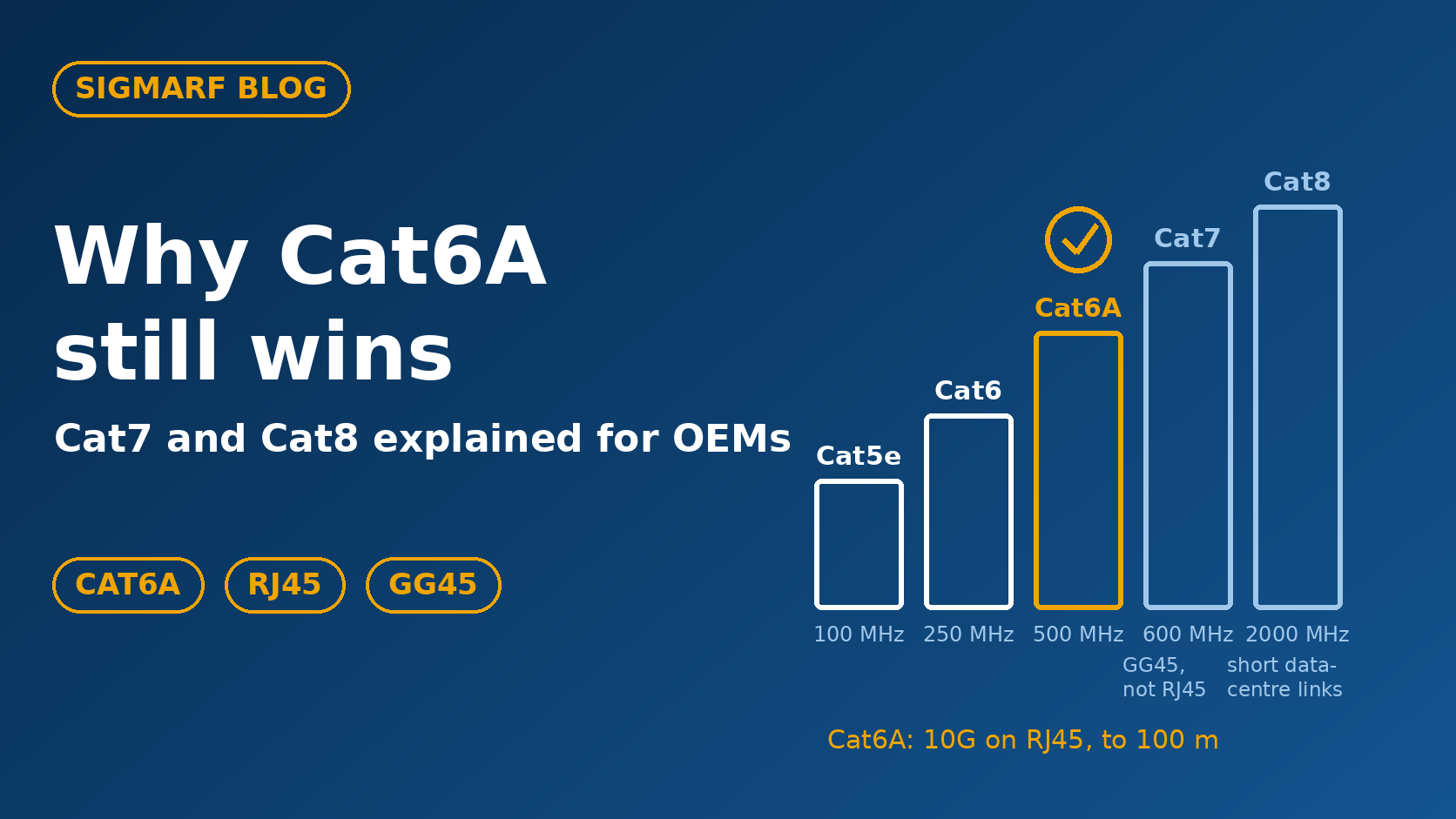
Cat7 is not a TIA category and Cat8 is limited to 30-metre channels, so Cat6A remains the practical ceiling for RJ45 equipment assemblies. Products sold as "Cat7 with RJ45 plugs" deliver Cat6A-class performance at best, because genuine Cat7 uses different connectors.
Is Cat7 better than Cat6A for equipment assemblies?
On paper, Cat7 offers a higher specified frequency than Cat6A. In practice, the comparison collapses on the connector. Cat7 and Cat7A are defined in ISO/IEC standards around GG45 and TERA interfaces, not the RJ45 plug that equipment actually uses. A cable labelled Cat7 but terminated with RJ45 plugs cannot deliver Cat7 channel performance, because the connector is the bottleneck.
For OEM equipment with RJ45 interfaces, Cat6A is the highest category that the connector ecosystem fully supports. That is why most custom assemblies for instruments, medical devices and industrial controllers standardise on Cat6A when they outgrow Cat6.
What Cat7 and Cat7A actually are
Cat7 (ISO/IEC Class F) is specified to 600 megahertz and Cat7A (Class FA) to 1000 megahertz. Both require individually screened pairs plus an overall screen, and both were standardised for GG45 and TERA connectors. Neither is recognised as a category by the TIA-568 standards used across North America, which is why you will not find Cat7 in TIA documentation.
The GG45 connector is backwards compatible with RJ45 in one direction only: a GG45 jack accepts an RJ45 plug, but the link then performs to the plug's limits. True Cat7 performance needs GG45 or TERA at both ends, hardware that almost no equipment manufacturer builds in.
The "Cat7 with RJ45" problem
Patch cords marketed as "Cat7 RJ45" combine a heavily screened cable with standard 8P8C plugs. The assembly may test well, but its performance class is set by the RJ45 interface, which aligns with Cat6A (Class EA, 500 megahertz). The "Cat7" label describes the cable stock, not the finished link.
For a buyer, the practical read is simple: a "Cat7 RJ45" cord is a Cat6A-class assembly with extra screening and a stiffer build. That can be the right part in a high-noise environment, but it should be purchased on its measured performance, not on a category name the connector cannot support. Our category decision guide compares the RJ45-based categories on equal terms.
Tell us the data rate, environment and connector constraints. We will recommend the category that the hardware can actually deliver.
Talk to us about category selectionWhere Cat8 fits, and where it is marketing
Cat8 (ISO/IEC Class I and II, specified to 2000 megahertz) targets 25GBASE-T and 40GBASE-T over channels of at most 30 metres, using shielded RJ45-style connectors. Its home is the data centre: switch-to-switch and switch-to-server links inside a rack row.
For OEM equipment, Cat8 rarely applies. Its 30-metre ceiling, thick shielded construction and data-centre focus make it a poor fit for instruments and machines. Where a device genuinely needs more than 10 gigabits, optical fibre is usually the engineering answer rather than ever-heavier copper categories.
Cat6A vs Cat7 vs Cat8 at a glance
| Property | Cat6A | Cat7 / Cat7A | Cat8 |
|---|---|---|---|
| Defined by | TIA-568 and ISO/IEC | ISO/IEC only (not TIA) | ISO/IEC (TIA recognises Class I/II equivalents) |
| Specified frequency | 500 MHz | 600 / 1000 MHz | 2000 MHz |
| Standard connector | RJ45 (8P8C) | GG45 or TERA | Shielded RJ45-style |
| Max channel for top rate | 100 m at 10GBASE-T | 100 m at 10GBASE-T (Class F) | 30 m at 25/40GBASE-T |
| Fits OEM RJ45 equipment | Yes | Only via RJ45 plug, losing Cat7 performance | Yes, but short and stiff |
| Typical use | Equipment, instruments, machines | Rare outside legacy European installs | Data-centre rack links |
A clear recommendation for equipment designers
Design to Cat6A when you need 10 gigabits or multi-gigabit headroom on RJ45 hardware. Choose shielded Cat6A constructions where the environment demands it, and remember that Cat6 versus Cat6A is a distance and noise question more than a speed question. Reserve GG45, TERA and Cat8 for the rare cases where the whole channel, connectors included, is engineered around them.
Specification tip: write the category and the test level on the assembly drawing, not a marketing label. "Cat6A, component and channel tested" is enforceable; "Cat7 RJ45" is not.
Buying on measured performance instead of labels
Category marketing confuses procurement more than engineering. A supplier quoting "Cat7" for an RJ45 assembly may be honest about the cable stock and silent about the connector limit. The protection is to specify what you can verify: the category of the complete assembly, the test level applied, and the measured report delivered with the batch. An assembly tested and reported at Cat6A channel limits outperforms a nominally higher category that ships without evidence.
This is where custom assembly earns its keep over commodity cords. When we build a Cat6A assembly at SigmaRF, the drawing fixes the cable stock, the plug type, the termination geometry and the test plan, and every assembly is 100% tested with digital test certificates available on critical builds. The label on the bag then matches the performance in the report, which is the only version of "Cat7 vs Cat6A" that matters to your product.
One more angle worth naming: marketing categories also confuse service. When a "Cat7" cord fails and gets replaced with a genuine Cat6A assembly, performance does not drop, because the RJ45 link was never running at Cat7 in the first place. Standardising on named, testable categories keeps replacements honest.
Common questions
Is Cat7 a real standard?
Yes, but only within ISO/IEC standards, where it appears as Class F at 600 megahertz with GG45 or TERA connectors. It is not recognised by TIA-568, and it was never defined for RJ45 plugs.
Is Cat7 faster than Cat6A?
Not in RJ45 equipment. Cat7's higher frequency rating depends on GG45 or TERA connectors. Terminated with RJ45 plugs, the link performs to Cat6A limits, so there is no speed gain.
What is Cat8 used for?
Cat8 supports 25GBASE-T and 40GBASE-T over channels up to 30 metres, mainly for switch and server links inside data centres. Its length limit and stiff shielded construction make it unsuitable for most equipment assemblies.
Should I buy Cat7 cables for future-proofing?
For RJ45 equipment, no. Cat6A covers 10 gigabits to 100 metres and matches the connector ecosystem. Beyond that, plan the move to fibre rather than higher copper categories.
What is the difference between GG45 and RJ45?
GG45 is a 12-contact connector that accepts RJ45 plugs in compatibility mode and adds extra contacts for full Cat7 performance. RJ45 is the 8-contact interface used across Ethernet equipment. A link with an RJ45 plug performs to RJ45 limits.
Bottom Line
Cat7 belongs to a connector ecosystem equipment rarely uses, and Cat8 belongs to the data centre. For RJ45-based products, Cat6A is the ceiling that actually delivers. Specify category and test level on the drawing, and treat "Cat7 RJ45" as Cat6A-class cable with extra screening.
Cat6A assemblies, built and tested to your requirement
Send the data rate, run length, environment and quantity. We build to the category that the hardware supports.
Custom Ethernet cable assemblies | Talk to SigmaRF
Alankar is a Technical Content Writer at SigmaRF, writes on various topics from Technology, Compliance and Business process
- RF Transistor Frequency Response and Power Performance
- How Semiconductor Materials Affect RF Device Performance
- RFIC vs MMIC: Terminology, Integration and Selection
- What Is an MMIC? Inside a Monolithic Microwave Circuit
- What Are Microwave Vacuum Tubes and Where Are They Used?
- What Is a MESFET and How Is It Used in RF Circuits?
- What Is a Heterojunction Bipolar Transistor (HBT)?
- GaN vs GaAs RF Technology: Power, Noise and Design Trade-offs
- BJT vs MOSFET vs HEMT: RF Transistor Technologies Explained
- What Are RF Frequency Multipliers and How Do They Work?