RFIC vs MMIC: Terminology, Integration and Selection
Published on 11/12/2026 • Updated on 11/12/2026
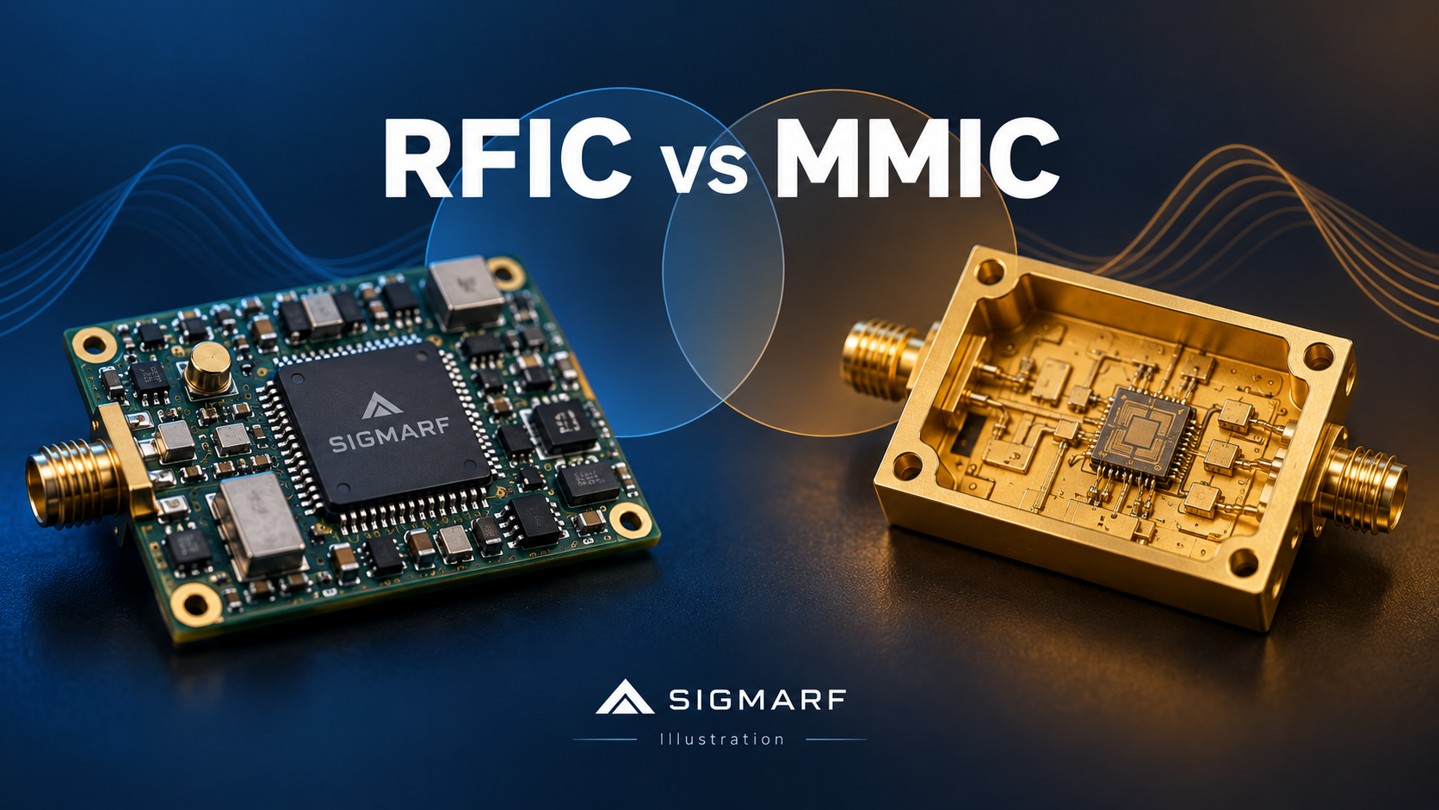
Illustration for concept explanation, not a product photograph or measured device cross-section.
A procurement brief that asks for an RFIC instead of an MMIC may be mixing terminology with a real integration requirement. One team may mean a complete transceiver; another may mean a single microwave amplifier die. Resolve the function, ports and integration level before comparing parts or assigning a process technology.
RFIC is a broad term for a radio-frequency integrated circuit. MMIC emphasizes monolithic integration for microwave circuitry. The terms overlap; they are not two mutually exclusive material families or a universal low-frequency versus high-frequency split.
On This Page
Start with function and integration level
RFIC identifies an integrated circuit used for RF functions. The label can cover a mixer, synthesizer, amplifier or transceiver. MMIC identifies monolithic microwave integration. The same part may reasonably fit both descriptions. Neither word by itself guarantees a packaged device, a particular semiconductor, internal matching or a complete signal chain.
Why material-based shortcuts are misleading
RFIC is often associated with silicon radios and MMIC with compound-semiconductor microwave parts, but these associations are not definitions. Silicon-based microwave circuits exist, and compound-semiconductor circuits perform RF functions. A better specification names the required function, operating band, supply, interfaces and integration constraints. Compare data sheets rather than buying a label.
Need an interconnect for the test setup? Define the operating band, connector interfaces, power conditions and mechanical constraints before choosing the cable assembly.
Discuss a Custom AssemblySystem-on-chip versus microwave building block
A highly integrated radio can reduce external interconnect and add control, calibration or digital functions. A dedicated microwave building block can offer a focused RF function with different process options. Integration can simplify assembly while reducing access to internal nodes. Separate blocks offer flexibility but add board area, transitions and interface budgeting. Neither approach is automatically lower loss or lower total cost.
Write an unambiguous selection brief
List receive and transmit functions, frequency coverage, bandwidth, gain or conversion loss, noise, linearity, control interfaces and reference-clock needs. State package, temperature, supply and evaluation requirements. Ask which functions remain external and which specifications include the evaluation board. A part that meets a carrier-frequency headline may still fail the modulation bandwidth or noise requirement.
Practical comparison
| Item and design check |
|---|
| RFIC Meaning: Broad RF integrated-circuit label Design check: Ask which function is included |
| MMIC Meaning: Monolithic microwave integration Design check: Ask die or package conditions |
| Radio module Meaning: Assembly-level implementation Design check: Ask what supporting hardware is included |
Worked example
Illustrative external-interface count:
Architecture A: integrated transceiver plus external power amplifier
Architecture B: separate mixer, oscillator, filter and amplifier blocks
Count every RF transition and assign its loss budget.
Do not assume the more integrated option has a specific dB advantage without measured data.
Before comparing measurements
Write down the instrument calibration plane, source level, operating point, frequency span and ambient or mounting temperature. Use the same conditions when comparing two results. If a fixture or cable is outside the calibration, characterize its effect rather than silently attributing it to the component. A measured system result and an intrinsic device model are different kinds of evidence.
Selection checklist
Confirm the function and band. Separate typical data from guaranteed limits. Check the power and bias conditions. Include the package and thermal path. Verify interfaces and external components. Keep a record of the test setup so a later engineer can reproduce the result.
Mistakes to avoid
Defining RFIC as silicon-only and MMIC as GaAs-only.
Treating the terms as mutually exclusive categories.
Comparing a bare die price with a fully supported module price.
Frequently asked questions
Can an MMIC also be an RFIC?
Yes. RFIC is broad, and a monolithic microwave circuit performs RF functions.
Is there one frequency boundary between RFIC and MMIC?
No universal boundary makes them exclusive categories. Industry usage varies; specify the actual operating range.
Does RFIC mean a complete transceiver?
Not necessarily. It may implement only one RF function.
Does MMIC mean GaAs?
No. Material choice and monolithic integration are different attributes.
Which is better for a new product?
Compare specific architectures against function, power, noise, bandwidth, integration and qualification needs.
Should procurement specify only RFIC or MMIC?
No. Include function, electrical limits, package, interfaces and operating conditions so suppliers can propose comparable parts.
Bottom Line
Use RFIC and MMIC to describe the circuit, not to replace an engineering specification. Resolve overlap in the terms and compare complete implementations at consistent reference planes.
Related reading is listed below for the interconnect and measurement details that support a repeatable RF setup.
RF cable and coaxial cable assembly FAQ
IEEE discussion of RFIC and MMIC terminology
Technical references
Monolithic microwave circuit fundamentals
Transistor technology textbook
Define the RF interconnect before you order
Share the operating band, interfaces, loss budget and mechanical constraints with SigmaRF. Confirm the assembly specification and test requirements for your application.
Standard AssembliesCustom AssembliesTalk to an Engineer
Alankar is a Technical Content Writer at SigmaRF, writes on various topics from Technology, Compliance and Business process
- RF Transistor Frequency Response and Power Performance
- How Semiconductor Materials Affect RF Device Performance
- What Is an MMIC? Inside a Monolithic Microwave Circuit
- What Are Microwave Vacuum Tubes and Where Are They Used?
- What Is a MESFET and How Is It Used in RF Circuits?
- What Is a Heterojunction Bipolar Transistor (HBT)?
- GaN vs GaAs RF Technology: Power, Noise and Design Trade-offs
- BJT vs MOSFET vs HEMT: RF Transistor Technologies Explained
- What Are RF Frequency Multipliers and How Do They Work?
- Understanding Schottky Diodes in Microwave Applications