Custom Patch Cables for Telecom Racks and Network Infrastructure
Published on 10/26/2026
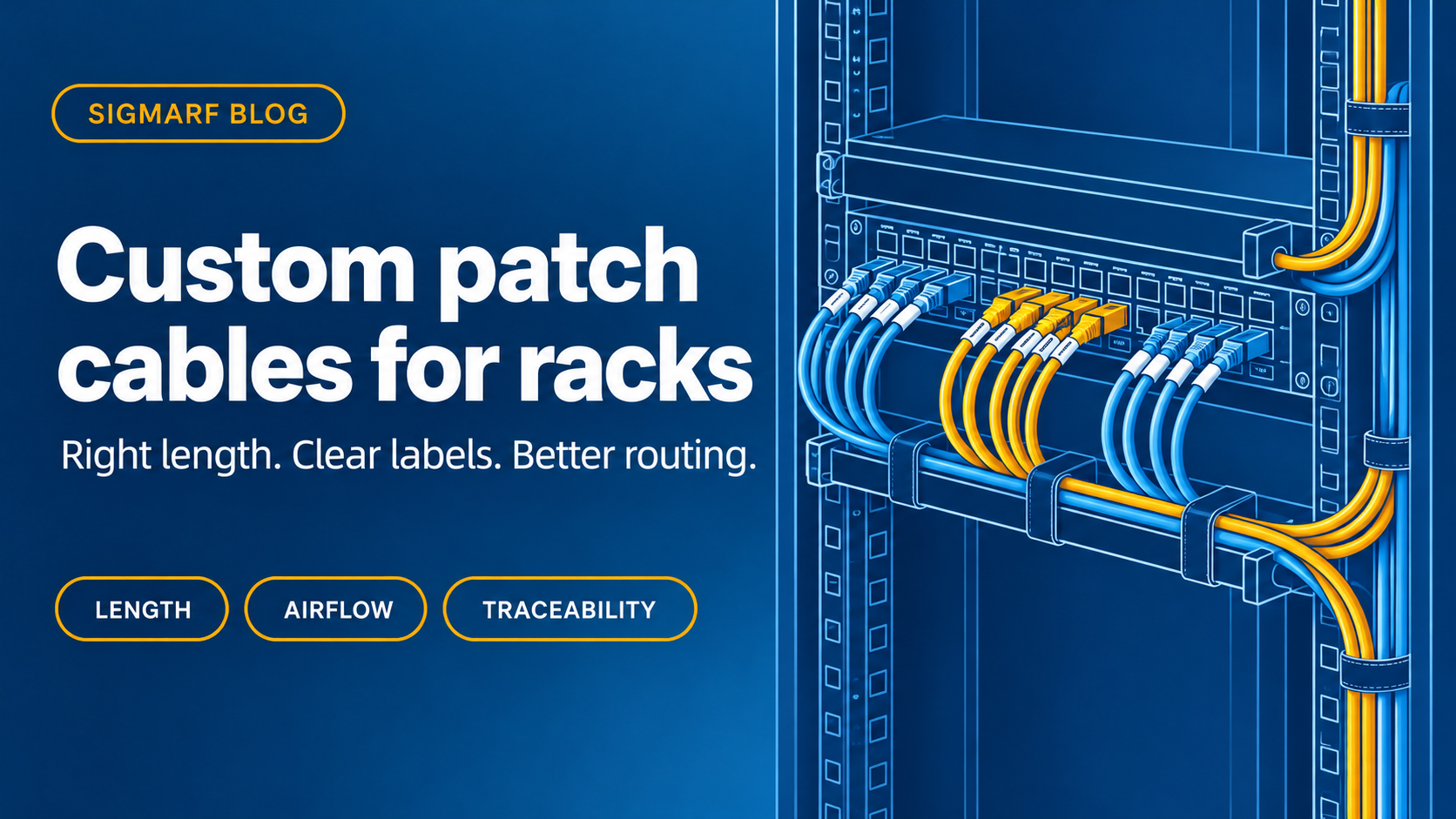
Custom patch cables can reduce excess slack, simplify tracing and preserve clear equipment access in telecom racks when lengths are based on the actual route. Specify category, conductor size, connector envelope, colours, labels and power duty together. Shorter or slimmer is not automatically better: retain service allowance, bend radius and the required channel performance.
- When do custom patch cables improve a rack?
- Keep category and channel performance in view
- Slim Cat6A trades space against other requirements
- Route for access and airflow, not appearance alone
- Build a colour and label scheme that survives service
- Quote the rollout, not a vague bulk quantity
- Worked example: release one rack before fifty
- Common questions
- Bottom Line
When do custom patch cables improve a rack?
The useful difference is controlled fit, not the word custom. Stock lengths can work well in many racks. A measured custom length becomes valuable when repeated surplus loops crowd cable managers, hide labels or obstruct service. The design should remove avoidable slack without leaving a cable under tension or preventing equipment removal.
Map each connection from port to port through its intended managers. Measure the route rather than a straight line across the rack face. Include bends, vertical travel, connector protrusion and a defined service allowance. A neatly drawn route that cannot be installed or maintained is not a finished specification.
| Design decision | Evidence to request | Acceptance focus |
|---|---|---|
| Electrical interface | Equipment specification and part data | Rate, pairs and pinout |
| Installed environment | Route and exposure requirements | Temperature, support and compatibility |
| Production release | Controlled drawing and agreed tests | Repeatability and documented limits |
For a large rollout, group connections into a manageable set of length variants where practical. Excessive variation can complicate stocking and replacement. The right balance depends on rack repetition, service methods and inventory cost. A small pilot helps determine whether tightly tailored lengths save useful space or merely create too many nearly identical parts.
Keep category and channel performance in view
Choose the required Ethernet category from the supported link and channel design. A category marking on bulk cable is not the entire finished patch-cord specification. Connectors, conductor construction, length and test limits matter. Use the category comparison guide to frame the rate decision before deciding how compact the cord should be.
Stranded patch cable is often useful for handling and rack service, but it has different attenuation characteristics from some fixed-installation constructions. Follow the applicable channel design rules for the actual cord lengths and conductor sizes. Do not treat the familiar maximum channel length as an independent allowance for every segment.
Turn your design requirements into a controlled assembly specification.
Specify a custom Ethernet assemblyWhere links carry power as well as data, include the power requirement in selection. A short assembly may have less conductor resistance than a longer one of the same construction, but that does not justify ignoring connector suitability, bundle heating or installation temperature. Data rate and power duty should be reviewed together.
Slim Cat6A trades space against other requirements
A smaller-diameter assembly may ease access and reduce congestion around densely populated ports. It can also change conductor size, resistance, allowed length and thermal behavior. Do not order by outside diameter alone or assume every slim Cat6A cord has the same performance envelope as a larger construction.
Ask for the exact conductor size, cable diameter, supported patch-cord length and test specification. American Wire Gauge (AWG) is a conductor-size system in which a lower gauge number generally denotes a larger conductor. Compare actual product data, since category and outside diameter do not uniquely determine the wire gauge.
For Power over Ethernet (PoE), assess the current duty, resistance balance, temperature and bundle conditions. The PoE cable requirements guide explains why a tidy dense bundle can still need a thermal review. Keep the port's insertion and release space in the mechanical comparison; an overly bulky boot can defeat the benefit of a slimmer cable.
Route for access and airflow, not appearance alone
Cables should not block intended equipment airflow or prevent removal of fans, modules and other service items. Custom length can help reduce congestion, but it does not guarantee a measurable cooling improvement. Assess the actual rack and cooling arrangement rather than converting a cleaner photograph into an unsupported temperature claim.
Use suitable managers and supports without crushing jackets or creating sharp bends. Avoid tight restraints and keep the cable within its specified radius. A bundle that looks uniform can hide strain at the outermost ports. Inspect the worst route and the most crowded port, not only the easiest connection in the rack.
Decide how a technician replaces one cord without disturbing its neighbors. Preserve access to latches and labels. If an angled connector is considered, define its direction using a controlled view and check the complete envelope. The right-angle RJ45 guide explains that clearance depends on actual parts rather than a universal saving.
Build a colour and label scheme that survives service
Use colours to communicate a stable meaning, such as network function or ownership, rather than changing the scheme from one order to the next. Document exceptions. Colour alone is insufficient when lighting, visibility or a replacement part makes identification uncertain. Labels should carry the information needed to recover the correct connection.
Define the label text, font or minimum readability, position at each end and required durability. Check that a label remains visible after the plug is installed and that it does not interfere with the latch or bend. For larger orders, provide a controlled schedule of identifiers rather than a collection of untracked emails.
Match packaging to installation. A kit can group the correct lengths and identifiers for one rack, but the packing list must map to the installation drawing. Verify counts and end labels before release. This reduces picking errors without claiming that labelling alone prevents every service mistake or network outage.
Quote the rollout, not a vague bulk quantity
A useful request for quotation includes quantities by length, colour and label set; category; conductor and jacket requirements; connector and boot preferences; power duty; tests; packaging; and delivery destination. Distinguish prototype approval from the full release. A supplier can price more accurately when it knows the real variant mix.
Compare total landed cost, including engineering, setup, identification, test documentation, packing and delivery. Do not assume custom lengths are always cheaper than stock cords. The value may come from reduced installation effort or easier service rather than cable price. Ask for a confirmed quotation and lead time instead of presenting a generic volume discount as a promise.
SigmaRF's custom Ethernet assemblies page describes cut-to-length, colour coding, labelling, packaging and prototype-to-volume work. It also describes manufacturing in Vadodara and precision finishing near Cleveland. Availability and timing for your particular materials and variant mix still need confirmation; a general fast-turn statement is not a delivery guarantee for every bulk rollout.
Worked example: release one rack before fifty
This illustrative rollout begins with one representative rack containing the longest routes, densest ports and required powered devices. The team measures the installed paths, assigns a limited set of cord lengths and checks labels with the actual cable managers in place. It tests service removal as well as initial fit.
After the pilot, the drawing and packing schedule are revised to remove a tensioned route and make two similar identifiers easier to distinguish. Only then is the larger quantity released. The approved sample and cable references remain controlled, so a later substitute cannot silently change diameter, boot clearance or power suitability.
Record the final arrangement and keep spare parts that match it. The aim is not the shortest possible cable at every port. It is a repeatable rack that meets data and power requirements and remains understandable when a technician needs to change one connection under time pressure.
Common questions
Are custom-length patch cables always better than stock lengths?
No. Stock cords can be suitable and economical where their lengths fit the route. Custom lengths help when repeated surplus or poor access creates a real problem. Measure the route, preserve service allowance and compare the total installation and maintenance value rather than assuming custom manufacture is always preferable.
Can slim Cat6A patch cables carry PoE++?
Check the exact cord's documented power, length and installation limits. Slim construction can use smaller conductors, which affects resistance and heating. Confirm the required power class, bundle conditions and connector suitability. Category and diameter alone do not prove that a particular assembly suits every high-power installation.
How much spare length should a rack cable have?
There is no universal allowance. Include enough length for the planned route, bends, connector access and service method without unnecessary loops. Define measurement datums and tolerance on the drawing. Validate the proposed length in a representative populated rack before releasing a large order or stocking replacement parts.
What should be on custom patch cable labels?
Use the identifiers needed for installation and service, such as assembly part number and end or port reference. Define text, position and durability in a controlled schedule. Confirm readability after installation. Colour can reinforce the scheme but should not be the only way to distinguish important connection functions.
Bottom Line
Measure the route, preserve service access and specify the electrical duty before trimming slack. Control lengths, labels, packaging and substitutions through a pilot rack. Send the variant schedule, power requirements and test expectations for confirmed volume pricing and delivery rather than an undefined bulk-cable request.
Build around your equipment, not a generic cord
Share category, shielding, length, connector orientation, environment, quantity and required testing.
Custom Ethernet cable assemblies | Talk to SigmaRF
Alankar is a Technical Content Writer at SigmaRF, writes on various topics from Technology, Compliance and Business process
- RF Transistor Frequency Response and Power Performance
- How Semiconductor Materials Affect RF Device Performance
- RFIC vs MMIC: Terminology, Integration and Selection
- What Is an MMIC? Inside a Monolithic Microwave Circuit
- What Are Microwave Vacuum Tubes and Where Are They Used?
- What Is a MESFET and How Is It Used in RF Circuits?
- What Is a Heterojunction Bipolar Transistor (HBT)?
- GaN vs GaAs RF Technology: Power, Noise and Design Trade-offs
- BJT vs MOSFET vs HEMT: RF Transistor Technologies Explained
- What Are RF Frequency Multipliers and How Do They Work?