RF Connectors in Medical Devices: MRI, Ablation and Imaging
Published on 11/1/2026 • Updated on 11/1/2026
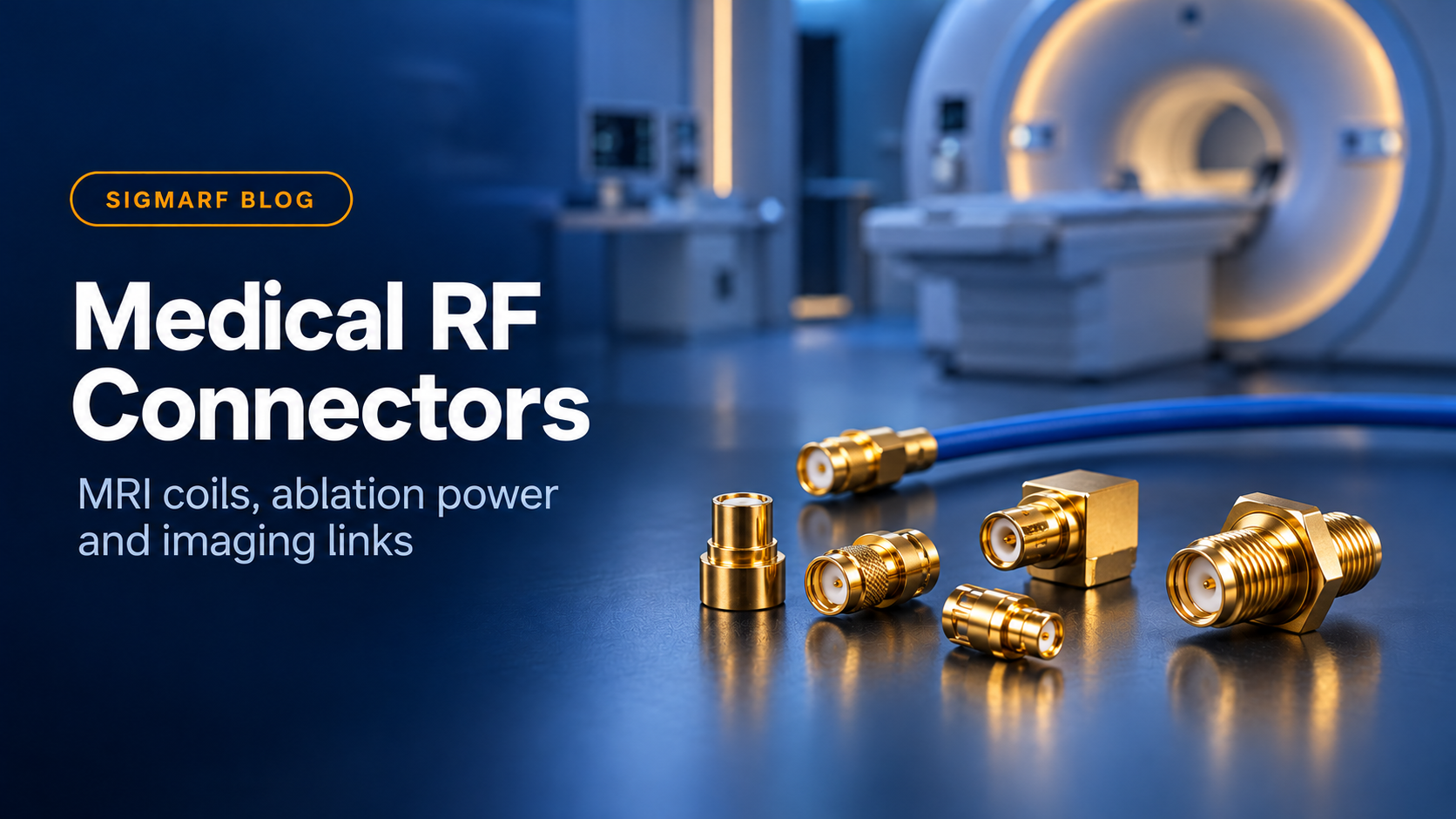
Medical RF design punishes casual connector choices twice. Inside an MRI coil, a nickel-plated connector distorts the field and shows up as a shadow in the image. In an ablation generator, a contact that runs hot becomes a patient-safety problem. And everywhere in the hospital, the cable gets wiped with chemicals that strip ordinary plating. The connector is small; the requirements are not.
Short answer: medical RF connectors fall into three requirement groups - non-magnetic parts for MRI coils, high-current RF parts for ablation and electrosurgery, and chemically resistant, high-cycle parts for imaging and monitoring interconnects. Each group narrows the connector family, the materials and the evidence you should demand from the supplier.
On This Page
MRI coils: why non-magnetic matters
An MRI scanner lives on field homogeneity. A 1.5 T or 3 T magnet only produces a clean image if the field inside the bore stays uniform, and ferromagnetic hardware inside the coil volume bends that field. Modern multi-channel receive coils pack dozens of small loops - high-end arrays exceed 32 channels - each with coax connections inside the magnet. A single connector with nickel underplating or a steel spring in that volume can distort the field enough to mark the image.
Non-magnetic RF connectors are built specifically for this: published medical-grade parts specify magnetic susceptibility around 10^-5 and field distortion below 0.5 ppm at 10 mm from the connector surface. The families that show up in coil designs are small 50 ohm types - MMCX for module interconnects and SMP-class blind-mate for board arrays - because the channels are numerous, space is tight and frequencies sit below 6 GHz. The MMCX guide covers the base interface; the medical variant is a materials build of it.
Key idea: Non-magnetic is a measured property, not a material adjective. Ask for the susceptibility figure and the test distance; a connector described as "MRI compatible" without ppm-level evidence is marketing, not engineering.
Materials and plating rules
The standard RF connector stack - brass body, nickel underplate, gold top plate - fails MRI duty because nickel is ferromagnetic. Non-magnetic builds replace it with gold over copper or phosphor-bronze and beryllium-copper springs with no nickel anywhere, and some go further with non-metallic housings. Plating choice also drives chemical resistance and contact wear; the gold plating article and the brass vs stainless comparison cover the base trade-offs that medical builds inherit.
Ablation and electrosurgery RF
RF ablation and electrosurgical generators deliver real power - tens to hundreds of watts around 400 to 500 kHz, with some systems working into the low MHz - through a single coaxial or multi-pole connection to the catheter or handpiece. At these frequencies the connector is a power connector first: contact resistance decides heating, contact force decides arcing, and finger-proofing and locking decide safety. Proprietary circular multi-contact connectors dominate because one latching shell carries the RF path, sensing thermocouples and irrigation lines together with keying that prevents cross-connection.
Imaging and monitoring interconnects
Ultrasound probes, patient monitors and diagnostic carts run dense arrays of small coax or high-speed differential lines through cables that flex thousands of times and get wiped down between patients. The connector requirements here are cycle life in the thousands, latching that survives a cart rolling over the cable, and housings that tolerate hospital disinfectants. Micro-coax and micro-miniature interfaces carry the signals; the mechanical design around them decides how long the probe survives.
Cleaning, sterilization and handling
Hospital chemicals attack cable jackets and connector housings: quaternary ammonium wipes, bleach solutions and hydrogen peroxide vapor all appear in reprocessing instructions. Parts that touch the patient or enter sterile fields face worse: autoclave cycles at 134 °C, EtO or plasma sterilization, each with its own material list. The cable side of this is covered in medical RF cable assemblies: materials and sterilization; on the connector side, specify the reprocessing method in the requirement document, because a connector qualified for wipes is not automatically qualified for autoclave.
⚠️ Regulatory evidence belongs to the device maker. A connector supplier can document materials, biocompatibility-relevant coatings and test data, but device certification, ISO 13485 traceability and patient-contact approvals are system-level obligations. Treat any connector marketed as "medical certified" with the same suspicion as "MRI compatible" without numbers.
What to ask a supplier
Check
- ✓Magnetic susceptibility value and measurement distance for any MRI-coil part, plus a full materials declaration showing no nickel or ferromagnetic content.
- ✓Contact resistance and current rating at the operating frequency for ablation and electrosurgery paths, with temperature-rise data.
- ✓Mating cycle rating that matches the use case: hundreds for equipment rooms, thousands for probes and daily-use interconnects.
- ✓Chemical and sterilization compatibility stated against the actual reprocessing method, not a generic claim.
- ✓Lot traceability and change notification: a silent plating change can reintroduce nickel into a qualified coil.
- ✓Test evidence on the finished assembly - continuity, VSWR or insertion loss where the band justifies it - not just the bare connector data.
Have a medical interconnect requirement?
Send the application, band, power and reprocessing method. An engineer will review which materials and interfaces fit, and what evidence is realistic.
Talk to an EngineerMedical RF connector mistakes
Avoid
- ✗Standard nickel-plated connectors inside an MRI coil volume.
- ✗Trusting the words "non-magnetic" or "MRI compatible" without susceptibility data.
- ✗Specifying a connector by frequency only and ignoring contact current in ablation paths.
- ✗Qualifying a cable assembly for wipe-down and later autoclaving it.
- ✗Ignoring cycle life on probe and cart connections that flex and mate daily.
- ✗No change-control agreement, so a supplier material change invalidates a qualified design.
Medical RF connector questions
What makes an RF connector MRI compatible?
Materials. No nickel plating, no ferromagnetic springs or shells, verified by a magnetic susceptibility measurement around 10^-5 with field distortion below about 0.5 ppm at 10 mm. The interface family is usually a small 50 ohm type such as MMCX or SMP.
Which connectors are used inside MRI coils?
Small non-magnetic builds of MMCX and SMP-class interfaces between coil loops, tuning boards and feeds, chosen for size and sub-6 GHz performance. The exact set is a coil-design decision.
What connector does an RF ablation catheter use?
Usually a proprietary circular multi-contact design that carries the RF power path plus sensing leads in one keyed, latching shell. The RF contact itself is rated by current and temperature rise at 400 to 500 kHz.
Can standard SMA connectors be used in medical devices?
Outside the magnet bore and away from the imaging volume, standard interfaces are common on carts and test fixtures. Inside MRI coils, no: the nickel underplate and steel hardware distort the field.
How do hospital cleaning chemicals affect connectors?
Disinfectants attack some housing plastics and plating stacks, and repeated wipe-downs wear markings and seals. Specify the reprocessing chemistry and cycles in the requirement and qualify against them.
Bottom Line
Medical RF connectors are chosen by requirement group: non-magnetic materials with ppm-level evidence for MRI coils, current-rated contacts for ablation power, and chemical-resistant high-cycle interfaces for imaging and monitoring. Put the reprocessing method, the cycle life and the evidence list in the requirement, and treat certification as a device-level obligation that no connector datasheet can grant.
Discuss your medical interconnect requirement
Custom coaxial assemblies with documented materials and test evidence. Talk to an engineer about feasibility for your application.

Aadeshwar Modi is a marketing technical content writer who loves writing on technology and AI topics.
- RF Transistor Frequency Response and Power Performance
- How Semiconductor Materials Affect RF Device Performance
- RFIC vs MMIC: Terminology, Integration and Selection
- What Is an MMIC? Inside a Monolithic Microwave Circuit
- What Are Microwave Vacuum Tubes and Where Are They Used?
- What Is a MESFET and How Is It Used in RF Circuits?
- What Is a Heterojunction Bipolar Transistor (HBT)?
- GaN vs GaAs RF Technology: Power, Noise and Design Trade-offs
- BJT vs MOSFET vs HEMT: RF Transistor Technologies Explained
- What Are RF Frequency Multipliers and How Do They Work?