Mini-FAKRA and HSD Connectors: Automotive RF Beyond FAKRA
Published on 11/1/2026 • Updated on 11/1/2026
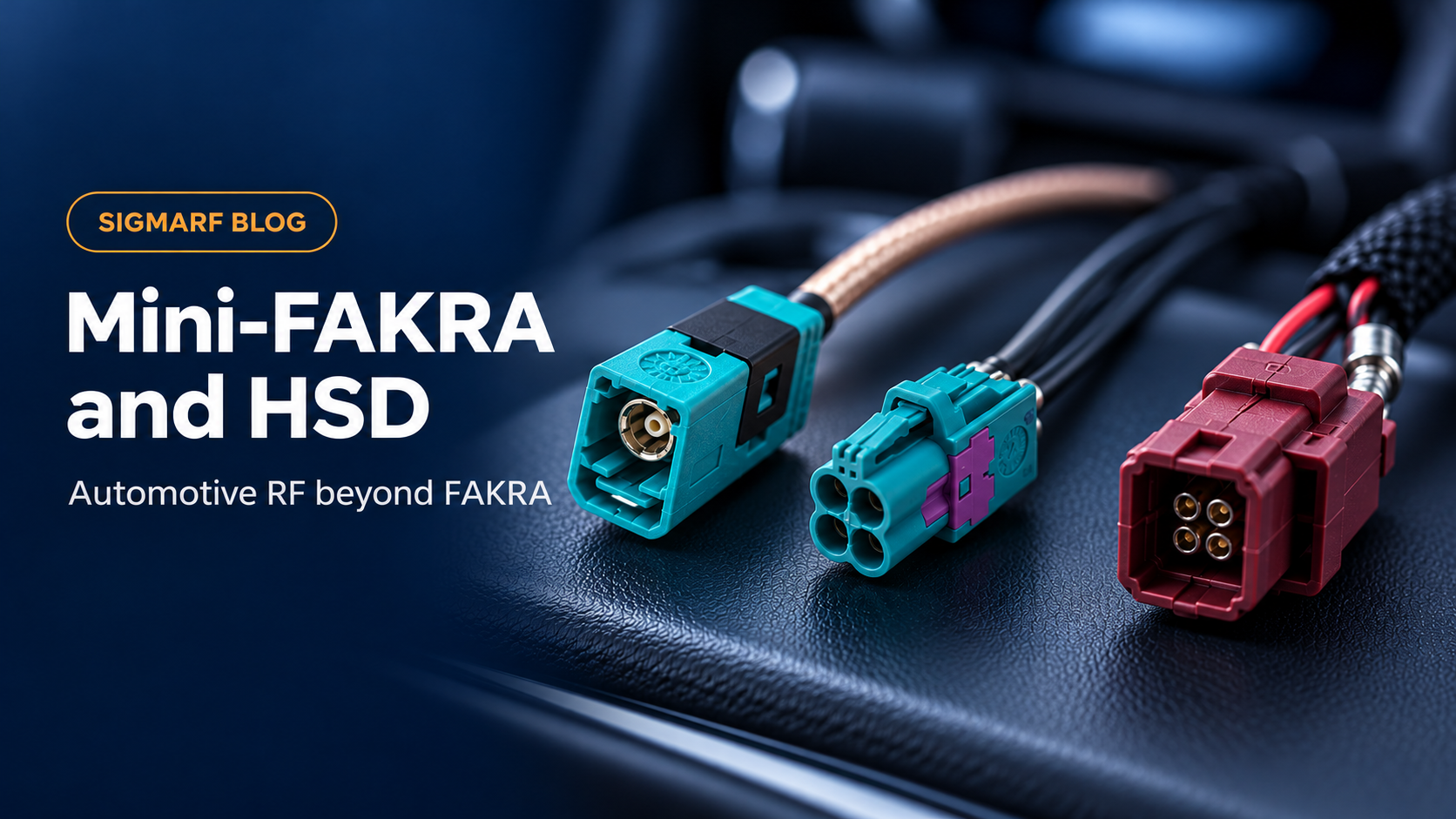
The camera module on a modern mirror needs a 6 Gbps video link. The antenna cluster on the roof carries GNSS, two cellular bands and satellite radio. The head unit wants four camera feeds over one quad cable. Plain FAKRA solved the antenna problem years ago; it cannot solve the data problem. That is where mini-FAKRA and HSD come in, and they are not interchangeable.
Short answer: mini-FAKRA (HFM class) is a 50 ohm coaxial system shrunk about 80% from FAKRA, rated DC to 20 GHz and tens of gigabits per second, for cameras and antenna aggregators. HSD is a 100 ohm shielded differential system for LVDS, USB and automotive Ethernet style data. Coax versus differential is the dividing line.
On This Page
Why FAKRA needed successors
FAKRA standardized the keyed, color-coded RF housing the auto industry still runs on for antennas, and the FAKRA color code guide covers that system. Two pressures outgrew it: camera and radar-adjacent data links needing multi-gigabit rates over coax, and packaging - a mirror or bumper module has no room for four full-size FAKRA jacks. The industry answered in two directions at once: shrink the coax connector (mini-FAKRA) and move data onto differential pairs (HSD and its successors).
Mini-FAKRA (HFM): small coax, big data
High-Speed FAKRA-Mini systems keep the coaxial 50 ohm world and compress it: published systems quote up to 80% smaller than FAKRA, frequencies DC to 20 GHz, and data rates to about 28 Gbps, carrying the camera serializer protocols (FPD-Link, GMSL class), MIPI A-PHY and similar links. Quad versions put four coax contacts in one keyed housing so a surround-view camera module connects with one latch. Mechanical coding and CPA (connector position assurance) carry over from the FAKRA playbook, and validation is against automotive connector standards such as USCAR.
Cable is mini-coax or shielded micro-coax rather than RG174; the harness is built by specialists because termination is process-critical, not field work. This is not a connector you crimp with hand tools at the bench.
HSD: 100 ohm differential
HSD - High-Speed Data - is a different species: a 100 ohm fully shielded differential interconnect for low-voltage data, running over shielded twisted-quad cable rather than coax. Published systems quote frequency ranges DC to about 6 GHz and data rates to 8 Gbps, aimed at LVDS camera links, USB 2.0/3.x, Firewire legacy and automotive Ethernet (100BASE-T1 and up). It keeps the automotive housing virtues - keying, color codes, primary and secondary locks - but the electrical channel is a differential pair with impedance control and crosstalk budgets, not a 50 ohm line.
Key idea: The one-line separator: mini-FAKRA carries a 50 ohm coaxial channel, HSD carries a 100 ohm differential channel. A camera link designed for one cannot be re-terminated into the other.
Mini-FAKRA vs HSD vs FAKRA
| Need | Choice | Why |
|---|---|---|
| Antenna to telematics unit, radio, GNSS | FAKRA | Proven, cheap, color-coded RF at broadcast and cellular bands |
| Multi-gigabit camera serializer link | Mini-FAKRA (HFM) | Coaxial data to ~28 Gbps in a small keyed housing |
| Aggregated roof antenna to one module | Mini-FAKRA quad | Multiple 50 ohm channels in one latch |
| LVDS / USB / 100BASE-T1 style data | HSD | 100 ohm differential channel with shielding |
| Head unit display link, legacy infotainment | HSD or HSL-class | Differential video/data tradition in infotainment |
The broader vehicle RF picture, including antennas and EMC, is in the automotive RF cabling guide.
Vehicle RF harness work?
Antenna feeders, FAKRA pigtails and custom coax assemblies for telematics projects - built to drawing and tested before shipment.
Talk to an EngineerHarness and assembly realities
Both systems live or die in process control. Mini-FAKRA terminations are automated crimp-and-snap operations on micro-coax with specified strip geometries; HSD terminations manage pair untwist length and shield 360-degree contact to hold impedance and crosstalk. Repair in the field is not in either playbook: harnesses are replaced, not spliced. For buyers, that moves the quality question to the harness supplier: process documentation, pull-force records and continuity/HiPot test evidence per pigtail, and RF test where the link budget justifies it.
⚠️ Pinout is not universal. Mini-FAKRA and HSD housings come in multiple codings, and camera serializer pin maps differ between module makers. The drawing and the coding letter decide; color alone is not proof of compatibility.
Selection mistakes
Avoid
- ✗Assuming mini-FAKRA mates with FAKRA; it does not, and adapters are a last resort.
- ✗Routing a coax camera link through an HSD harness position because the housings look similar.
- ✗Field-crimping micro-coax with hand tools and accepting the result without test.
- ✗Ignoring the coding letter; mechanically keyed wrong housings force nothing and teach nothing.
- ✗Specifying by data rate only; cable length, temperature and flex life decide the harness too.
Mini-FAKRA and HSD questions
What is mini-FAKRA used for?
High-speed coaxial links in vehicles: camera serializer connections, antenna aggregators and telematics where four or more 50 ohm channels must fit in a small keyed housing. Published systems reach DC to 20 GHz and about 28 Gbps.
Is HSD the same as Ethernet?
HSD is a connector system, not a protocol. Its 100 ohm differential channel carries LVDS, USB, Firewire legacy and automotive Ethernet standards such as 100BASE-T1 - the protocol comes from the equipment, the connector just has to pass it.
Can mini-FAKRA replace FAKRA?
Where data rates or space demand it, yes; for plain antenna RF at broadcast and cellular bands, full-size FAKRA remains the cheaper proven answer. They are not intermateable.
Who terminates these harnesses?
Specialist harness makers with automated tooling. Mini-FAKRA micro-coax and HSD quad cables are process-terminated and tested, not field-installed.
What should I ask a harness supplier for?
Process documentation, per-harness continuity and pull records, coding and pinout drawings, and RF test evidence where the link budget is tight.
Bottom Line
FAKRA still owns antennas. Mini-FAKRA owns high-speed coax channels - cameras and aggregated antenna feeds - at up to 20 GHz in 80% less space. HSD owns 100 ohm differential data for LVDS, USB and automotive Ethernet. Choose by channel type first, coding second, and buy the harness as a tested assembly, because neither system forgives field termination.
Get vehicle RF assemblies built and tested
FAKRA pigtails, antenna feeders and custom coax assemblies for automotive programs, tested before shipment.

Aadeshwar Modi is a marketing technical content writer who loves writing on technology and AI topics.
- RF Transistor Frequency Response and Power Performance
- How Semiconductor Materials Affect RF Device Performance
- RFIC vs MMIC: Terminology, Integration and Selection
- What Is an MMIC? Inside a Monolithic Microwave Circuit
- What Are Microwave Vacuum Tubes and Where Are They Used?
- What Is a MESFET and How Is It Used in RF Circuits?
- What Is a Heterojunction Bipolar Transistor (HBT)?
- GaN vs GaAs RF Technology: Power, Noise and Design Trade-offs
- BJT vs MOSFET vs HEMT: RF Transistor Technologies Explained
- What Are RF Frequency Multipliers and How Do They Work?