RJ45 Plug Types for Cable Assemblies: Shielded, Unshielded, Pass-Through and Right-Angle
Published on 10/25/2026
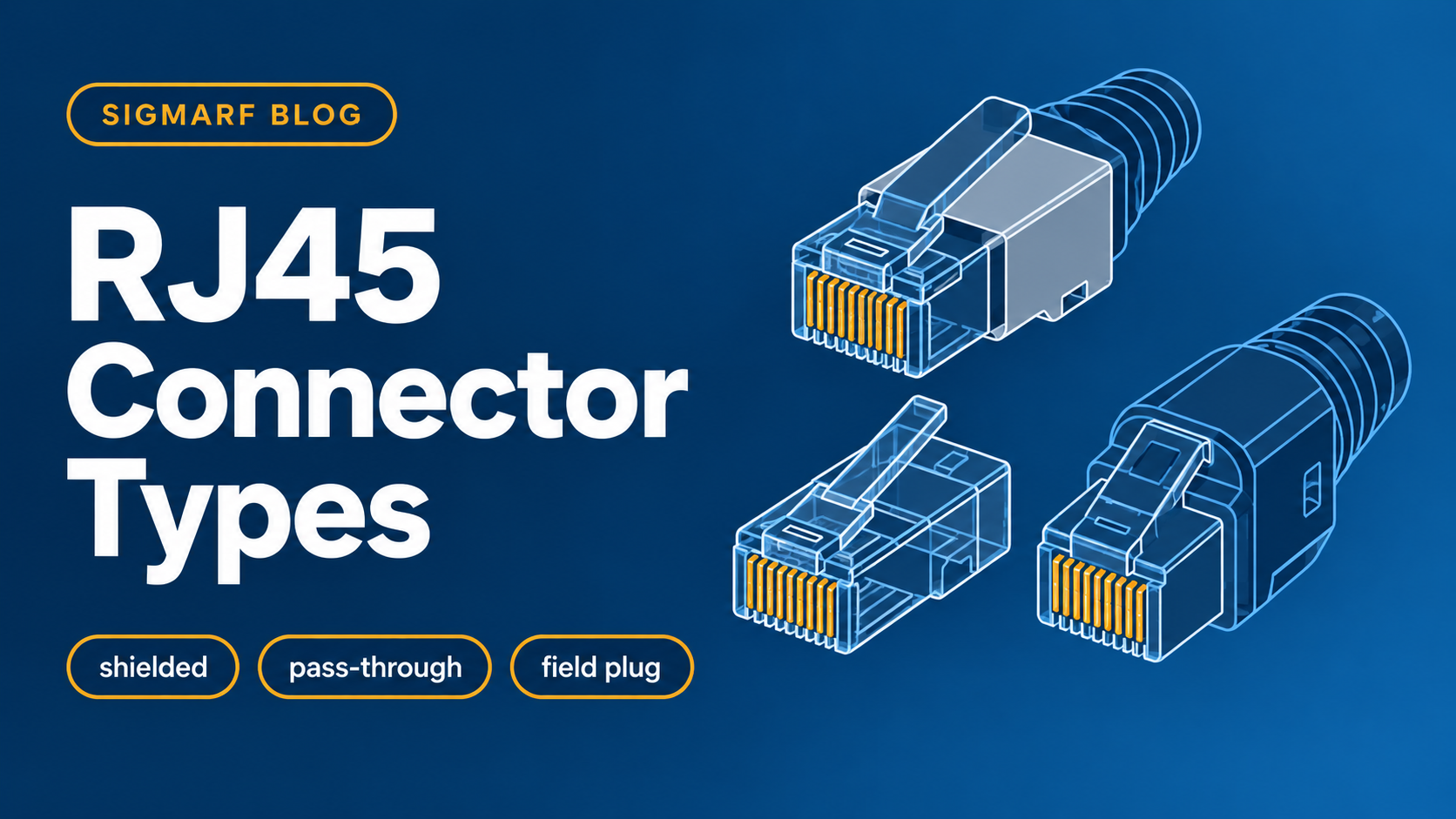
RJ45 plugs differ by shielding, conductor type they accept (solid or stranded), latch style and orientation. OEM assemblies normally use shielded or unshielded plugs designed for stranded cable, with molded boots; pass-through plugs are a field-installation tool, not a production choice.
The 8P8C modular plug, everyone calls it RJ45, looks like a commodity. It is not. The plug is where most assembly failures start, and where category performance is most easily lost. A drawing that says only "RJ45 both ends" leaves the three decisions that matter most unmade. This guide walks the taxonomy and the specification lines that belong on your drawing.
On This Page
The taxonomy at a glance
| Plug type | What it is | When to use it |
|---|---|---|
| Unshielded standard | Clear plastic body, 8 contacts, for U/UTP cable | Quiet environments, Cat5e/Cat6, lowest cost |
| Shielded (metal shell) | Metal shell that bonds the cable screen 360 degrees | F/UTP, S/FTP and Cat6A assemblies; EMI environments |
| Right-angle | Cable exits at 90 degrees, in a specified direction | Tight enclosures, panels, behind displays |
| Slim / short-body | Reduced body length and boot for dense ports | High-port-density switches and modules |
| Pass-through | Conductors exit the front, trimmed after crimp | Field termination speed, not OEM production |
| Field-terminable | Tool-less IDC plug for installation rework | Site repairs; rarely inside a product |
For industrial Ethernet, RJ45 often gives way to M12 circular connectors, D-coded for 100 Mb or X-coded for 10G, which seal against washdown and vibration. That is a separate decision covered in our industrial Ethernet assemblies guide; inside an enclosure, RJ45 remains the default.
Contacts: plating and insertion cycles
The contact is a gold-plated phosphor-bronze spring that bites through the conductor insulation at crimp. Plating thickness is the spec that separates grades: entry plugs carry gold flash (well under 10 micro-inches), standard plugs around 30 micro-inches, and premium plugs 50 micro-inches. Thicker gold resists fretting corrosion, which is the slow oxidation dance between mated contacts that raises resistance over years of thermal cycling.
Insertion cycles matter where the cable gets mated repeatedly. A standard modular plug is specified for a finite mating life, typically in the hundreds of cycles, which is plenty behind a panel and nowhere near enough on a test fixture that gets re-plugged fifty times a day. When the duty cycle matters, ask for the plug's rated cycle count. High-cycle applications need either rated high-cycle plugs or a sacrificial adapter that takes the wear. Our test equipment cabling guide covers that pattern.
Why pass-through plugs are a field tool, not an OEM choice
Pass-through plugs let the conductors slide out the front so the installer can verify the color order before crimping, then the tool trims the excess. They make field work faster and forgive sloppy preparation. In production they create three problems: the trimmed conductor ends sit exposed at the plug face and can corrode or short against a shielded shell; the crimp quality depends on the installer's tool and hand, not on a controlled process; and the plug's electrical performance to category limits is typically worse than a closed-body plug terminated on a press.
For a product, specify closed-body plugs terminated under process control, with pull testing on samples. Field convenience is not worth a corrosion path inside every connector you ship.
Stranded vs solid: the contact mismatch that fails
Plug contacts are shaped for the conductor. Plugs for solid cable use contacts that straddle and grip the single conductor; plugs for stranded cable use contacts that pierce into the strand bundle. Put stranded wire in a solid-cable plug and individual strands escape the contact, giving you intermittent opens that come and go with vibration. Put solid wire in a stranded plug and the contact cuts too deep, weakening the conductor at the crimp.
Most custom assemblies use stranded cable for flex life, so most assembly plugs are stranded-type, but the drawing should say so explicitly. This is the single most common root cause we find in returned "bad cable" that turns out to be someone else's mismatched termination.
SigmaRF standard plug options and lead-time impact
Our standard builds cover unshielded and shielded plugs for stranded Cat5e, Cat6 and Cat6A, with molded snagless boots in matched jacket colors, plus right-angle exits in the four standard orientations. Standard plugs add nothing to lead time; they are on the shelf. Specialty requests, high-cycle contacts, unusual boot colors, keyed or latch-protected variants, add procurement time on the first order and then become repeatable line items.
When you send a drawing, four plug lines cover everything: shielded or unshielded, conductor type (stranded or solid), boot style and color, and orientation for right-angle plugs. Add the mating-cycle expectation if the cable lives on a fixture.
Common questions
Are RJ45 and 8P8C the same thing?
In everyday Ethernet language, yes. Strictly, 8P8C (eight position, eight contact) is the modular connector form factor and RJ45 is a registered-jack wiring designation that modern Ethernet usage has absorbed. Any supplier you talk to will understand RJ45 to mean the 8P8C Ethernet plug.
Do shielded plugs work with unshielded cable?
They crimp on, but there is no screen to bond, so the shell does nothing and the extra cost is wasted. Match the plug to the cable construction: shielded plugs for F/UTP and S/FTP, unshielded plugs for U/UTP.
How many times can an RJ45 plug be inserted?
Standard plugs are typically specified for a mating life in the hundreds of cycles; the exact rating is on the plug manufacturer's datasheet. That suits ports behind panels. Test fixtures and lab benches that re-plug daily need high-cycle rated plugs or a sacrificial short adapter that absorbs the wear and gets replaced on schedule.
Does gold plating thickness really matter?
Yes, over years. Thin flash plating wears through under repeated mating and thermal cycling, exposing the base metal to oxidation and rising contact resistance. For a product expected to last a decade, 30 to 50 micro-inch plating is cheap insurance against intermittent field failures.
What is a snagless boot and do I need one?
A snagless boot covers the latch so it cannot catch on neighboring cables when a cord is pulled through a bundle or tray. Inside equipment where cables get dressed and redressed, molded snagless boots prevent the broken-latch failures that cause most intermittent links. We fit them by default on custom assemblies.
Bottom Line
"RJ45 both ends" is not a specification. Name the shielding, the conductor type the plug accepts, the boot, the orientation if angled, and the plating or cycle grade where the application wears contacts. Those four or five lines decide whether the termination is the strongest or the weakest part of your assembly. If you inherit a design with unexplained intermittent links, audit the terminations first; the plug is small, cheap and statistically guilty. When in doubt, specify the plug grade one step above the minimum your duty cycle needs; the cost difference per assembly is cents, and the failure it prevents is a service call.
Need plugs matched to your cable and use case?
We terminate shielded and unshielded, straight and right-angle plugs on stranded assemblies under process control, with pull testing and per-piece electrical reports. Send your connector requirements with the drawing.

Alankar is a Technical Content Writer at SigmaRF, writes on various topics from Technology, Compliance and Business process
- RF Transistor Frequency Response and Power Performance
- How Semiconductor Materials Affect RF Device Performance
- RFIC vs MMIC: Terminology, Integration and Selection
- What Is an MMIC? Inside a Monolithic Microwave Circuit
- What Are Microwave Vacuum Tubes and Where Are They Used?
- What Is a MESFET and How Is It Used in RF Circuits?
- What Is a Heterojunction Bipolar Transistor (HBT)?
- GaN vs GaAs RF Technology: Power, Noise and Design Trade-offs
- BJT vs MOSFET vs HEMT: RF Transistor Technologies Explained
- What Are RF Frequency Multipliers and How Do They Work?