SMA Connector Guide: Specs, Frequency Range, Male vs Female and Common Mistakes
Published on 10/23/2026 • Updated on 10/23/2026
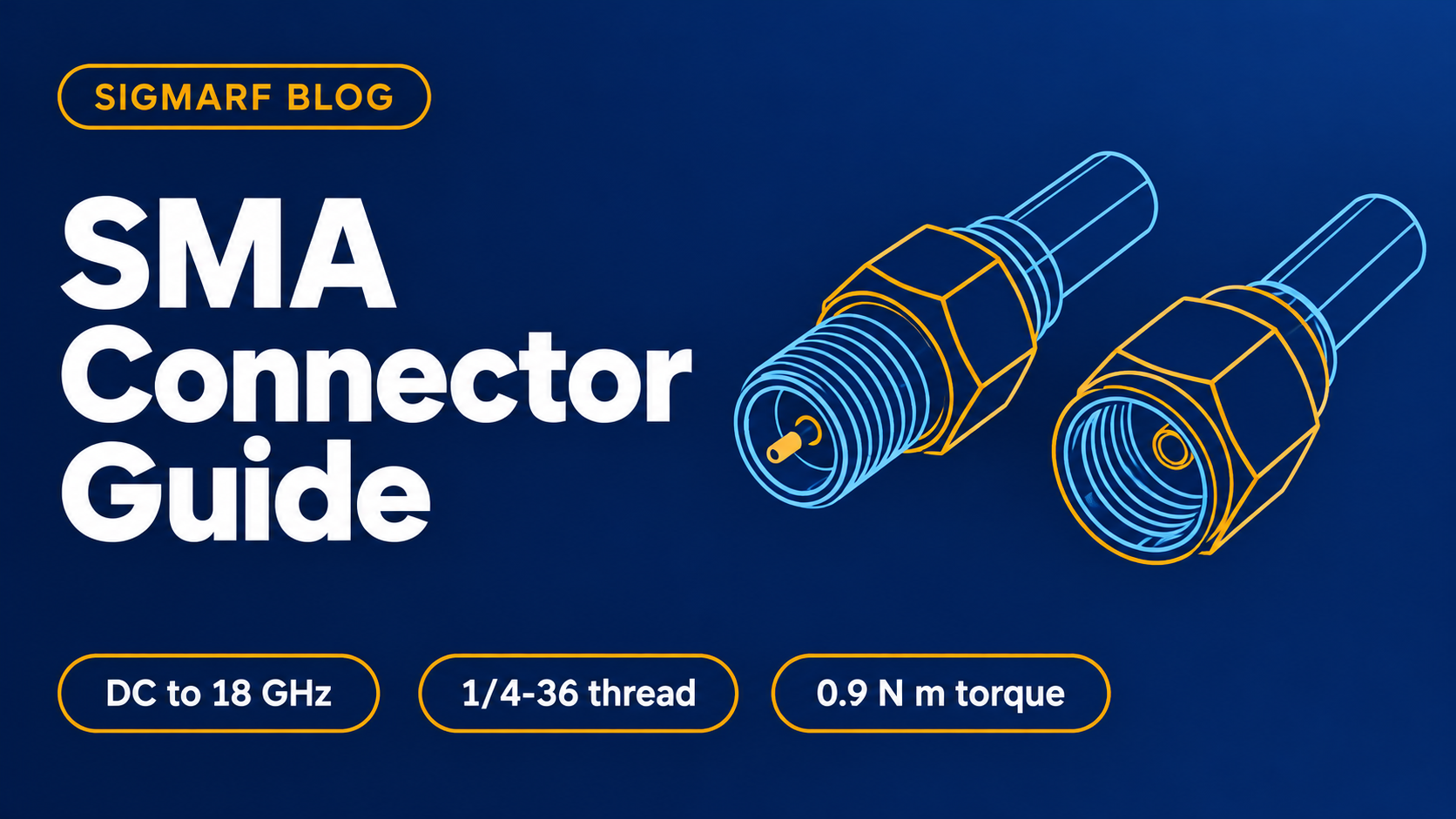
An engineer orders fifty "SMA cables" for a Wi-Fi router build, and half of them will not mate. The drawing said SMA, the routers have RP-SMA jacks, and nobody checked the center contact. The SMA is the most common small RF connector in the world, and it still causes more ordering errors than any other series.
This guide covers what the SMA actually is: the 1/4-36 threaded coupling, the 50 ohm interface, the real frequency limits, how to tell male from female (and SMA from RP-SMA), the torque that keeps it alive, and the mistakes that ruin threads, pins and test ports.
On This Page
- What an SMA connector is
- SMA specifications that matter
- SMA male vs female: read the pin, not the nut
- Frequency range: 18 GHz typical, 26.5 GHz precision
- Brass vs stainless and mating-cycle reality
- Where SMA is used
- Worked example: a 5.8 GHz module pigtail
- SMA mistakes that cost money
- SMA questions
- Bottom Line
What an SMA connector is
SMA stands for SubMiniature version A. It is a 50 ohm coaxial connector with a threaded 1/4-36 UNS coupling: the plug carries a hex nut with the internal thread, the jack carries the external thread. The dielectric is PTFE, the center contact is a pin on the male and a slotted socket on the female, and the interface is rated by most manufacturers to DC to 18 GHz in standard form.
The thread is what separates SMA from snap-on and bayonet series. It gives a repeatable, vibration-resistant mate that holds its electrical length, which is why SMA became the default port on synthesizers, spectrum and network analyzers, software-defined radios and compact antennas. If you need the wider family picture first, our RF connector identification chart places SMA next to N, TNC, BNC and the rest.
SMA specifications that matter
| Property | Typical value | Why it matters |
|---|---|---|
| Impedance | 50 ohm | Matches standard RF and test systems; do not mix with 75 ohm video parts |
| Frequency range | DC to 18 GHz standard; precision versions to 26.5 GHz (extended-range designs beyond that) | Above 18 GHz, connector grade and cable quality dominate performance |
| Coupling thread | 1/4-36 UNS-2A/2B | Fine thread; cross-threading destroys both halves |
| Nut size | 8 mm (5/16 in) hex | Use a proper 8 mm torque wrench, not pliers or an adjustable wrench |
| Coupling torque | About 0.8 to 1.1 N m (7 to 10 in lbf) stainless; about 0.34 to 0.56 N m (3 to 5 in lbf) brass | Under-torque loosens in vibration; over-torque damages the interface |
| Dielectric | PTFE | Stable to high temperature; still deformable by a bent center pin |
| Mating cycles | Up to 500 (stainless, gold-plated contact) | Cycle life depends on materials and torque discipline, not the series name |
| Voltage rating | 335 Vrms continuous (typical catalog value) | Power handling is set by frequency and cable, not the connector alone |
Key idea: An "SMA connector" is an interface, not a performance guarantee. The frequency, voltage and cycle numbers above are family reference values. Your assembly's real limits come from the specific connector part, the cable, and the termination quality.
SMA male vs female: read the pin, not the nut
Connector gender is defined by the center contact. A standard SMA male (plug) has a center pin inside a coupling nut with the internal thread. A standard SMA female (jack) has a center socket and an external thread body. Both the contact and the thread have to match for a pair to mate.
RP-SMA (reverse polarity SMA) keeps the same threads but swaps the contact: the RP-SMA plug has the nut but a socket, the RP-SMA jack has the external thread but a pin. An RP-SMA plug screws perfectly onto a standard SMA jack and makes no electrical contact, which is exactly the failure behind the Wi-Fi router story at the top of this page. Wi-Fi routers and their antennas are almost always RP-SMA; GPS, cellular and test equipment are almost always standard SMA. The side-by-side identification walkthrough is in our SMA vs RP-SMA identification and mating guide.
| Part | Center contact | Thread | Typical home |
|---|---|---|---|
| SMA plug (male) | Pin | Nut (internal) | Cable ends, antenna pigtails |
| SMA jack (female) | Socket | External | Instrument and device ports, bulkheads |
| RP-SMA plug | Socket | Nut (internal) | Wi-Fi antennas |
| RP-SMA jack | Pin | External | Wi-Fi router ports |
Frequency range: 18 GHz typical, 26.5 GHz precision
The standard SMA interface is rated DC to 18 GHz. Precision SMA versions, with tighter mechanical tolerances and better contact support, are rated to 26.5 GHz, and extended-range designs go further. The limit is geometric: above roughly 18 GHz the interface dimensions start to support a higher-order waveguide mode, and return loss degrades even if the connector still screws together.
In practice the cable usually limits the assembly first. RG316 with SMA ends is a sensible 3 GHz assembly and a marginal 18 GHz one. Semi-rigid 0.086 or 0.141 in cable keeps SMA honest into the teens of GHz. If your application sits above 18 GHz, SMA is the wrong conversation; that is 2.92 mm (K) territory, which mates with SMA but is specified for 40 GHz. For power and frequency comparisons against the larger threaded series, see SMA vs N-type vs TNC vs BNC.
Need an SMA assembly that is tested, not assumed?
Tell us the cable, connector genders, length and band. Every SigmaRF assembly is VNA-swept for VSWR and insertion loss before it ships.
Brass vs stainless and mating-cycle reality
Standard commercial SMA bodies are brass with gold or nickel plating. Precision and test-grade SMA bodies are stainless steel, passivated, with gold-plated beryllium copper contacts. Stainless survives the catalog rating of up to 500 mating cycles; soft brass threads and plating wear much sooner, especially under repeated torque wrench use.
The practical rule: on a test port or anything connected daily, use stainless and count the cycles. On an antenna port that gets connected twice in its life, brass is fine and cheaper. A worn connector does not fail open; it degrades return loss slowly, which is worse, because you chase the fault everywhere else first. The wear mechanisms and inspection points are covered in SMA mating cycles and lifespan.
Where SMA is used
SDR and radio modulesGPS and GNSS antennasLTE and 5G CPE portsTest and measurementModule pigtailsWi-Fi (as RP-SMA)
The pattern: SMA wins where the port is small, the mate is threaded and the band is under 18 GHz. Modules with miniature onboard connectors such as U.FL typically reach the outside world through a short U.FL to SMA pigtail; the miniature end has its own rules, covered in the U.FL / IPEX connector guide.
Worked example: a 5.8 GHz module pigtail
A telemetry module needs a 300 mm pigtail from its SMA jack to a bulkhead SMA on the enclosure at 5.8 GHz. Assume RG316 cable with a published attenuation of about 2.9 dB per metre at 5.8 GHz and a connector-pair allowance of 0.3 dB. These are example figures for method, not a build specification.
Cable loss = 2.9 dB/m x 0.30 m = 0.87 dB
Estimated assembly loss = 0.87 + 0.30 = 1.17 dB
Power delivered ratio = 10^(-1.17/10) = 0.764, about 76%
If the run doubles to 0.60 m: 1.74 + 0.30 = 2.04 dB, about 63% delivered
The math is why short pigtails exist. If 1.2 dB is too much, the options are a shorter run, a lower-loss cable such as LMR-240 (with the matching SMA crimp body), or relocating the radio. State the loss budget in the inquiry and the assembly can be specified against it.
SMA mistakes that cost money
Avoid these
- ✗Mating SMA to RP-SMA. The threads engage fully and the contacts never touch. Check the pin, not the fit.
- ✗Tightening with pliers or an adjustable wrench. The 8 mm hex rounds off and torque becomes a guess. Use an 8 mm torque wrench.
- ✗Over-torquing. Past the rated torque the jack threads stretch and the center contact support cracks. Damage details are in over-torque damage and correct torque.
- ✗Spinning the cable or device instead of the nut. Twisting the body torques the center contact and the cable termination. Hold the body, turn only the nut.
- ✗Assuming every SMA is good to 26.5 GHz. That rating belongs to precision grades. Standard parts are 18 GHz parts.
- ✗Cross-threading the 1/4-36. Start every mate by hand; a thread that resists in the first turn is misaligned, not tight.
SMA questions
What does SMA connector stand for?
SubMiniature version A. It is a 50 ohm threaded coaxial interface developed for semi-rigid cable and now used across radio, antenna and test applications.
What is the frequency range of an SMA connector?
DC to 18 GHz for standard parts, 26.5 GHz for precision grades, with extended-range designs beyond that. The cable and termination usually set the real assembly limit first.
How do I tell SMA male from female?
Look at the center contact. Pin means male (plug), socket means female (jack). For standard SMA the male also carries the coupling nut; for RP-SMA the nut stays but the contacts swap, so always check the pin.
Is SMA the same as RP-SMA?
No. They share the 1/4-36 thread but the center contacts are reversed, so they screw together without making contact. Wi-Fi gear is usually RP-SMA; test, GPS and cellular are usually standard SMA.
What torque should an SMA connector be tightened to?
About 0.8 to 1.1 N m (7 to 10 in lbf) for stainless interfaces and roughly half that for brass, with an 8 mm torque wrench. Series values are in our RF connector torque specs reference.
How many times can you mate an SMA connector?
Up to 500 cycles for stainless, gold-contact parts kept at correct torque. Brass commercial parts wear earlier. Test ports that see daily use should run adapter savers and periodic inspection.
Bottom Line
The SMA is simple: 50 ohm, 1/4-36 thread, 18 GHz standard. The failures are simple too: wrong polarity, wrong torque, wrong frequency assumption. Identify the contact, wrench it to spec, and match the cable to the band.
When the assembly itself has to be right, specify the cable, both connector ends with gender and polarity, the length and the band, and buy against a tested build rather than a bin of adapters.
Get SMA assemblies built to your drawing
Standard and custom SMA cable assemblies, VNA-tested for VSWR and insertion loss before shipment, from 100 MHz to 40 GHz across suitable cable systems.

Aadeshwar Modi is a marketing technical content writer who loves writing on technology and AI topics.
- RF Transistor Frequency Response and Power Performance
- How Semiconductor Materials Affect RF Device Performance
- RFIC vs MMIC: Terminology, Integration and Selection
- What Is an MMIC? Inside a Monolithic Microwave Circuit
- What Are Microwave Vacuum Tubes and Where Are They Used?
- What Is a MESFET and How Is It Used in RF Circuits?
- What Is a Heterojunction Bipolar Transistor (HBT)?
- GaN vs GaAs RF Technology: Power, Noise and Design Trade-offs
- BJT vs MOSFET vs HEMT: RF Transistor Technologies Explained
- What Are RF Frequency Multipliers and How Do They Work?