Solid vs Stranded Center Conductors: Which Is Better for RF Cables?
Published on 11/4/2026
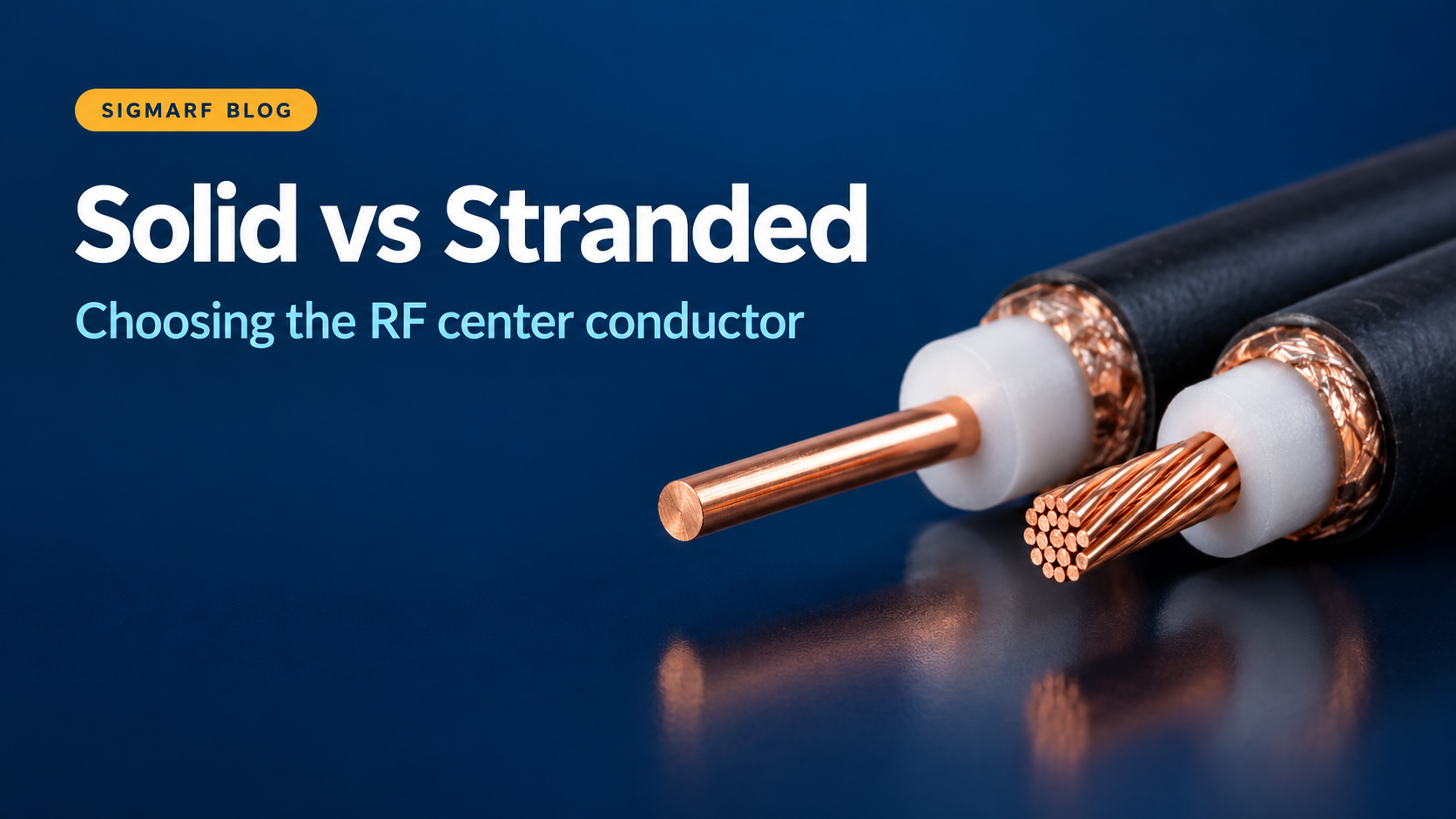
Two coaxial cables sit side by side with identical jackets, identical shields and identical connectors. One has a solid copper core, the other a bundle of fine strands. On a datasheet they look interchangeable, until one gets flexed five thousand times on a robot arm and the other goes into a phased array where a degree of phase drift ruins the beam. The center conductor choice is small on paper and large in practice.
Short answer: solid center conductors give lower loss, better phase stability and cheaper, more repeatable cable, so they suit fixed installations and high-frequency work. Stranded conductors trade a little of that performance for flexibility and flex life, so they suit patch cords, moving assemblies and anywhere the cable bends in service. Pick by how the cable will live, not by habit.
On This Page
What actually differs
A solid center conductor is a single wire, sometimes plated, running the length of the cable. A stranded conductor is a bundle of thin wires twisted together to the same overall diameter. Everything else in the cable, the dielectric, shield and jacket, can be identical, which is why the two versions often share a part family, like RG58 solid and its stranded patch-cord cousins.
The trade is fundamental: strands move against each other when the cable bends, which protects the metal from fatigue but adds tiny, shifting contact points in the current path. Solid metal conducts better and stays put, but work-hardens and eventually cracks if you flex it enough.
Key idea: Choose solid when the cable will be installed once and left alone, especially at high frequency. Choose stranded when the cable will move: patch panels, test benches, robots and handheld gear all punish solid cores.
Electrical performance: loss and phase
Solid conductors win on attenuation. A single smooth cylinder presents a clean surface to the RF current, which at high frequency hugs the outer skin of the metal, as covered in our skin effect article. Strands present a rougher surface and internal contact points, so a stranded version of the same cable typically shows 10 to 20 percent higher loss, sometimes more at microwave frequencies.
Solid also wins on stability. Because the geometry does not shift, a solid-core cable holds its impedance and electrical length steady, which matters in phase-matched systems and precision test leads. Stranded cores drift a little as the bundle settles and flexes. For applications where phase must stay put, our phase-matched cable article explains why that drift costs real performance.
Mechanical life: bending and vibration
Flexing is where stranding earns its keep. Bend a solid core repeatedly and the metal fatigues at the bend until it cracks, often inside an intact jacket, leaving an intermittent fault that is miserable to find. A stranded bundle distributes the bending strain across many fine wires and survives orders of magnitude more flex cycles. Vibration tells the same story: stranded cores tolerate it, solid cores eventually fail at stress points.
There is a middle path: many RF cables use a solid core for fixed runs and reserve stranded constructions for the last metre, the patch lead that gets plugged, coiled and moved daily. Semi-rigid and conformable cables go the other way, using a solid outer conductor so the assembly holds a formed shape, covered in our flexible vs semi-rigid vs rigid guide.
Patch lead or permanent run?
SigmaRF builds both: flexible stranded patch cords and low-loss solid-core assemblies, each VNA-swept before it ships.
Talk to an EngineerTermination and connector fit
Termination is easier to get right on a solid core: it solders cleanly, crimps predictably and holds its shape in the connector. Stranded cores need a little more care, since a stray whisker can short to the shield and an uneven bundle can resist a clean crimp. Good practice is to tin lightly or use the correct ferrule, and to follow the connector maker's strip dimensions exactly.
Patch lead vs fixed run, same cable family
Fixed rooftop antenna run, 20 m, installed once:
choose solid core: lower loss, stable match, lower cost.
Test bench patch lead, flexed daily:
choose stranded: survives thousands of bends.
Robot arm feed, constant motion:
stranded, high-flex construction, generous bend radius.
Phased-array harness, phase-critical:
solid or phase-stable construction, matched lengths.
Avoid
- ✗Using solid core on moving assemblies. It will work-harden and fail intermittently, usually at the connector, and usually after the system ships.
- ✗Assuming stranded beats skin effect. At RF the bundle acts like one conductor with a rougher surface, so stranded cable has slightly higher loss, not lower.
- ✗Ignoring phase stability. In matched or phased systems, the drift of a stranded core can matter more than its loss.
- ✗Over-bending either type. Exceed the bend radius and you distort the dielectric in both, adding reflections that show up on a sweep.
Solid vs stranded questions
Is solid or stranded better for RF cable?
Solid is better electrically: lower loss and better phase stability. Stranded is better mechanically: it survives repeated flexing and vibration. Fixed installations favour solid; patch leads and moving assemblies favour stranded.
Does stranded coax have more loss than solid?
Yes, typically 10 to 20 percent higher attenuation for the same cable family, because the stranded surface is rougher and the strands contact each other. The penalty grows with frequency.
Which lasts longer, solid or stranded coax?
Under repeated bending, stranded lasts far longer because the fine wires share the strain. In a fixed, undisturbed run, both last indefinitely and solid performs better electrically.
Can you solder and crimp stranded center conductors?
Yes, with care. Use the correct ferrule or light tinning, keep whiskers out of the dielectric, and follow the connector strip dimensions. Solid cores are simply more forgiving.
When must you use solid core coax?
Phase-matched and phase-stable assemblies, formed semi-rigid runs, and high-frequency fixed links where the lowest loss and the steadiest impedance matter.
Does stranding help with the skin effect?
No. At radio frequencies the bundle behaves as a single conductor, so stranding adds surface roughness without adding useful surface area.
Bottom Line
Solid versus stranded is a contest between electrical performance and mechanical endurance. Solid cores lose less signal and hold phase, stranded cores survive motion. Decide how the cable will live, then pick the construction to match, and verify the finished assembly with a swept test.
The right conductor for the job
Standard and custom coaxial assemblies in solid and stranded constructions, VNA-tested to 40 GHz, with lead times as short as 2 days.

Ed is a Sourcing & Marketing Expert at SigmaRF, writes content related to Technology and Engineering topics
- RF Transistor Frequency Response and Power Performance
- How Semiconductor Materials Affect RF Device Performance
- RFIC vs MMIC: Terminology, Integration and Selection
- What Is an MMIC? Inside a Monolithic Microwave Circuit
- What Are Microwave Vacuum Tubes and Where Are They Used?
- What Is a MESFET and How Is It Used in RF Circuits?
- What Is a Heterojunction Bipolar Transistor (HBT)?
- GaN vs GaAs RF Technology: Power, Noise and Design Trade-offs
- BJT vs MOSFET vs HEMT: RF Transistor Technologies Explained
- What Are RF Frequency Multipliers and How Do They Work?