Alien Crosstalk and NEXT: Why Cat6A Assemblies Are Built Differently
Published on 10/28/2026 • Updated on 10/28/2026
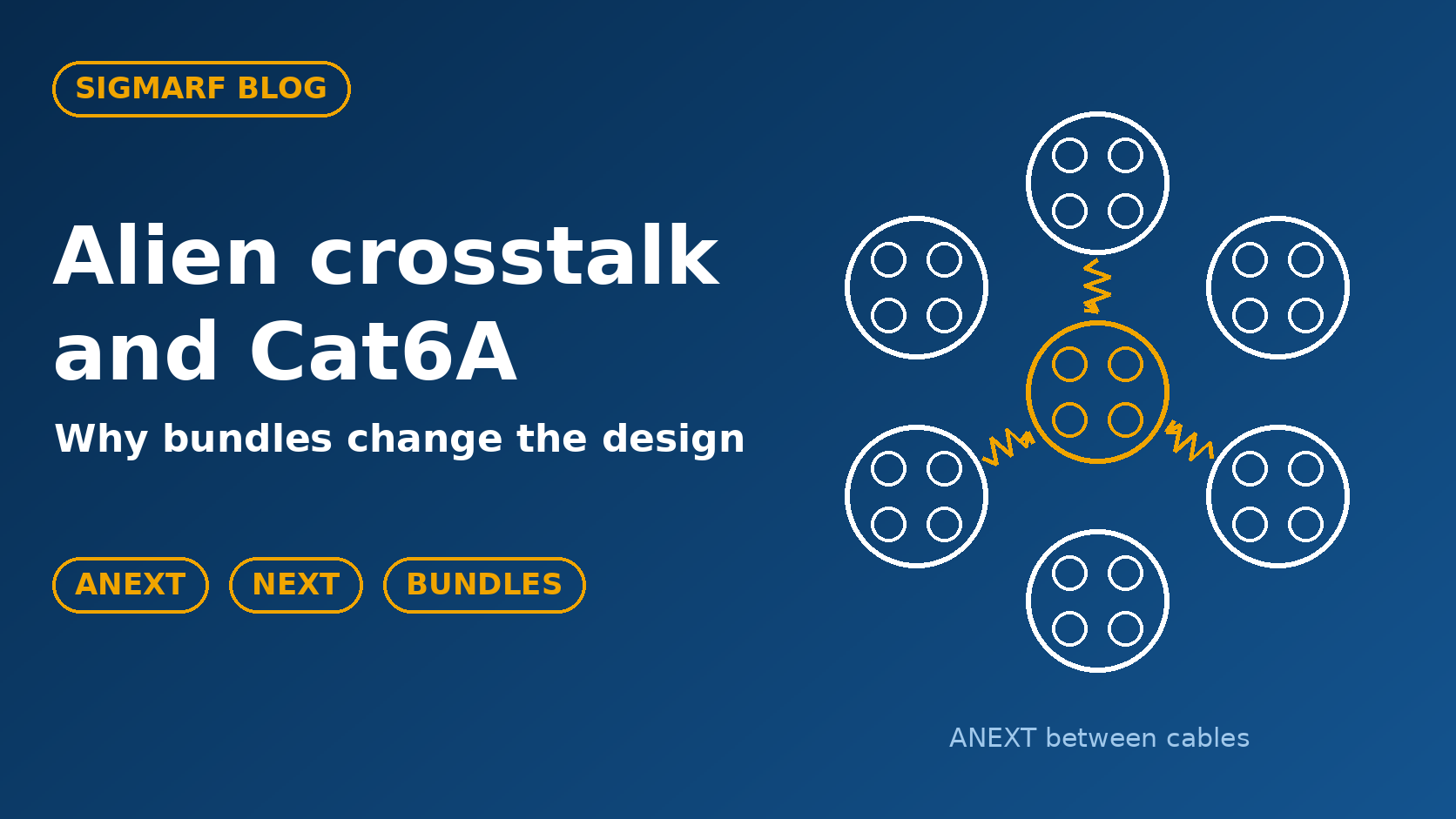
Alien crosstalk is noise coupled from adjacent cables, and it is the main reason 10 Gigabit links fail in bundles. Cat6A uses larger pair spacing, tighter twists or shielding to suppress it, which is why Cat6A assemblies are built differently from Cat6.
What is alien crosstalk in Ethernet cables?
Alien crosstalk (ANEXT, alien near-end crosstalk) is unwanted signal coupling between separate cables that share a route. Unlike the crosstalk between pairs inside one cable, alien crosstalk comes from outside the jacket, so a cable cannot control it alone. It grows with frequency, with bundle size and with the length the cables run together.
Gigabit Ethernet is largely indifferent to alien crosstalk because 1000BASE-T works at modest frequencies. 10GBASE-T, with its dense PAM-16 encoding, is not: the standard assumes alien crosstalk is controlled, which is exactly what Cat6A is designed to do and Cat6 is not.
NEXT, FEXT and the crosstalk family in plain language
NEXT (near-end crosstalk) is coupling between pairs inside one cable, measured at the same end as the signal source. FEXT (far-end crosstalk) is the same coupling measured at the far end. PS-NEXT (power-sum NEXT) adds the contributions of all disturbing pairs at once, which matters because every pair in 10GBASE-T carries data simultaneously.
Alien crosstalk completes the family: the same three measurements, but from neighbouring cables instead of neighbouring pairs. A certification report for a single cord tells you nothing about alien crosstalk; it only appears when cables are bundled. That is why a tray of individually compliant Cat6 cords can still fail at 10G.
Why bundled Cat6 fails at 10G
Cat6 was specified before 10GBASE-T existed. Its internal crosstalk limits support 10G only over reduced distances, and its construction does nothing about coupling between cables. Pack six or twenty-four Cat6 cords into one bundle and their combined alien crosstalk can push a marginal 10G link over the edge, typically beyond roughly 37 to 55 metres depending on conditions.
Inside equipment the same physics applies at smaller scale. A harness of many high-speed cables laced together for a long common run concentrates alien crosstalk even when every individual assembly passes its test.
How Cat6A geometry fixes it
Cat6A attacks alien crosstalk with construction. Unshielded Cat6A uses larger overall diameter, greater pair separation and tighter, varied twists to weaken coupling between cables. Shielded Cat6A (F/UTP or S/FTP) wraps the pairs in foil or braid so coupling is absorbed by the screen instead. Either approach keeps 10GBASE-T working to the full 100 metres in realistic bundles, which is the headline difference from Cat6.
The trade-offs are mechanical: Cat6A cords are thicker, stiffer and need more bend room. Inside a compact enclosure that matters, and it is why category choice and mechanical design belong in the same conversation, as covered in our bend radius guide.
Building 10G equipment with dense harnesses? Send the bundle layout and lengths, and we will build Cat6A assemblies to suit.
Request tested Cat6A assembliesBundling custom assemblies in trays and harnesses
A few layout habits reduce alien crosstalk regardless of category. Keep high-speed links physically short where the design allows. Split very long common runs into two smaller bundles rather than one large one. Avoid lacing cables tight over their whole length; a little spacing between cables weakens coupling. And separate the noisiest neighbours, such as motor or power wiring, from data pairs by route, not by hope.
Where the layout is fixed and dense, shielded Cat6A assemblies are the straightforward answer, with the shield correctly terminated at both ends as our shielded cable grounding guide explains.
What gets tested on Cat6A builds
Assembly-level testing verifies the parameters the category promises: wiremap, length, insertion loss, NEXT, return loss and delay skew, swept across the full 500 megahertz range. Every assembly we ship is 100% tested, and digital test certificates are available on critical builds, so the margin on each cord is documented rather than assumed.
Alien crosstalk itself is a channel property, not a single-cord property, so it is addressed by design: category choice, shielding and bundle layout as described above. Where an application is sensitive, we can align the assembly test plan with the customer's channel requirements.
Rule of thumb: one or two 10G cords in free space can survive on Cat6. A bundle of 10G cords cannot. Choose Cat6A when cables share a route.
A note on mixed-category bundles
Real plants rarely bundle one category alone. Cat5e, Cat6 and Cat6A cords share trays, and the question becomes which links are at risk. The answer follows the victim, not the disturber: a 10G link is the sensitive listener, so protect the 10G cords. Running the 10G segments in shielded Cat6A, or physically separating them in the tray, protects them even when the neighbours are noisy older categories. The Gigabit links around them will be fine either way.
When we review a harness drawing for 10G content, the bundle layout is part of the review for exactly this reason: category choice and route design solve the problem together.
One clarification buyers appreciate: alien crosstalk is not a defect in any single cord. Every individual assembly can pass its certification sweep while the bundle still misbehaves. That is why the fix lives in construction and layout decisions made at design time, not in swapping one "bad" cord for another identical one.
Common questions
What is the difference between NEXT and alien crosstalk?
NEXT is coupling between pairs inside one cable; alien crosstalk is coupling between separate cables. A single-cord test report covers NEXT. Alien crosstalk only appears when cables are bundled, and it is the limiting factor for 10GBASE-T in dense installations.
Does alien crosstalk affect Gigabit Ethernet?
Rarely. 1000BASE-T operates at modest frequencies with tolerant encoding, so alien crosstalk is seldom an issue at 1G. It becomes important at 10GBASE-T and is one reason 10G needs Cat6A in bundled routes.
Is shielded Cat6A better than unshielded for alien crosstalk?
Shielded Cat6A constructions suppress alien crosstalk strongly and allow tighter bundles, at the cost of grounding discipline. Well-designed unshielded Cat6A also controls it through spacing and twist. The right choice depends on bundle density and the equipment grounding design.
Can I fix alien crosstalk on an existing Cat6 installation?
Partially. Shortening links, splitting bundles and adding spacing between cables all help. If the links must stay long and dense, recabling those segments with Cat6A is the reliable fix.
Why are Cat6A cables so much thicker?
The diameter comes from pair separation and varied twists that weaken coupling between cables, or from shielding layers in screened versions. The bulk is the alien-crosstalk control mechanism, not wasted material.
Bottom Line
Alien crosstalk is the bundle problem, and 10GBASE-T is where it bites. Cat6A is built to suppress it through spacing, twist or shielding; Cat6 is not. Shorten runs, split bundles where you can, and specify tested Cat6A assemblies where cables share a route.
Cat6A assemblies with documented test margins
Send the link rate, bundle layout, lengths and quantity. We build and test to the channel requirement.
Custom Ethernet cable assemblies | Talk to SigmaRF
Alankar is a Technical Content Writer at SigmaRF, writes on various topics from Technology, Compliance and Business process
- RF Transistor Frequency Response and Power Performance
- How Semiconductor Materials Affect RF Device Performance
- RFIC vs MMIC: Terminology, Integration and Selection
- What Is an MMIC? Inside a Monolithic Microwave Circuit
- What Are Microwave Vacuum Tubes and Where Are They Used?
- What Is a MESFET and How Is It Used in RF Circuits?
- What Is a Heterojunction Bipolar Transistor (HBT)?
- GaN vs GaAs RF Technology: Power, Noise and Design Trade-offs
- BJT vs MOSFET vs HEMT: RF Transistor Technologies Explained
- What Are RF Frequency Multipliers and How Do They Work?