Coaxial Cable Types Explained: RG, LMR, Semi-Rigid and Which to Use
Published on 10/23/2026 • Updated on 10/23/2026
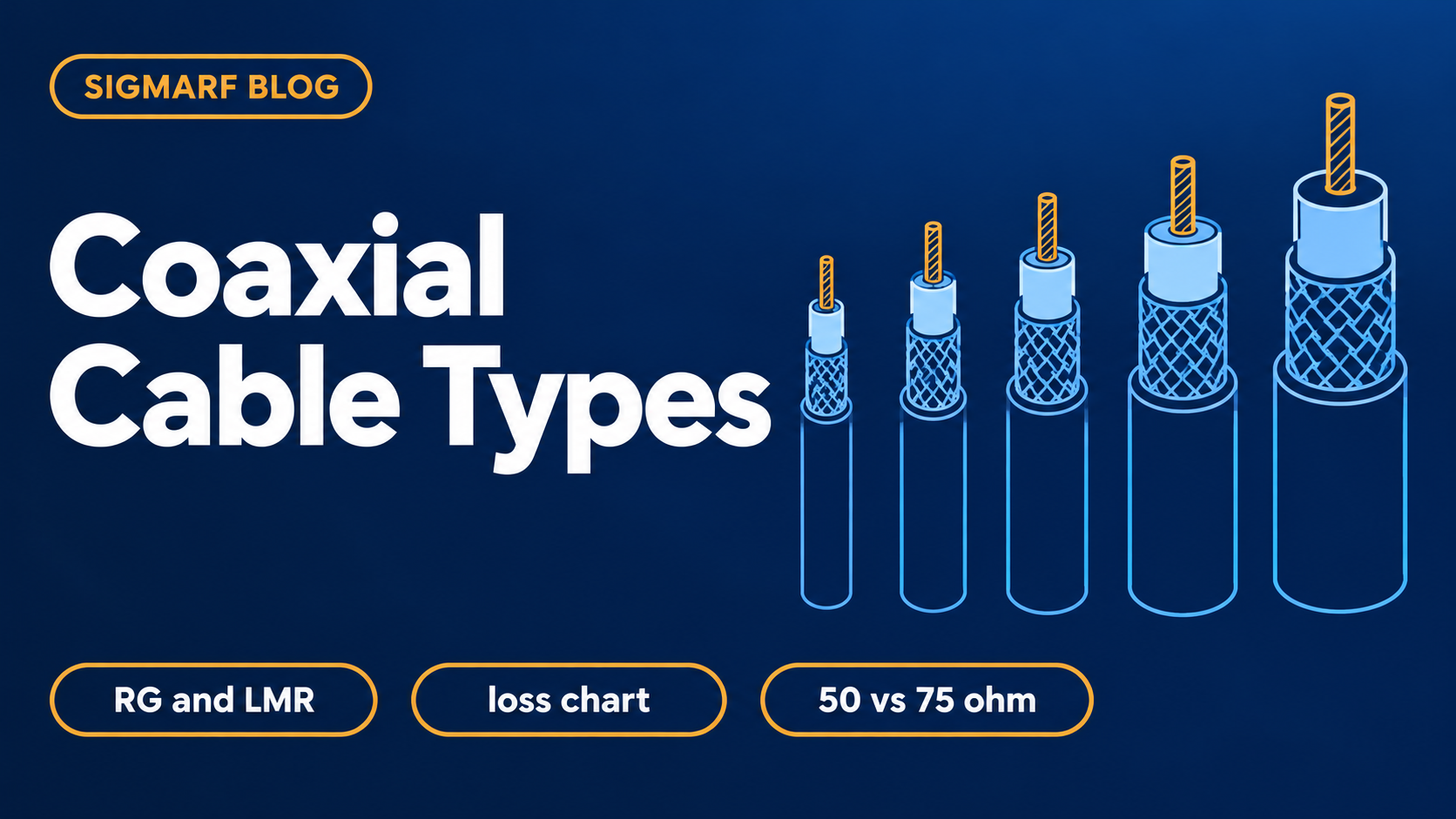
Ask five engineers which coax to use and you will get six answers, all starting with "it depends." It does depend, but on a short list of things: frequency, length, power, flexibility and environment. Get those five right and the cable choice makes itself.
This guide is the reference table plus the reasoning behind it: the RG families, the LMR low-loss series, and semi-rigid, with impedance, loss, bend radius, jacket and the connectors each one takes.
On This Page
The three families: RG, LMR, semi-rigid
RG types. The classic military-spec designations, still the common language of coax. RG58, RG174, RG316, RG59, RG6, RG213. General-purpose, widely stocked, fine for most work below a few hundred MHz and for short runs at higher frequency.
LMR series. Modern low-loss foam-dielectric cables built as drop-in upgrades over the RG sizes. LMR-100, 195, 200, 240, 400 and 600 roughly parallel RG174 through RG213 in diameter while cutting loss substantially. The default choice for antenna feeders and any run where metres of cable meet GHz of frequency.
Semi-rigid and conformable. A solid outer conductor, usually copper tube, in 0.086 and 0.141 inch diameters. Best shielding and phase stability available, bent once into shape and left there. Inside radios, between modules, and anywhere the cable is part of the design rather than the installation.
The master table
Loss figures are typical attenuation at 1 GHz per 30 m (100 ft); treat them as comparison numbers, since construction varies between makers.
| Cable | Impedance | Outer diameter | Loss at 1 GHz, per 30 m | Min bend radius | Typical connectors | Typical use |
|---|---|---|---|---|---|---|
| RG174 | 50 ohm | 2.8 mm | about 32 dB | about 13 mm | SMA, MMCX, MCX, BNC | Short pigtails, portable gear |
| RG178 | 50 ohm | 1.8 mm | about 43 dB | about 10 mm | MMCX, MCX, U.FL | Tiny pigtails inside enclosures |
| RG316 | 50 ohm | 2.5 mm | about 34 dB | about 15 mm | SMA, BNC, TNC, N | Pigtails, test leads, high temperature |
| RG58 | 50 ohm | 5.0 mm | about 17 dB | about 25 mm | SMA, BNC, TNC, N | Test leads, short antenna runs |
| RG59 | 75 ohm | 6.1 mm | about 12 dB | about 30 mm | BNC, F | Video camera runs |
| RG6 | 75 ohm | 6.9 mm | about 9 dB | about 35 mm | F, BNC compression | Antenna and satellite distribution |
| RG213 | 50 ohm | 10.3 mm | about 8 dB | about 50 mm | N, UHF, BNC | Antenna feeders, higher power |
| RG400 | 50 ohm | 4.9 mm | about 15 dB | about 25 mm | SMA, BNC, TNC | High-temperature double-braid runs |
| LMR-100 | 50 ohm | 2.8 mm | about 24 dB | about 13 mm | SMA, MMCX, MCX | Low-loss small pigtails |
| LMR-195 | 50 ohm | 5.0 mm | about 11 dB | about 25 mm | SMA, BNC, TNC, N | Antenna jumpers |
| LMR-200 | 50 ohm | 5.0 mm | about 10 dB | about 25 mm | SMA, BNC, TNC | Flexible antenna jumpers |
| LMR-240 | 50 ohm | 6.1 mm | about 8 dB | about 32 mm | SMA, BNC, TNC, N | Medium antenna feeders |
| LMR-400 | 50 ohm | 10.3 mm | about 4 dB | about 40 mm | N, TNC, SMA | Long antenna feeders |
| LMR-600 | 50 ohm | 15.0 mm | about 3 dB | about 64 mm | N | Long runs, higher power |
| 0.086 semi-rigid | 50 ohm | 2.2 mm | about 25 dB | formed once | SMA, SMP | Inside modules and radios |
| 0.141 semi-rigid | 50 ohm | 3.6 mm | about 14 dB | formed once | SMA, SMA, N | Interconnects inside equipment |
How to choose in five questions
- What frequency? Loss climbs with frequency. Above 1 GHz on anything longer than a pigtail, look at LMR or larger RG first.
- How long is the run? Short pigtails can afford small, lossy cable. A 20 m rooftop run cannot.
- How much power? Transmit duty drives you toward RG213, LMR-400 and LMR-600 class cable with proper connectors.
- Does it move? Repeated flexing wants stranded center conductors and flexible jackets, not semi-rigid.
- Where does it live? Outdoors means UV-stable jacket and weatherproofed connectors; high temperature means FEP-jacketed types like RG316 or RG400.
50 ohm vs 75 ohm
The two impedances are not interchangeable. 50 ohm is the standard for radio, test and data equipment. 75 ohm is the standard for video and broadcast distribution, where it minimizes loss. An impedance mismatch costs you reflected power and shows up as VSWR; mixing a 75 ohm cable into a 50 ohm antenna system is a self-inflicted problem. The connector identification chart helps confirm the mating side, since connector impedance follows the system too.
Jackets and environment
PVC is the default: cheap, flexible, indoor-friendly, and it stiffens in the cold and chalks in the sun. PE and UV-stabilized jackets handle outdoor runs. FEP survives high temperature and chemicals, which is why RG316 and RG400 show up inside hot equipment. Plenum spaces need plenum-rated jackets by code. Match the jacket to the worst environment the cable will see, not the average one.
Matching connectors to cable
Every connector is built for a specific cable diameter and construction. An SMA for RG316 does not fit RG58; an N for LMR-400 does not fit RG213 without checking the variant. The termination method follows the cable too: small coax takes small hex dies, LMR-400 takes a 0.429 inch die as covered in the N on LMR-400 guide, and crimp technique in general is covered in the SMA crimping guide. When in doubt, order the assembly built: the connector, cable and die are matched at the factory and the result is tested.
Coax cable questions
Is LMR-400 the same as RG8?
Similar diameter and role, different construction. LMR-400 uses a foam dielectric and bonded foil plus braid shield, giving lower loss and better shielding than classic RG8 or RG213. Connectors are often shared by diameter, but confirm the exact variant.
Can I use 75 ohm cable on a 50 ohm antenna?
You can physically connect it, and it will cost you reflected power and VSWR. For receive-only listening it may be tolerable; for transmitting, stay at 50 ohm end to end.
What cable should I use for a 2.4 GHz rooftop antenna?
As short and as low-loss as the budget allows: LMR-240 for a few metres, LMR-400 beyond that. At 2.4 GHz, cable loss is the cheapest place to throw away range and the most expensive place to buy it back.
When does semi-rigid make sense?
Inside equipment, where the cable is formed once and never moved: module interconnects, filters, compact radio builds. For anything that flexes or routes through an installation, use flexible coax.
Bottom Line
Pick impedance first, then let frequency, length, power, flexing and environment narrow the table to one or two candidates. When the choice is close, buy the lower loss cable, because loss never gets cheaper after installation. And when the termination matters, order the assembly tested.
Get the cable and connector matched
Assemblies on every cable in this table, with the right connector and die for each, VNA-tested for VSWR and insertion loss before shipment.

Alankar is a Technical Content Writer at SigmaRF, writes on various topics from Technology, Compliance and Business process
- RF Transistor Frequency Response and Power Performance
- How Semiconductor Materials Affect RF Device Performance
- RFIC vs MMIC: Terminology, Integration and Selection
- What Is an MMIC? Inside a Monolithic Microwave Circuit
- What Are Microwave Vacuum Tubes and Where Are They Used?
- What Is a MESFET and How Is It Used in RF Circuits?
- What Is a Heterojunction Bipolar Transistor (HBT)?
- GaN vs GaAs RF Technology: Power, Noise and Design Trade-offs
- BJT vs MOSFET vs HEMT: RF Transistor Technologies Explained
- What Are RF Frequency Multipliers and How Do They Work?