Copper vs Silver-Plated Copper Conductors in RF Cable Assemblies
Published on 11/4/2026
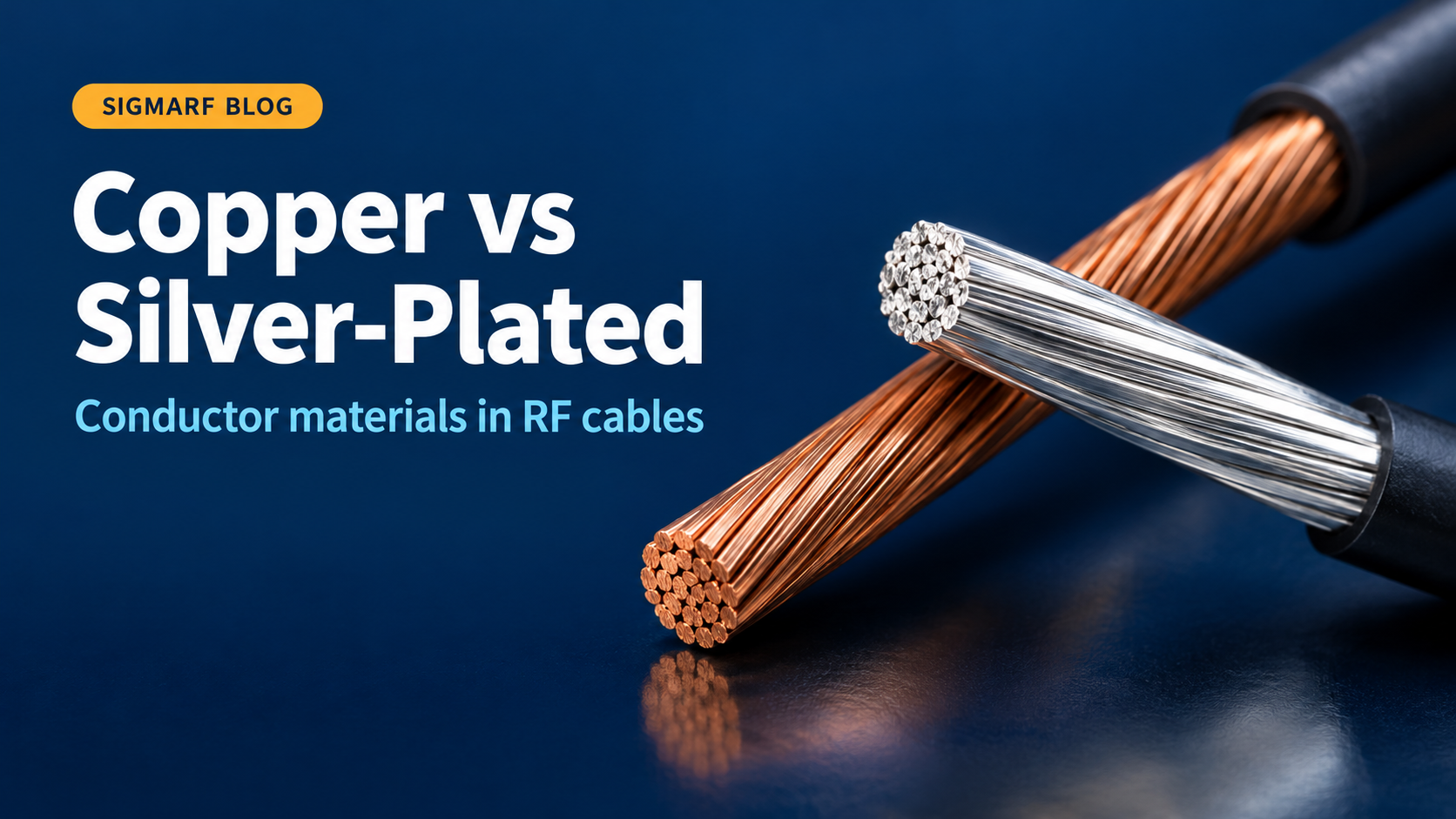
Open up a cheap coax and the center conductor is bare copper. Open up a microwave test cable and that same copper gleams with a layer of silver a few micrometres thick. The difference costs real money, so it is worth asking the only question that matters: at your frequency, does the plating actually buy you anything?
Short answer: at radio frequencies, current travels in a thin skin at the conductor surface, so the surface metal, not the bulk, sets the resistance. Silver conducts a few percent better than copper and stays conductive as it ages, so silver plating lowers loss and stabilizes it at high frequencies. Below a few hundred megahertz the benefit is small; at microwave frequencies it is one of the cheapest dB you can buy.
On This Page
Copper, silver-plated, and the other options
RF cable conductors come in a small family of recipes. Bare copper is the baseline: excellent conductivity, low cost, but it oxidizes over time and the oxide is a poor conductor. Tinned copper adds a solder-friendly coating that resists corrosion, at a small conductivity penalty. Silver-plated copper puts a thin layer of the best practical conductor on the surface. Silver-plated copper-clad steel swaps the core for steel to add strength, common in hand-formable and other high-reliability cable.
The choice is not about which metal is best in the abstract. It is about which metal touches the RF current, and that depends on frequency, because of the skin effect covered in our skin effect article.
Key idea: RF current lives at the surface. A plating a few micrometres thick sits exactly where the current flows, so a small upgrade in surface metal can outperform a much larger amount of better metal buried in the core.
Why the surface metal decides
At 1 GHz the current in copper crowds into a layer about 2 micrometres thick; at 10 GHz, under a micrometre. A silver plating of 1 to 2 micrometres therefore carries essentially all of the current at microwave frequencies. Since silver has the highest conductivity of any metal, the resistance of the plated surface is a few percent lower than copper, and it stays that way as the cable ages, because silver tarnish still conducts reasonably well while copper oxide does not.
A few percent of resistance sounds modest, and at low frequency it is. But at microwave frequencies every fraction of a dB per metre adds up over a run, and surface roughness and oxidation become the difference between a cable that meets spec on day one and one that still meets it in year five.
Where plating pays, and where it does not
Plating pays at high frequency. Above roughly 1 GHz, and decisively above 6 GHz, the current is so surface-bound that plating directly cuts insertion loss. This is why microwave and test cables almost always use silver-plated conductors, in the center and often in the shield too.
Plating pays in harsh environments. Heat, humidity and time oxidize bare copper, and oxide raises surface resistance. Silver plating holds performance steady, which is why it is standard in high-reliability and outdoor high-frequency hardware.
Plating barely matters at low frequency. At HF and below, the current penetrates deep into the copper, so the surface layer is a small part of the story. Tinning for corrosion protection is usually the sensible spend here, not silver. Our silver vs tin plating comparison breaks that choice down.
High-frequency assembly to build?
SigmaRF supplies silver-plated and low-loss constructions rated to 40 GHz, each swept for insertion loss before shipment.
Talk to an EngineerCost, corrosion and the honest trade-offs
Silver plating adds cost, both material and process, so it is spent where it counts. Copper-clad steel trades some conductivity for a much stronger core that survives flexing and thin gauges, with the silver surface restoring high-frequency performance. Tin plating trades a little conductivity for solderability and corrosion resistance at low cost. Bare copper is the value option where frequency and environment allow it.
The point is matching the recipe to the job. A 50 ohm feed at 150 MHz over a short run gains little from silver. An 18 GHz test lead that gets flexed daily gains twice: lower loss from the plating and longer life from the corrosion resistance. The cable selection guide walks the full checklist.
Plating at two frequencies
At 100 MHz, skin depth in copper about 6.6 micrometres:
current spreads through plating and copper alike,
plating saves little; tinned copper usually suffices.
At 10 GHz, skin depth about 0.66 micrometres:
nearly all current flows in the silver layer,
plating cuts surface resistance and holds it for years.
Same cable family, same plating: value decided by frequency.
Avoid
- ✗Paying for silver at low frequency. Below a few hundred MHz the current uses the whole conductor, so plating buys little performance.
- ✗Skipping plating at microwave. Above a few GHz, bare or oxidized copper costs measurable loss that a thin silver layer prevents.
- ✗Assuming plating fixes a bad cable. Plating improves the surface; it cannot rescue poor dielectric, weak shielding or sloppy geometry.
- ✗Forgetting the shield and connectors. The return current lives on the shield inner surface and the contacts too, so plating and finish matter there as well.
Conductor material questions
Is silver-plated copper better than bare copper for RF?
At high frequency, yes. RF current flows in the surface skin, and silver conducts slightly better than copper while resisting the oxidation that raises copper surface resistance over time. Below a few hundred MHz the benefit is small.
What is SPC in cable specifications?
Silver-plated copper: a copper conductor coated with a thin layer of silver, used for high-frequency and high-reliability cables. SPCCS, silver-plated copper-clad steel, adds a steel core for strength.
Does silver plating reduce cable loss?
Yes, at frequencies where the skin depth is comparable to the plating thickness, roughly 1 GHz and above. The improvement is a few percent of resistance, which grows in importance over long runs and with aging.
Why use copper-clad steel in RF cable?
The steel core is far stronger than copper, so thin conductors survive flexing and forming. Because RF current flows at the surface, a silver-plated steel core performs nearly like solid copper at high frequency.
Is tinned copper good enough for RF?
For lower frequencies and soldered terminations, yes. Tin resists corrosion and solders easily, at a small conductivity cost. For microwave frequencies, silver plating is the better surface.
Does conductor material affect VSWR?
Indirectly. VSWR is set mainly by geometry and impedance consistency, but surface quality and plating influence loss and how stable the cable stays over time and temperature.
Bottom Line
Because RF current hugs the surface, conductor choice is surface choice. Silver-plated copper cuts loss and holds it with age at microwave frequencies; tinned or bare copper is the sensible economy at low frequency; copper-clad steel adds strength where flexing demands it. Match the metal to the frequency and the environment, then verify with a swept measurement.
The right conductor for your frequency
Standard and custom coaxial assemblies in bare, tinned and silver-plated constructions, VNA-tested to 40 GHz.

Alankar is a Technical Content Writer at SigmaRF, writes on various topics from Technology, Compliance and Business process
- RF Transistor Frequency Response and Power Performance
- How Semiconductor Materials Affect RF Device Performance
- RFIC vs MMIC: Terminology, Integration and Selection
- What Is an MMIC? Inside a Monolithic Microwave Circuit
- What Are Microwave Vacuum Tubes and Where Are They Used?
- What Is a MESFET and How Is It Used in RF Circuits?
- What Is a Heterojunction Bipolar Transistor (HBT)?
- GaN vs GaAs RF Technology: Power, Noise and Design Trade-offs
- BJT vs MOSFET vs HEMT: RF Transistor Technologies Explained
- What Are RF Frequency Multipliers and How Do They Work?