What Is a Custom Ethernet Cable Assembly? (And When a Standard Patch Cord Isn't Enough)
Published on 10/25/2026
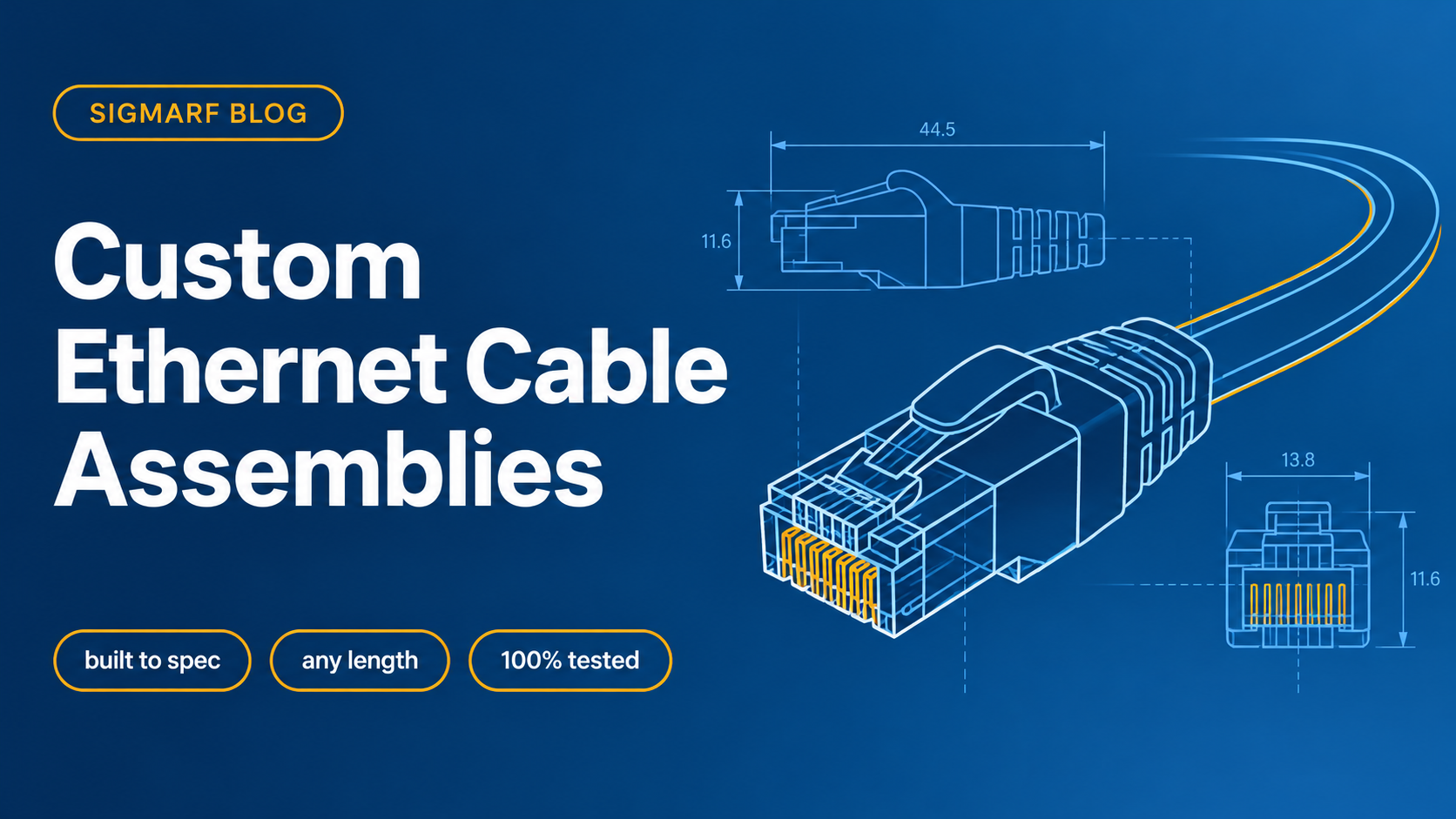
A custom Ethernet cable assembly is a network cable built to a specified length, category, shielding, connector and jacket for one device or installation. Instead of coiling the spare half meter of a stock patch cord inside your enclosure, you order the exact cable the design needs, terminated and tested at the factory.
Picture a benchtop analyzer with four RJ45 ports on the back panel. The stock cords from the IT supplier are 1 m long, but the run to the internal switch is 280 mm. The extra cable gets folded, tie-wrapped and pressed against a switching power supply. It works on the bench, then fails intermittently in the field. That is the kind of problem a custom assembly removes by design.
On This Page
What custom actually means
Three products get confused under the word cable. Bulk cable is unterminated reel stock. A patch cord is a short, factory-terminated flexible cord in a fixed retail length, typically 0.5, 1, 2 or 3 m. A cable assembly is any terminated cable built to a drawing: your length, your category, your shielding, your plugs, your jacket, your label.
When you order a custom assembly, the manufacturer cuts bulk cable to your length, terminates it with the plugs you specify, molds or fits the boots, prints or applies your labels, and tests the finished link. What arrives is a part with a part number, not a consumable.
The five things a custom assembly controls
Every custom Ethernet specification comes down to five decisions. Get these on the drawing and the rest follows.
| Decision | Typical options | What it changes |
|---|---|---|
| Length | 100 mm jumpers to 100 m channels | Fit inside the enclosure, return loss, PoE heating |
| Category | Cat5e, Cat6, Cat6A | Bandwidth headroom and data rate margin |
| Shielding | U/UTP, F/UTP, S/FTP | EMI immunity near motors, drives and RF sources |
| Connector | RJ45 straight or right-angle, shielded plugs, M12 for industrial | Clearance, mating cycles, sealing |
| Jacket | PVC, LSZH, PUR, TPE | Flame and smoke rating, oil resistance, flex life |
The category decision deserves its own guide, and we wrote one: Cat5e vs Cat6 vs Cat6A for equipment designers. Shielding is covered in shielded vs unshielded Ethernet cable.
Signs a stock patch cord is costing you
Stock cords are fine for a desk and for many light-duty builds. Inside a demanding product, they can show up later as warranty calls. The recurring symptoms:
- Coiled slack in the enclosure. Spare length pressed against switch-mode supplies or motor wiring invites EMI onto the link.
- Intermittent links. A plug latched into a tight bend loses contact under vibration; the link renegotiates to 100 Mb or drops.
- Failed EMC tests. Unshielded retail cords radiate or pick up noise the compliance lab will find before your customers do.
- Broken latches and pulled plugs. Cords dressed at sharp angles put side load on the latch and the plug crimp.
- No traceability. When a cord fails in the field there is no part number, test record or batch to investigate.
Who uses custom assemblies
Medical devices. A patient monitor cart needs a 450 mm LSZH cord from the display to the internal computer, with no slack near the isolation barrier and a jacket that survives hospital cleaning agents.
Instrumentation and industrial control. A PLC panel builder orders 200 identical 1.2 m shielded cords, each labeled with the cabinet port code, so commissioning takes hours instead of days.
Test and measurement. A calibration lab wants rack-to-instrument links cut to exact length with serialized test reports filed against each asset.
Communication equipment. An OEM building gateway appliances standardizes on one 300 mm right-angle assembly so the enclosure lid closes without stressing the port.
What to send a manufacturer to get a quote
A quotable request fits in five lines: length with tolerance, category, shielding type, connector and boot style at each end, jacket material and color, plus the quantity and any labeling. A simple drawing or a photo of the routing helps. Our custom Ethernet cable assemblies page lists the full option set, and the custom Ethernet cable manufacturer overview shows how we build and test them.
A drawing your manufacturer can build from
The fastest quotes come from a one-page drawing or a clear table. A complete assembly drawing carries:
- Overall length and tolerance, measured tip to tip, with the measurement method stated.
- Cable construction, category, conductor stranding, shield type and jacket material with color.
- Connector at each end, plug type, shielded or unshielded, boot style and, for right-angle plugs, the exit direction viewed from the latch side.
- Labels, text, position and whether they must survive cleaning or heat.
- Test requirements, from basic wiremap to full category certification, and whether you want per-piece reports.
If you are not sure about a line item, say so on the drawing. A good manufacturer will propose the standard option and flag where the choice matters, which is faster than guessing and revising later.
Common questions
Is a custom Ethernet cable assembly more expensive than a patch cord?
Per piece, usually yes at very small quantities. In production volumes the gap usually narrows, and the total cost comparison should include assembly labor, cable management, EMC retests and field failures. By that measure custom assemblies can come out cheaper, but it depends on your volumes and failure history, so run the numbers rather than assuming either way.
What is the minimum order for a custom assembly?
It depends on the manufacturer. SigmaRF quotes prototypes and small pilot lots as well as production volumes, so you can validate the fit and the test results before committing to a full run.
How long does a custom cable order take?
Simple Cat5e or Cat6 assemblies in standard configurations ship in days. New designs with custom labels, colors or connector combinations take longer on the first order while the drawing and test limits are agreed, then repeat orders move at the same pace as standard parts.
How is a custom assembly tested before shipping?
Every assembly should at minimum pass wiremap and continuity. Better suppliers add channel or patch-cord parameters on a cable analyzer and keep the results. Ask for the test report format with your first samples so you know what evidence you will get per batch.
Can a custom assembly mix categories or connector types at each end?
Yes. A common build is a straight RJ45 plug on the device side and a right-angle or shielded plug on the panel side. Mixed builds are normal in custom work; just specify each end separately on the drawing so nothing is assumed.
Bottom Line
A custom Ethernet cable assembly turns a consumable into a specified, tested component: your length, category, shielding, connectors and jacket, with a part number and test evidence behind it. If stock cords are creating slack, intermittent links or EMC trouble inside your product, that is the point to move.
Need a cable built to your drawing?
Send five lines: length, category, shielding, connectors and jacket, plus quantity. We cut, terminate, label and test every assembly before it ships. For a quote, send those five lines with your target price and annual volume.

Aadeshwar Modi is a marketing technical content writer who loves writing on technology and AI topics.
- RF Transistor Frequency Response and Power Performance
- How Semiconductor Materials Affect RF Device Performance
- RFIC vs MMIC: Terminology, Integration and Selection
- What Is an MMIC? Inside a Monolithic Microwave Circuit
- What Are Microwave Vacuum Tubes and Where Are They Used?
- What Is a MESFET and How Is It Used in RF Circuits?
- What Is a Heterojunction Bipolar Transistor (HBT)?
- GaN vs GaAs RF Technology: Power, Noise and Design Trade-offs
- BJT vs MOSFET vs HEMT: RF Transistor Technologies Explained
- What Are RF Frequency Multipliers and How Do They Work?