Shielded vs Unshielded Ethernet Cable: How to Decide for Your Equipment
Published on 10/25/2026
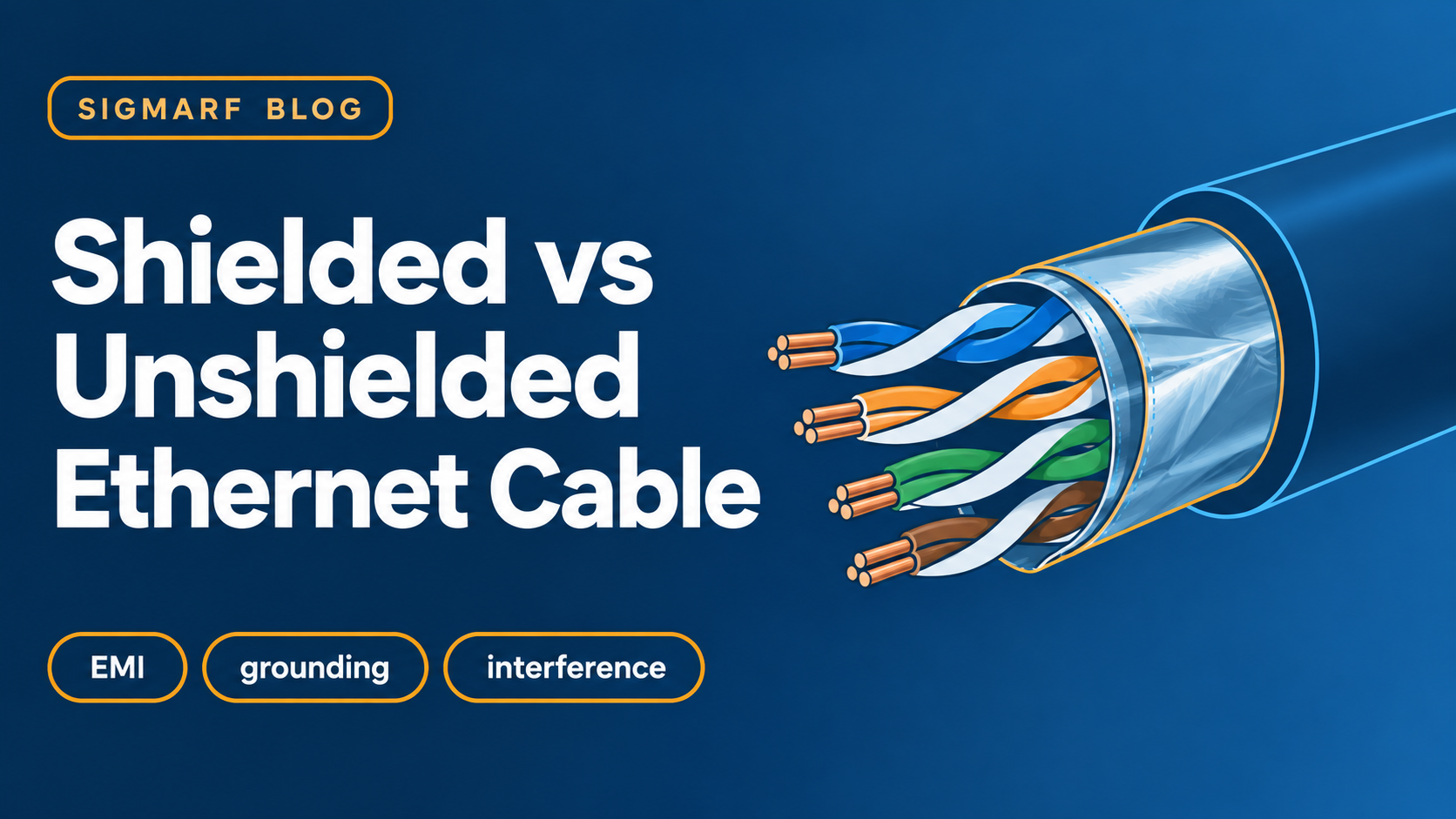
Choose shielded Ethernet cable when the run passes motors, drives, RF sources or medical imaging equipment, or when it carries 10 Gigabit in bundles. Choose unshielded for quiet, short, flexible runs where grounding discipline is not guaranteed. The shield only helps when it is terminated correctly.
This decision shows up in nearly every custom assembly quote we review, and it is usually made by habit: "industrial means shielded", or "unshielded is cheaper, done". Both shortcuts fail. The right answer depends on the EMI environment, the data rate, and whether the equipment can actually bond the shield. This guide makes the decision systematic.
On This Page
What the shield actually does
Twisted pairs already reject a surprising amount of interference through balance: noise couples equally onto both wires of a pair, and the receiver subtracts it. That mechanism works until the noise gets strong enough or fast enough to unbalance the pair. The shield adds a second line of protection: a conductive barrier that intercepts electric fields and carries interference currents to ground instead of letting them onto the pairs.
Two consequences follow. First, an unterminated shield is not a shield at all; it is an antenna soldered to nothing. The shield must bond to the plug shell with a 360-degree termination, and the jack side must connect that shell to chassis ground. Second, shielding works in both directions: it keeps external noise off your link and keeps your link's emissions inside, which matters for EMC compliance testing. The termination details are covered in our guide to UTP, F/UTP, S/FTP and SF/UTP shielding types, and the same physics applies at RF frequencies, as explained in how cable shielding effectiveness is measured.
The decision table
| Factor | Leans unshielded (U/UTP) | Leans shielded (F/UTP, S/FTP) |
|---|---|---|
| EMI environment | Office-grade, no drives or RF nearby | Motors, VFDs, SMPS, transmitters, imaging |
| Data rate | 1 Gb/s or below | 10GBASE-T, especially in bundles |
| Grounding available | Plastic enclosure, no chassis bond point | Metal chassis with bonded jacks |
| Flexibility needed | Tight routing, frequent handling | Fixed runs, gentle bends |
| EMC test margin | Pre-compliance already passing | Radiated emissions or immunity failures |
| Cost priority | Every cent per assembly counts | Field reliability dominates |
Common EMI sources around equipment
The suspects are the same in nearly every enclosure and plant floor:
- Motors and variable frequency drives. The fast switching edges in a VFD output radiate broadband noise; cables routed in the same tray as motor leads are the classic victim.
- Switch-mode power supplies. Compact SMPS modules switch at tens to hundreds of kHz with harmonics into the MHz range, exactly where Ethernet signalling lives.
- RF transmitters. Wireless modules, RFID readers and nearby radios couple directly onto unshielded pairs.
- Imaging magnets and coils. MRI and similar equipment creates both intense static fields and fast gradient switching; anything conductive nearby needs careful shielding and grounding.
- Relays, contactors and solenoids. The arc at a switching contact is a small broadband transmitter firing every cycle.
Symptoms on the link are distinctive: rising CRC or frame-error counters, links that renegotiate from 1G to 100 Mb, or drops that correlate with a motor starting. When the error counter moves in step with a machine cycle, you have found your coupling path.
The hidden cost of shielded cable
Shielded cable costs more per meter, but the cable is the cheap part. The real cost is discipline. Shielded runs need shielded plugs, shielded jacks, and a chassis bond at the equipment side. Every link in that chain that goes plastic breaks the shield for the whole run. Maintenance matters too: a field technician who swaps in a retail unshielded patch cord silently downgrades the link, and nobody notices until the error counters climb.
Shielded cable is also stiffer. Foil and braid shields raise the minimum bend radius and make tight routing behind panels harder. In a cramped enclosure with gentle EMI, forcing shielded cable can create the mechanical failures, crushed jackets and broken latches, that you were trying to avoid electrically.
What we recommend per market
Medical devices. Shielded by default. The EMC limits in IEC 60601-1-2 are tight, cables route near isolation barriers and imaging electronics, and the cost of a failed EMC run dwarfs the cable premium. F/UTP Cat6 or Cat6A with LSZH jackets is the common build.
Industrial control. Shielded anywhere drives or contactors share the panel or tray; unshielded is acceptable for sensor runs in quiet zones. When in doubt on a machine with VFDs, shield it and bond it.
Test and measurement. Mixed. Instrument internal links are often unshielded and short; anything crossing between racks or into a noisy DUT fixture goes shielded.
Communication equipment. Mostly unshielded inside well-designed chassis with good plane grounding, shielded for external-facing ports and 10G bundled runs.
Common questions
Do I need shielded Ethernet cable for medical equipment?
In most designs we see, yes. Medical EMC requirements are strict, cables run near sensitive analog front ends and imaging electronics, and shielded cable helps both emissions and immunity margins. The final requirement comes from the device's own EMC design and test plan, and the shield must bond to the device chassis through shielded jacks to work.
Can I mix shielded and unshielded Ethernet cables?
Physically yes; they intermate without damage. But one unshielded segment breaks the shield path for the whole run and becomes the entry point for noise. If a run needs shielding, keep every cord, coupler and jack in that run shielded end to end.
Does shielded cable improve data speed?
Not directly. It preserves margin in noisy environments so the link sustains its rated speed without retransmissions or fallback. A shielded Cat6 cable and an unshielded Cat6 cable have the same rated bandwidth; the shielded one keeps that bandwidth usable next to a motor drive.
What happens if the shield is not grounded?
An ungrounded shield can couple noise onto the pairs instead of draining it, sometimes performing worse than unshielded cable. At minimum the shield must connect to chassis ground at one end through the plug shell and a bonded jack; within one enclosure, bonding both ends is normal practice.
Is foil or braid shielding better for Ethernet?
Foil covers 100 percent of the pair surface and blocks high-frequency electric fields well, but it is fragile under flexing. Braid is tougher and better at low frequencies but has small apertures. F/UTP suits fixed runs; S/FTP, braid over foil-wrapped pairs, suits cables that move. The braid and foil combination guide explains the same trade-off for coax.
Bottom Line
Shielding is a system, not a cable feature: shielded cable, shielded plugs, bonded jacks and grounded chassis, all or nothing. Specify it where EMI or 10G bundling demands it, skip it where quiet short runs and tight bends argue against it, and write the construction (U/UTP, F/UTP or S/FTP) explicitly on your assembly drawing. If you inherit a design with unexplained link errors, check the error counters against machine cycles first, then audit the shield path end to end before replacing hardware.
EMI trouble on your links?
Describe the environment, drives, supplies, imaging equipment, and the data rate, and we will recommend the shielding construction and build the assemblies with proper 360-degree shield termination.

Aadeshwar Modi is a marketing technical content writer who loves writing on technology and AI topics.
- RF Transistor Frequency Response and Power Performance
- How Semiconductor Materials Affect RF Device Performance
- RFIC vs MMIC: Terminology, Integration and Selection
- What Is an MMIC? Inside a Monolithic Microwave Circuit
- What Are Microwave Vacuum Tubes and Where Are They Used?
- What Is a MESFET and How Is It Used in RF Circuits?
- What Is a Heterojunction Bipolar Transistor (HBT)?
- GaN vs GaAs RF Technology: Power, Noise and Design Trade-offs
- BJT vs MOSFET vs HEMT: RF Transistor Technologies Explained
- What Are RF Frequency Multipliers and How Do They Work?