UTP, F/UTP, S/FTP and SF/UTP: Ethernet Shielding Types Decoded
Published on 10/25/2026
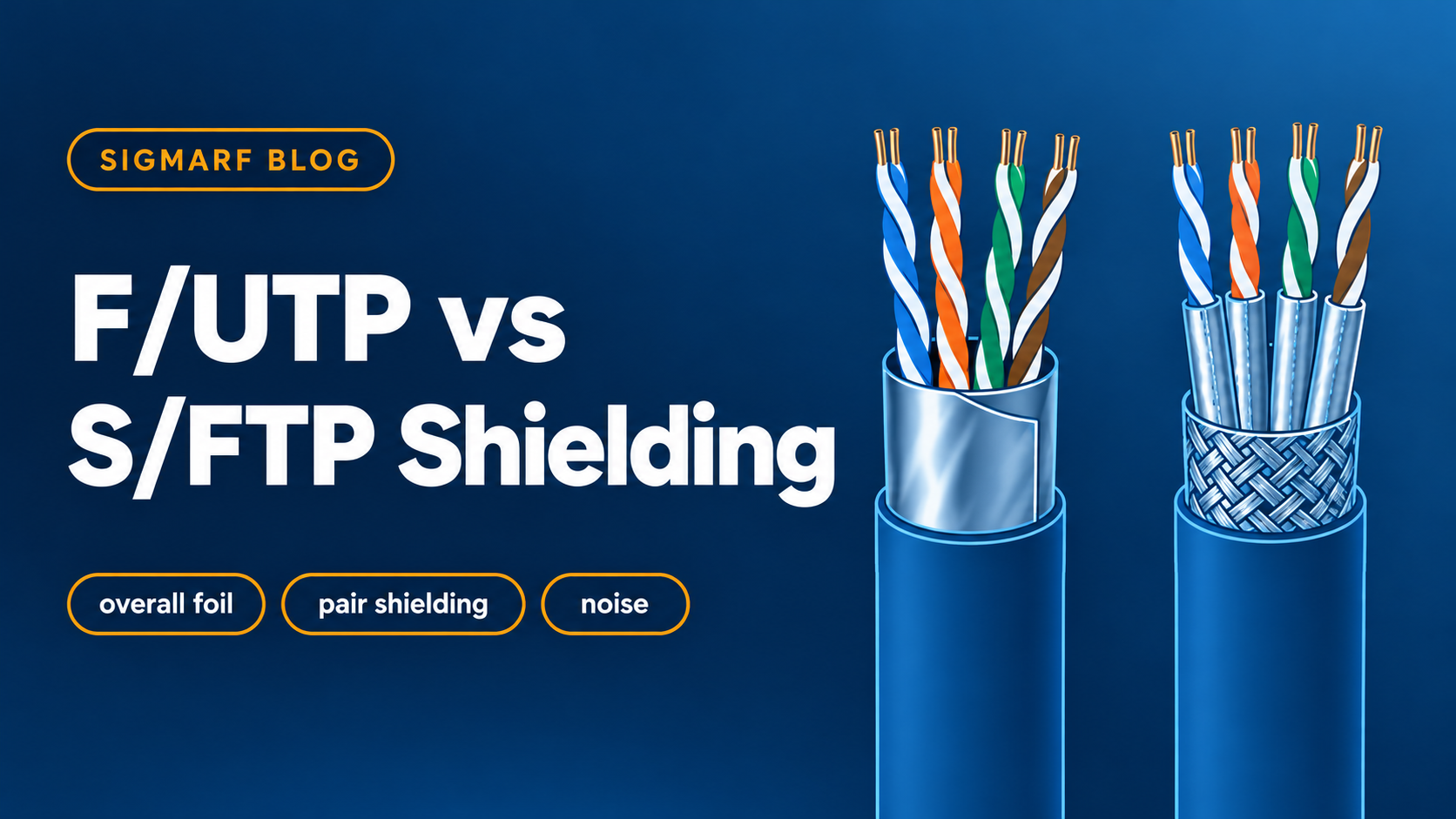
In the X/YTP naming convention, the letter before the slash is the overall shield and the letter after it is the per-pair shield: F/UTP has one foil around everything, S/FTP has a braid overall plus foil on each pair. U means unshielded, F means foil, S means braid. Once you can read the code, the datasheets stop being alphabet soup.
Buyers regularly order "SFTP cable" expecting one thing and receive another, because marketing names drift while the ISO/IEC 11801 notation stays exact. This guide decodes the notation, shows what each construction actually contains, and gives the trade-offs that matter when you specify a custom assembly.
On This Page
How to read X/YTP notation
The notation comes from ISO/IEC 11801, the international cabling standard. It has the form XX/YTP, though the leading U is often dropped in casual writing. The part before the slash describes the screen around the whole cable core; the part after the slash describes the screen around each twisted pair. TP simply means twisted pairs.
Three letters do all the work. U is unshielded: nothing but plastic and twists. F is foil: a thin aluminum-polyester tape wrapped around the target, usually with a drain wire for termination. S is a braid: woven tinned-copper wires forming a tough, flexible screen. Combinations stack, so SF means braid over foil.
Older terms map onto this loosely: UTP is U/UTP, FTP is F/UTP, STP historically meant a braid-shielded cable, and SFTP is SF/UTP or sometimes S/FTP depending on who wrote the label. When a supplier writes only "STP" or "SFTP", ask for the ISO notation before you approve the drawing.
The four constructions you will actually meet
U/UTP. Four twisted pairs in a jacket, no shield at all. The pair twists alone reject interference through balance. Lightest, cheapest, most flexible, and the right answer for quiet environments. Most Cat5e and plenty of Cat6 patch cords are U/UTP.
F/UTP. One foil tape around all four pairs, with a drain wire, under the jacket. The foil covers 100 percent of the surface and is excellent against high-frequency electric fields, but it tears if flexed hard or bent below radius. F/UTP is the workhorse for fixed installations and the most common shielded construction in equipment assemblies.
U/FTP. No overall screen, but each pair gets its own foil wrap. Pair-to-pair (alien) crosstalk is very well controlled, which is why some unshielded-looking Cat6A cables are actually U/FTP inside. Flex life is better than F/UTP because the foils move with each pair.
S/FTP. Foil on each pair plus a braid overall. The belt-and-suspenders construction: pair foils kill alien crosstalk, the braid adds low-frequency shielding, mechanical strength and an easy, robust termination into the plug shell. This is the default for high-flex or high-EMI Cat6A assemblies, at the highest cost and stiffness of the four.
You may also see SF/UTP, braid over a single overall foil with unshielded pairs. It shields the bundle well but does nothing for pair-to-pair coupling, so it is less common in Cat6A work.
Performance and flexibility trade-offs
| Construction | External EMI immunity | Alien crosstalk control | Flex life | Relative cost |
|---|---|---|---|---|
| U/UTP | Lowest; relies on pair balance | Moderate; needs spacing in bundles | Best | 1.0 (baseline) |
| F/UTP | Good, especially high frequency | Good between cables | Fair; foil cracks under tight repeated bends | About 1.2 to 1.5 |
| U/FTP | Good at pair level; no overall barrier | Very good | Good | About 1.4 to 1.8 |
| S/FTP | Best across the band | Excellent | Good; braid tolerates flexing, foils are protected | About 1.8 to 2.5 |
One non-obvious row in that table: shielded does not automatically mean worse flex life. S/FTP tolerates movement well because the braid carries the mechanical load and the pair foils are stranded-friendly. The construction that hates movement is F/UTP, where one torn foil quietly deletes your shielding. The same foil-versus-braid physics governs coaxial cable, covered in our braid and foil shielding guide.
Which construction we use by default and why
For medical and instrumentation assemblies with fixed routing, F/UTP Cat6 or Cat6A: full coverage, thin, economical, and the EMI profile fits those environments. For industrial equipment where cables flex, share trays with motor leads, or get handled at every service visit, S/FTP: the braid survives the abuse that kills foil. For quiet, short internal links, honest U/UTP, because paying for a shield you cannot ground is worse than not buying one, a point we expand in shielded vs unshielded Ethernet cable.
Whatever you choose, write the ISO notation on the drawing, not a marketing abbreviation, and name the plug to match. A shielded construction needs a shielded plug with the screen bonded 360 degrees to the shell; pair foils and drain wires each terminate differently, and your manufacturer should state the method.
Common questions
What is the difference between F/UTP and S/FTP?
F/UTP has a single foil screen around all four pairs. S/FTP adds foil around each individual pair plus a braid screen overall. S/FTP controls pair-to-pair alien crosstalk far better and survives flexing, while F/UTP is thinner and cheaper for fixed runs.
Is SFTP the same as S/FTP?
Not reliably. Vendors use "SFTP" loosely for both SF/UTP (braid plus one overall foil) and S/FTP (braid plus per-pair foils). The constructions differ in alien crosstalk performance. Always ask for the ISO/IEC 11801 notation so the drawing says exactly which screens exist.
Does the drain wire carry the shield connection?
The drain wire makes the foil easy to terminate, but a pigtail drain connection is inductive and leaks at high frequency. Good assemblies bond the foil and drain to the plug shell over the full 360 degrees of the screen. Ask how the termination is done, not just whether a drain wire exists.
Which shielding type do I need for Cat6A?
For custom assemblies, F/UTP or S/FTP are the practical choices because they control alien crosstalk without the fat, stiff cable of unshielded Cat6A. Choose F/UTP for fixed runs and S/FTP where the cable moves or the EMI is severe.
Can shielded and unshielded constructions be mixed in one channel?
They intermate without damage, but the channel's shield continuity ends at the first unshielded segment, and that segment becomes the noise entry point. Mixing U/UTP patch cords into an S/FTP run is a common silent downgrade; keep the construction consistent end to end.
Bottom Line
Read shielding codes as overall-slash-per-pair: U/UTP is bare, F/UTP is one foil, U/FTP is per-pair foils, S/FTP is per-pair foils under a braid. Match the construction to the EMI and the flexing, write the ISO notation on the drawing, and require 360-degree shield termination at the plugs. When two candidate constructions both look right, order samples of each and test them in the real chassis; the difference between foil and braid is often mechanical, not electrical, and your enclosure will tell you which one fits.
Need a specific shielding construction?
We build U/UTP, F/UTP and S/FTP assemblies in Cat5e, Cat6 and Cat6A with properly terminated shields and per-piece test reports. Tell us the environment and we will recommend the construction.

Ed is a Sourcing & Marketing Expert at SigmaRF, writes content related to Technology and Engineering topics
- RF Transistor Frequency Response and Power Performance
- How Semiconductor Materials Affect RF Device Performance
- RFIC vs MMIC: Terminology, Integration and Selection
- What Is an MMIC? Inside a Monolithic Microwave Circuit
- What Are Microwave Vacuum Tubes and Where Are They Used?
- What Is a MESFET and How Is It Used in RF Circuits?
- What Is a Heterojunction Bipolar Transistor (HBT)?
- GaN vs GaAs RF Technology: Power, Noise and Design Trade-offs
- BJT vs MOSFET vs HEMT: RF Transistor Technologies Explained
- What Are RF Frequency Multipliers and How Do They Work?