PVC vs LSZH vs PUR vs TPE Ethernet Jackets: Choosing by Environment
Published on 10/25/2026
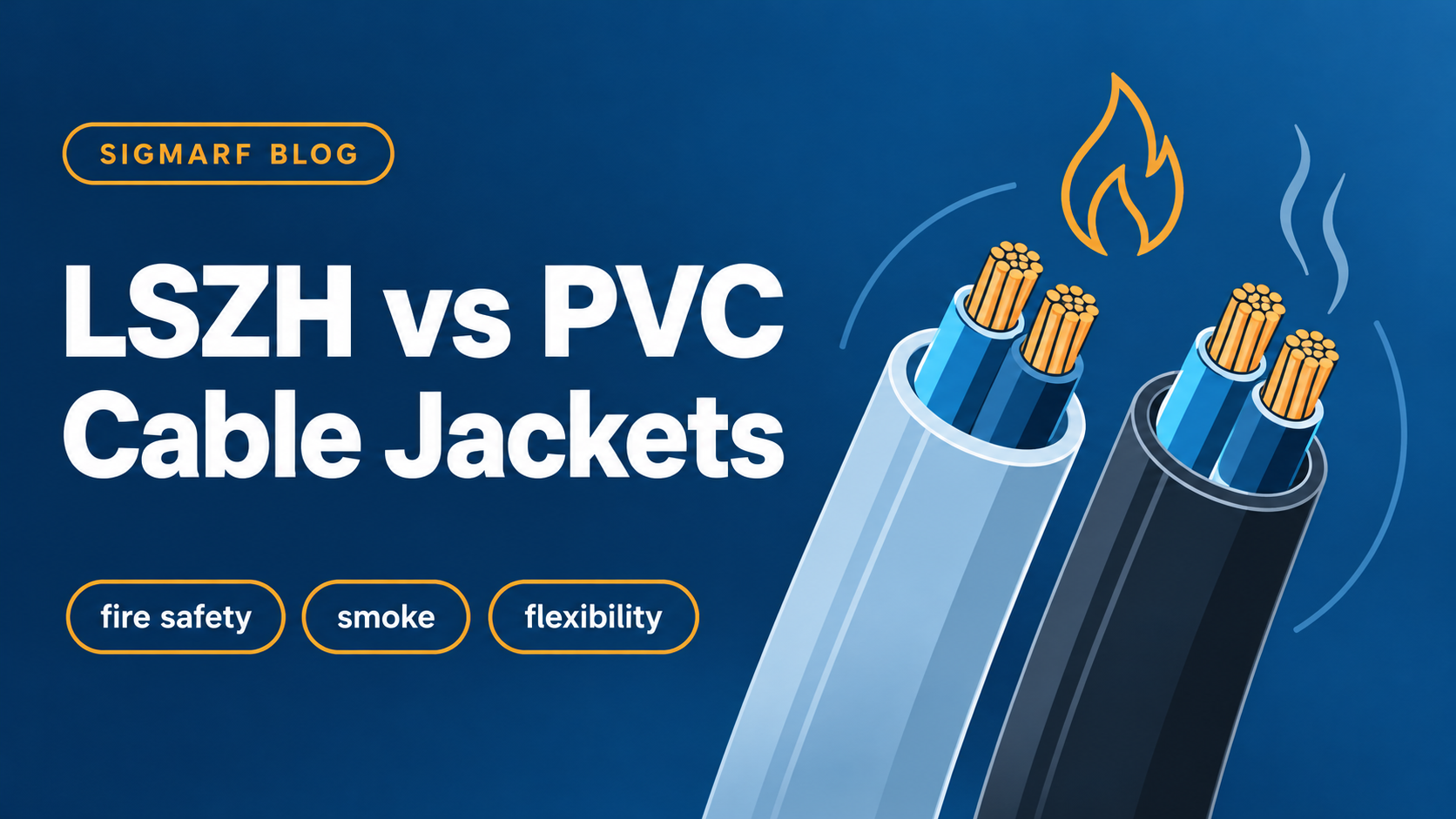
PVC is the economical default jacket, LSZH limits smoke and halogen gas in enclosed or occupied spaces, and PUR or TPE resist oil, abrasion and continuous flexing. The jacket does not change the data rate; it decides where the cable survives and what it emits when it burns.
Jacket material is the least glamorous line on an assembly drawing and the one most often copied from the last project without thought. Then the cable cracks in a freezer-rated enclosure, or a compliance reviewer asks why a hospital product ships with PVC, or a robot cell eats through a jacket in three months. A five-minute decision at the drawing stage prevents all three.
On This Page
The four jackets compared
| Property | PVC | LSZH | PUR | TPE |
|---|---|---|---|---|
| Fire behavior | Burns with dense smoke and corrosive halogen gas | Low smoke, no halogen acid gas | Flame-retardant grades available | Flame-retardant grades available |
| Flexibility | Good when new, stiffens with age and cold | Moderate; slightly stiffer than PVC | Excellent, stays flexible in cold | Excellent, rubber-like |
| Oil and chemical resistance | Poor to fair | Fair | Excellent | Good to very good |
| Abrasion and cut-through | Fair | Fair | Excellent | Very good |
| Typical temperature range | About -20 to +75 C | About -20 to +75 C | About -40 to +80 C and wider | About -40 to +105 C |
| Relative cost | 1.0 (baseline) | About 1.2 to 1.5 | About 1.8 to 2.5 | About 1.5 to 2.2 |
The regulatory drivers: LSZH, CM, CMR, CMP
When PVC burns it releases hydrogen chloride, a corrosive halogen acid gas that damages electronics and is dangerous to breathe, plus dense smoke that obscures escape routes. Low Smoke Zero Halogen (LSZH) compounds replace the PVC chemistry so the cable emits little smoke and no halogen acid in a fire. That is why LSZH is specified in enclosed public spaces, transport, tunnels, ships and, increasingly, in medical devices and their carts, where the cable sits inside a product used around patients. For the medical side, see our guide to Ethernet cables in medical devices.
North American building wiring adds its own ladder of flame ratings: CM (general communications), CMR (riser, vertical runs between floors) and CMP (plenum, air-handling spaces, the strictest). These ratings belong to installed building cable, not to assemblies inside equipment, but buyers conflate them. If your product ships into North American installations where the cord runs through a plenum space, say so on the drawing; the jacket and its listing change.
PUR and TPE for flex, oil and abrasion
Polyurethane (PUR) is the industrial default for a reason: it shrugs off cutting fluids, hydraulic oil and abrasion against cable-carrier tracks, and it stays flexible at freezer temperatures where PVC turns brittle. Thermoplastic elastomer (TPE) behaves like a rubber that can be extruded: very flexible, wide temperature range, and the usual choice for high-flex and outdoor-rated cords.
The pairing rule is simple: if the cable moves, drags, or lives near oil, PVC and LSZH are usually the wrong material family, however good their fire numbers look. Jacket wear is mechanical, and the first symptom is not a burned cable, it is a cracked one with the shield showing. The cable construction underneath still matters, so pair jacket choice with the stranding and shielding from our industrial Ethernet assemblies guide.
Choosing by environment
Office-grade electronics, benign enclosures: PVC. It is cheap, flexible enough, and available in every color for coding.
Medical devices, public enclosures, transport: LSZH. The fire chemistry is the deciding factor, and it doubles as a marketing-safe answer when the compliance team reviews the bill of material.
Machine tools, robot cells, food and packaging lines: PUR. Oil, coolant, abrasion and repeated motion all point the same way.
Cold storage, outdoor cabinets, high-flex motion: TPE, with PUR as the alternative when abrasion dominates over temperature range.
Colors, printing and identification
The jacket is also your labeling surface. Color coding by function (red for critical links, yellow for PoE, blue for data) survives longer than any adhesive label, and jacket printing with the part number and length turns every cord into a traceable component. In service photos, a printed jacket tells you what you are looking at without unhooking anything.
When the standard color range is not enough, combine a neutral jacket with colored molded boots at each end. You get the visual coding without a custom extrusion run, and the boots add strain relief at the same time.
Common questions
What does LSZH stand for and when is it required?
Low Smoke Zero Halogen. It is required where a fire in an enclosed or occupied space must not produce toxic halogen gas or vision-obscuring smoke: transport, tunnels, ships, public buildings, and increasingly medical products. It is a fire-safety material choice, not an electrical one.
What jacket material is best for cleanable medical cables?
LSZH and PUR both tolerate repeated wipe-downs better than standard PVC, but the cleaning agent matters more than the family name. Alcohol wipes are gentle; bleach and quaternary ammonium cleaners attack some compounds. Send us the hospital's cleaning protocol and we will match and sample the jacket against it.
Can I get custom colors in any jacket material?
PVC offers the widest stock color range; LSZH, PUR and TPE come in fewer standard colors, with custom colors possible at volume. For port coding, colored boots and labels on a standard jacket often achieve the same result without a custom extrusion minimum.
Does the jacket affect Cat6A performance?
Not the rated bandwidth: category performance comes from the pairs, twists and shields. The jacket affects the environment the cable survives, the minimum bend radius and the outer diameter. A Cat6A core in a PUR jacket is still Cat6A, just tougher and slightly thicker.
Is plenum-rated cable required inside equipment enclosures?
No. CMP and the CM/CMR ladder apply to cable installed in building spaces, not to assemblies inside a product. Inside equipment, the product's own flammability and safety standard governs. If your cord also routes through building air-handling space, that is when plenum listing enters the drawing.
Bottom Line
Match the jacket to the failure mode you actually face: fire chemistry (LSZH), oil and abrasion (PUR), cold and flex (TPE), or cost (PVC). Write the material and color on the drawing, state any cleaning agents or flame listings, and the cable will outlive the product instead of becoming its first warranty claim. When in doubt, order samples in two candidate jackets and abuse them the way your customers will: flex them cold, wipe them with the site cleaner, and drag them across the panel edge. A week of honest abuse beats a year of datasheet comparison. Once the jacket is chosen, keep it fixed in the controlled drawing so the qualified material is the one that ships. A jacket change is a material change, and in regulated products it can invalidate cleaning validation and flammability evidence you already paid for.
Not sure which jacket your environment needs?
Tell us the temperature range, chemicals, motion and fire requirements, and we will recommend the jacket and build sample assemblies for your qualification testing.

Aadeshwar Modi is a marketing technical content writer who loves writing on technology and AI topics.
- RF Transistor Frequency Response and Power Performance
- How Semiconductor Materials Affect RF Device Performance
- RFIC vs MMIC: Terminology, Integration and Selection
- What Is an MMIC? Inside a Monolithic Microwave Circuit
- What Are Microwave Vacuum Tubes and Where Are They Used?
- What Is a MESFET and How Is It Used in RF Circuits?
- What Is a Heterojunction Bipolar Transistor (HBT)?
- GaN vs GaAs RF Technology: Power, Noise and Design Trade-offs
- BJT vs MOSFET vs HEMT: RF Transistor Technologies Explained
- What Are RF Frequency Multipliers and How Do They Work?