Ethernet Cables in Medical Devices: EMC, Patient Safety and IEC 60601-1 Considerations
Published on 10/25/2026
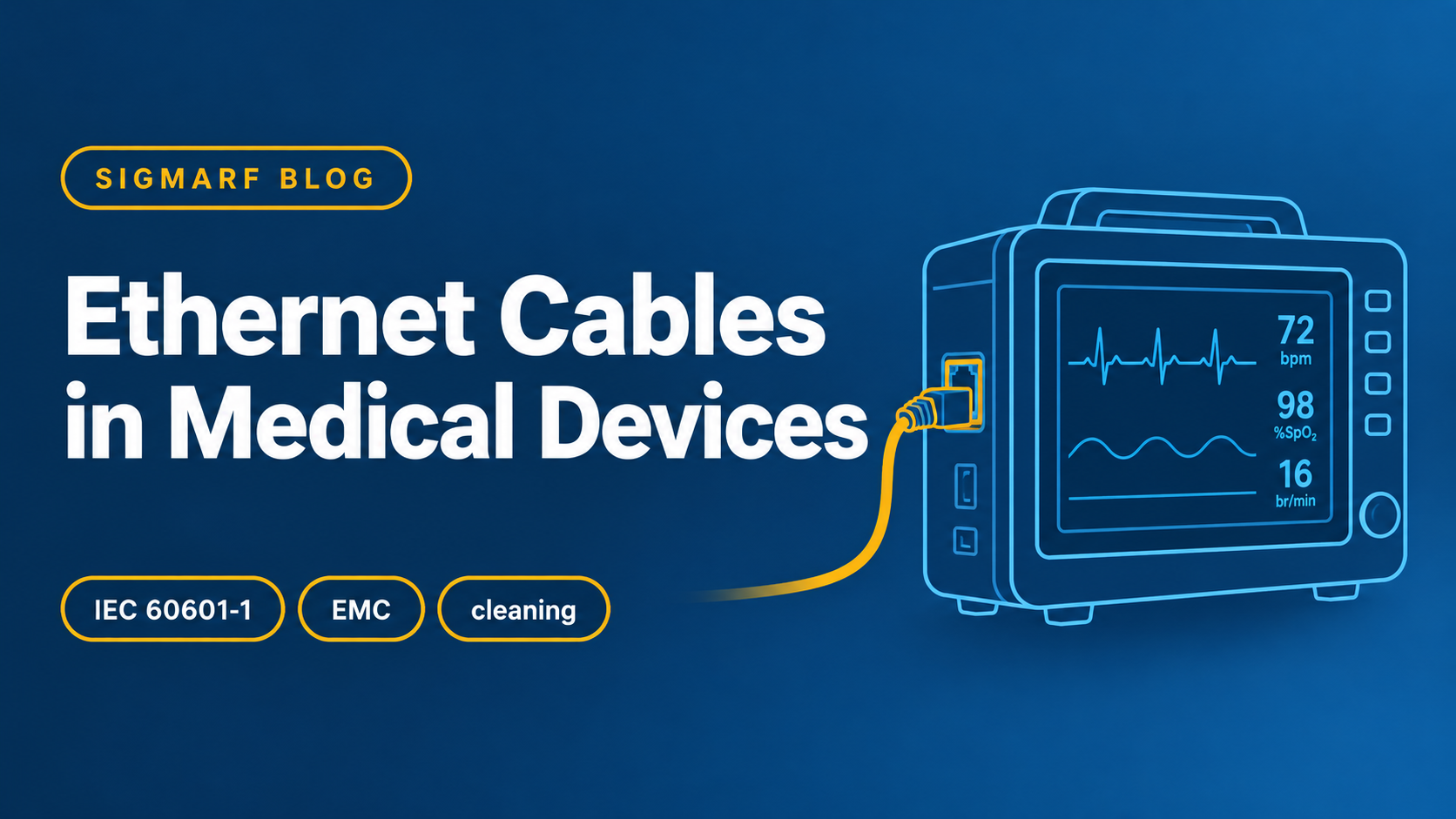
Medical device Ethernet cables are not certified under IEC 60601-1 on their own; the device is. The cable contributes through shielding, jacket choice and consistent construction that support the device's EMC and safety testing. IEC 60601-1 certifies medical electrical equipment, not the cables inside it, so treat any "60601-certified cable" claim with skepticism.
That distinction matters because buyers can waste weeks searching for a 60601-1 certificate for a cable, which the standard does not provide, while the questions that actually pass audits go unasked. This guide covers what IEC 60601-1 and its EMC collateral standard really say about data ports, where the cable genuinely helps, and the documentation a device manufacturer should demand from a cable supplier.
On This Page
What 60601-1 actually says about data ports
IEC 60601-1 is the basic safety standard for medical electrical equipment. Its scope is the device, not the components inside it. Cables can and do carry other certifications and listings, for example UL 758 Appliance Wiring Material listings and RoHS/REACH declarations, but none of those is a 60601-1 approval and none transfers the device's obligations to the cable. The parts that touch your cabling decision are the leakage-current limits and the insulation requirements at accessible interfaces. A network port on a medical device is treated as a possible path to the patient and the operator, so the device design must control how much current can flow through it under normal and single-fault conditions.
That control lives in the device: isolation barriers, medical-grade power supplies, and sometimes network isolators rated for the required means of protection (MOP). The cable cannot provide patient isolation, so be skeptical of any datasheet that implies it does. What the cable must do is behave predictably so the device's isolation strategy works: consistent construction, no surprise ground paths, and shielding that terminates where the designer intended.
EMC: where shielding earns its keep
The collateral standard IEC 60601-1-2 sets the electromagnetic emissions and immunity limits for medical devices, and the fourth edition raised immunity test levels significantly for professional and home healthcare environments. Cable assemblies sit on both sides of that test. As emitters, unshielded data cables are efficient antennas for the high-speed edges inside the device. As victims, they carry noise straight onto the PHY of a monitor or infusion system.
Shielded assemblies, F/UTP or S/FTP with 360-degree shield termination into a metal-shell plug, are our recommendation for most medical builds, though the device's EMC design and its 60601-1-2 test plan make the final call. They buy margin on radiated emissions and immunity in one decision. The termination quality decides whether the shield helps or just adds cost; the physics is the same as in any shielded link, covered in our shielded vs unshielded guide and the shielding types explainer.
Jacket, cleanability and LSZH
Hospital cables get wiped down constantly, and the cleaning agents are aggressive: alcohol, bleach solutions, quaternary ammonium compounds. Standard PVC jackets harden, craze and crack under some of these regimes. LSZH is a common specification for fire-chemistry reasons, low smoke and no halogen acid gas around patients. Specific LSZH or PUR compounds can tolerate repeated disinfection, but chemical resistance varies by compound and cleaning agent, so the jacket must be validated against the actual protocol. The jacket materials guide compares the families; for a medical build, send the actual cleaning protocol with the RFQ so the jacket can be sampled against it.
The biocompatibility question
Cables that contact patients fall under biocompatibility expectations, typically assessed against ISO 10993 for skin-contact materials. Most Ethernet assemblies inside medical equipment never touch a patient, so full biocompatibility testing is rarely required, but the question will come up in design review. The practical answer is to declare the jacket material and its composition so your device's biocompatibility assessment can disposition it, rather than claiming a generic "medical grade" that has no standard meaning.
Documentation your supplier must provide
Device manufacturers live and die by their technical file. Your cable supplier should support it with:
- Full material declarations for cable, plugs and boots, including RoHS and REACH status.
- A controlled drawing with revision history, so a supplier change never silently reaches a certified device.
- Per-lot test reports showing each assembly's electrical results against the agreed limits.
- Change notification commitments, so material or process changes reach you before they reach production.
- Lot traceability from shipped assembly back to raw cable batch.
If a supplier cannot produce these five, the cable is the weak document in your technical file, and auditors find weak documents.
Mistakes that show up in audits and EMC labs
- Asking for a "60601-certified cable". IEC 60601-1 has no cable certificate to give, and the request signals to suppliers that the requirement is a label rather than an engineering need. Specify construction, the listings the cable can genuinely hold, and documentation instead.
- Shield terminated as a pigtail. A drain-wire-only shield connection leaks at high frequency and undermines the 60601-1-2 immunity margin you bought the shielded cable for.
- Uncontrolled substitution. A second-source cable with a different jacket compound or shield coverage invalidates your cleaning validation and EMC evidence. Lock the drawing and require change notification.
- Retail patch cords in verification units. If the tested unit ships with a different cord than production, your EMC report describes a product that never ships.
Common questions
Do I need shielded Ethernet cable for medical equipment?
In practice, yes. The immunity limits in IEC 60601-1-2 are demanding, cables route near sensitive front ends and imaging electronics, and shielded assemblies with properly terminated shields buy both emissions and immunity margin. The device remains responsible for patient isolation; the cable supports the EMC side.
Is there such a thing as a medical-grade Ethernet cable?
Not as a formal certification. "Medical grade" on a cable datasheet is a marketing label. What exists are cables with LSZH or cleanable jackets, shielded constructions, material declarations and lot documentation that fit medical device requirements. Judge the evidence, not the label.
Does the Ethernet port on a medical device need an isolator?
That is a device design decision under 60601-1's means-of-protection framework, not a cable property. Where the device's analysis calls for isolation at the network interface, a rated medical network isolator provides it in the signal path. The cable assembly must simply not undermine the isolation with unintended shield or ground paths.
What category should medical device cabling use?
Most devices need only Gigabit, which Cat5e or Cat6 covers; imaging and high-data devices justify Cat6A. In medical builds the shielding and jacket decisions usually matter more than the category. See Cat5e vs Cat6 vs Cat6A for the bandwidth side.
Can the same assembly design serve medical and non-medical products?
Yes, and it often makes sense: a shielded LSZH assembly with full documentation is simply a good assembly. Standardizing one controlled design across product lines simplifies purchasing and keeps the documentation package identical everywhere it is used.
Bottom Line
There is no 60601-certified cable, only well-built assemblies with the right shielding, jacket and paperwork to support your device's 60601-1 and 60601-1-2 evidence. Specify construction precisely, demand material declarations and per-lot test reports, and your cabling stops being an audit risk. The device earns the certification; the cable earns its place in the technical file. Treat every assembly as a controlled component from the first prototype, and the production units will match the units your test lab passed, shipment after shipment.
Building a medical device?
We supply shielded, LSZH-jacketed Ethernet assemblies with material declarations, controlled drawings and per-lot test reports built for technical files. Send your construction and documentation requirements for a quote.

Ed is a Sourcing & Marketing Expert at SigmaRF, writes content related to Technology and Engineering topics
- RF Transistor Frequency Response and Power Performance
- How Semiconductor Materials Affect RF Device Performance
- RFIC vs MMIC: Terminology, Integration and Selection
- What Is an MMIC? Inside a Monolithic Microwave Circuit
- What Are Microwave Vacuum Tubes and Where Are They Used?
- What Is a MESFET and How Is It Used in RF Circuits?
- What Is a Heterojunction Bipolar Transistor (HBT)?
- GaN vs GaAs RF Technology: Power, Noise and Design Trade-offs
- BJT vs MOSFET vs HEMT: RF Transistor Technologies Explained
- What Are RF Frequency Multipliers and How Do They Work?