MCX vs MMCX vs SMB vs SMC: Small Snap-On Connectors Compared
Published on 11/1/2026 • Updated on 11/1/2026
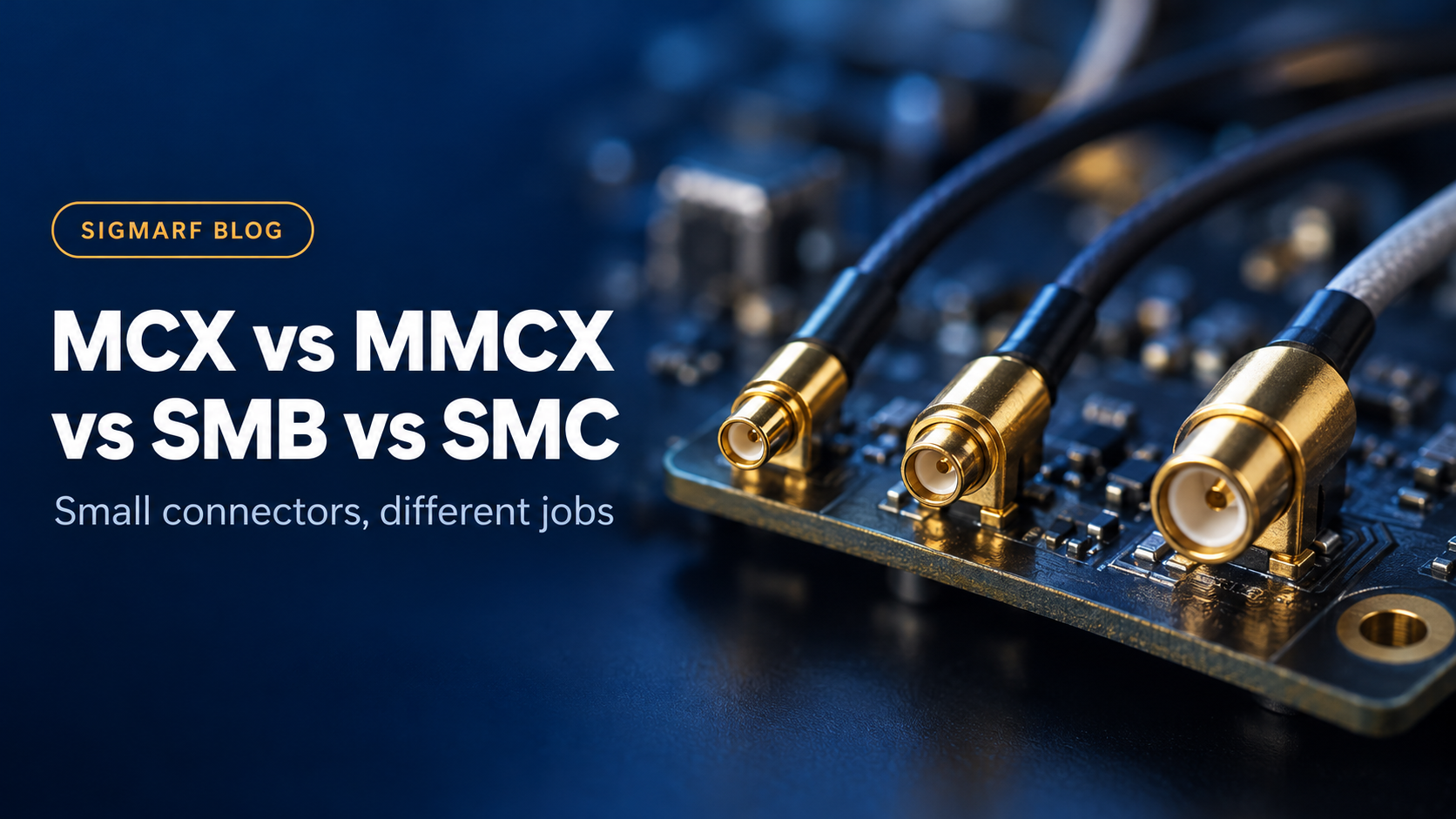
Four small connectors get confused constantly because they all terminate the same little coax and all end in the letter X or B: MCX, MMCX, SMB and SMC. Three of them snap together, one screws together, and their sizes, frequencies and retention behavior are genuinely different. Picking the wrong one is how a vibration-prone product ships with a snap-on connector that walks itself apart.
Short answer: SMB is the 4 GHz snap-fit workhorse in 50 and 75 ohm; SMC is its threaded sibling that reaches 10 GHz and stays put under vibration. MCX shrinks the snap-on idea to 6 GHz for compact devices, and MMCX shrinks it again for boards where every millimeter is spoken for. All four typically rate 500 mating cycles.
On This Page
MCX vs MMCX vs SMB vs SMC at a glance
| Property | SMB | SMC | MCX | MMCX |
|---|---|---|---|---|
| Coupling | Snap-fit | Threaded (#10-32 UNF) | Snap-on | Snap-on |
| Impedance | 50 and 75 ohm | 50 ohm | 50 ohm | 50 ohm |
| Frequency range | DC to 4 GHz | DC to 10 GHz | DC to 6 GHz | DC to 6 GHz |
| Relative size | Largest of the four | Like SMB plus threads | about 30% smaller than SMB | Smallest of the four |
| Mating cycles | 500 | 500 | 500 | 500 |
| Vibration behavior | Can unseat | Holds | Moderate | Weakest retention |
| Typical role | Board interconnect, telecom | Vibration-prone microwave links | Compact modules, GPS | Tiny boards, antenna pigtails |
Ratings above come from published interface datasheets (TE, Amphenol/Connex class parts); individual parts vary, so confirm the drawing. For deeper dives, the site already has an MCX vs SMB guide and an MMCX applications guide; this article is the four-way map.
SMB and SMC: the subminiature pair
SMB and SMC share a subminiature interface geometry - the name literally means subminiature version B and version C. The SMB snaps on with a spring-finger outer contact: fast to mate, easy to blind-pop in a chassis, and the first thing to loosen under sustained vibration. The SMC keeps the same size class but closes with a #10-32 UNF threaded nut, which both holds under vibration and keeps the interface stable enough to be specified to 10 GHz, well past the snap-fit version.
Both are cheaper than SMA at similar electrical performance below 4 GHz, which is why SMB lingers in telecom and test equipment internals and SMC survives in older microwave line-replaceable units. The 75 ohm SMB variant serves video and data-carrier applications; check impedance before mating, since the shells give no hint.
MCX and MMCX: the micro pair
MCX takes the snap-on concept down roughly 30% from SMB, with a 6 GHz ceiling and 50 ohm impedance. It became the default external antenna connector on compact radios, GPS receivers and SDR peripherals: big enough to terminate by hand, small enough for a handheld. MMCX goes one step smaller - micro-miniature - for board-level antenna pigtails and module interconnects where the connector lives its whole life mated and the tool for removal is fingernails or the official extraction tool.
Key idea: The smaller the snap-on, the less it likes side load. MCX and MMCX retention depends on tiny spring fingers; a cable that pulls sideways on the connector unseats it long before the rated pull force. Strain-relieve the cable, not the connector.
Which one for which design
| Design need | Best choice | Why |
|---|---|---|
| Dense internal interconnect below 4 GHz | SMB | Cheap, fast mating, 50 and 75 ohm options |
| Vibration environment below 10 GHz | SMC | Threaded retention in subminiature size |
| Compact external antenna port | MCX | Hand-matable, 6 GHz, common on small radios |
| Board-level pigtail, mated for life | MMCX | Smallest footprint, lowest height |
| Frequent mate and unmate by users | None - step up to SMA | Snap-ons wear and walk; threads win for users |
Cables and termination
All four terminate the small coax families: RG174, RG316 and RG178 class, with RG316 the workhorse for its temperature rating. Connector variants are cable-specific as always - body by dielectric diameter, ferrule by jacket - so the connector-to-cable group chart applies here unchanged. Right-angle PCB jacks are common in all four families; watch the footprint, because snap-on jacks need keep-out room for the mating plug body, not just the board pattern.
Small coax, small connectors, done right
RG174 and RG316 assemblies on MCX, MMCX, SMB and SMC, built to drawing and swept before shipment.
Talk to an EngineerSmall-connector mistakes
Avoid
- ✗Specifying SMB where vibration lives; choose SMC or a threaded interface.
- ✗Assuming MCX and MMCX mate with each other; they are different sizes and do not.
- ✗Letting a stiff RG316 pigtail side-load an MMCX jack until the spring fingers give up.
- ✗Ignoring the 75 ohm SMB variant and mixing it into a 50 ohm chain.
- ✗Exceeding 500 mating cycles on test fixtures and wondering why contact resistance drifts.
- ✗Forgetting that snap-on retention ratings are axial; real cables pull at angles.
MCX, MMCX, SMB, SMC questions
What is the difference between MCX and MMCX?
Size. Both are 50 ohm snap-on connectors rated to 6 GHz and about 500 cycles, but MMCX is roughly two-thirds the MCX footprint, aimed at board pigtails rather than user-facing ports.
SMB vs SMC: which should I use?
Same size class. SMB snaps on and suits calm interiors to 4 GHz; SMC screws on, holds under vibration and is specified to 10 GHz. Vibration is the deciding factor.
Do MCX and SMA mate?
No. Different interface families and sizes. Adapters exist, but every adapter adds loss and length; the adapter loss article puts numbers on that habit.
Why is my GPS antenna lead MMCX or MCX?
Small receivers need small connectors, and the short RG174-class lead keeps the loss of the small cable tolerable. MCX for ports users touch, MMCX for internal pigtails.
Are these connectors weatherproof?
No. None of the four is sealed. Outdoors they need an enclosure or full weatherproofing of the joint, per the site waterproofing guide.
Bottom Line
SMB for cheap snap-fit interiors, SMC when vibration or 10 GHz says threads, MCX for compact ports, MMCX for board pigtails. All four are 500-cycle parts on small coax, none is sealed, and none likes side load. Match the variant to the exact cable, strain-relieve the lead, and get the finished assembly swept.
Get small-connector assemblies built and tested
Custom RG174 and RG316 assemblies with MCX, MMCX, SMB or SMC terminations, VNA-swept before shipment.

Ed is a Sourcing & Marketing Expert at SigmaRF, writes content related to Technology and Engineering topics
- RF Transistor Frequency Response and Power Performance
- How Semiconductor Materials Affect RF Device Performance
- RFIC vs MMIC: Terminology, Integration and Selection
- What Is an MMIC? Inside a Monolithic Microwave Circuit
- What Are Microwave Vacuum Tubes and Where Are They Used?
- What Is a MESFET and How Is It Used in RF Circuits?
- What Is a Heterojunction Bipolar Transistor (HBT)?
- GaN vs GaAs RF Technology: Power, Noise and Design Trade-offs
- BJT vs MOSFET vs HEMT: RF Transistor Technologies Explained
- What Are RF Frequency Multipliers and How Do They Work?