Matching RF Connectors to Coax Cables: The Cable Group Chart
Published on 11/1/2026 • Updated on 11/1/2026
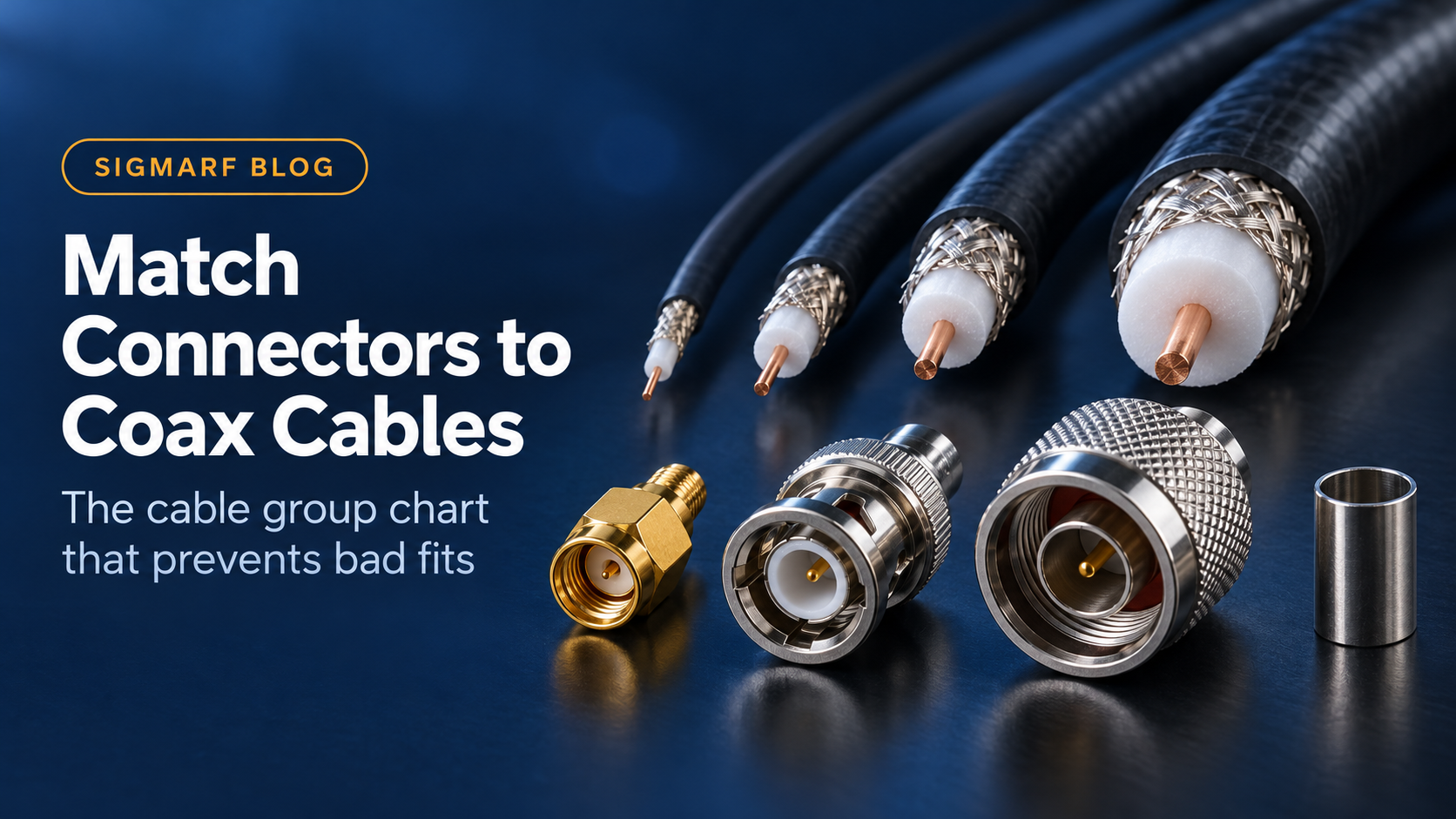
Every failed crimp I have been asked to autopsy started with the same assumption: an SMA is an SMA, so any SMA plug fits any coax. It does not. Connector bodies, ferrules and pins are built around one cable's exact dimensions, and the part number usually says which one. That mapping is the cable group chart, and it is the missing page between picking a connector family and ordering a part.
Short answer: match three dimensions - dielectric diameter, outer jacket diameter and braid construction - then buy the connector variant built for that cable group. The chart below maps the common 50 and 75 ohm cables to the connector families and cable groups they belong to, so a part search starts from the cable, not from the connector photo.
On This Page
Why connectors are cable-specific
A coax connector does three mechanical jobs: it holds the center contact on the center conductor, it captures the braid between the body tail and the ferrule, and it supports the dielectric so the impedance stays constant through the interface. Each job depends on a cable dimension. A ferrule bored for a 4.95 mm jacket slides loosely on a 2.5 mm one; a pin cavity sized for a 2.95 mm dielectric leaves a 1.52 mm dielectric unsupported and creates an impedance step you can measure on a VNA.
This is why connector catalogs list the same plug in five or six cable variants, and why the family name (SMA, BNC, N) tells you the mating face, not the fit. If you are still choosing the family, the connector selection guide and the identification chart are the starting points. This article starts where they stop.
The connector-to-cable group chart
The table maps common cables to their key dimensions and the connector families normally available for them. Dimensions are typical published values; confirm the exact cable part before ordering connectors, because makers vary.
| Cable | Jacket OD | Dielectric OD | Impedance | Connector families commonly available |
|---|---|---|---|---|
| RG178 | 1.85 mm | 0.85 mm | 50 ohm | MMCX, MCX, SMA (micro variants), U.FL pigtails |
| RG174 | 2.8 mm | 1.52 mm | 50 ohm | SMA, SMB, SMC, MCX, MMCX, BNC (micro), TNC |
| RG316 | 2.5 mm | 1.52 mm | 50 ohm | SMA, SMB, SMC, MCX, MMCX, BNC (micro), N (rare) |
| RG58 | 4.95 mm | 2.95 mm | 50 ohm | SMA, BNC, TNC, N, UHF |
| RG142 | 4.95 mm | 2.95 mm | 50 ohm | SMA, BNC, TNC, N (PTFE versions of RG58 group) |
| RG223 | 5.5 mm | 2.95 mm | 50 ohm | SMA, BNC, TNC, N |
| RG59 | 6.15 mm | 3.7 mm | 75 ohm | BNC (75 ohm), F |
| RG6 | about 6.9 mm | 4.6 mm | 75 ohm | F, BNC (75 ohm), compression types |
| RG8 / RG213 | 10.3 mm | 7.25 mm | 50 ohm | N, UHF (PL-259), 7/16 DIN |
| LMR-195 | 4.95 mm | 2.79 mm | 50 ohm | SMA, BNC, TNC, N (foam group, dedicated parts) |
| LMR-240 | 6.10 mm | 3.81 mm | 50 ohm | SMA, BNC, TNC, N |
| LMR-400 | 10.3 mm | 7.24 mm | 50 ohm | N, TNC, SMA (large-body), 7/16 DIN |
Key idea: Same jacket OD does not mean same group. LMR-195 matches RG58 on the outside but its foam dielectric is a different diameter, so it takes its own connector variant. Always check both dimensions.
The three dimensions that decide fit
- Dielectric outer diameter. Decides the pin and body bore. RG174 and RG316 share 1.52 mm, which is why many small-connector bodies serve both cables.
- Jacket outer diameter. Decides the ferrule. This is where RG174 (2.8 mm) and RG316 (2.5 mm) part ways: same body, different ferrule and crimp die.
- Braid construction. Single braid, double braid or foil-plus-braid changes how the ferrule captures the shield. Foam cables like LMR use foil-plus-braid and need connectors designed to bite the tape shield correctly.
Reading cable groups in part numbers
Connector makers encode the cable group in the part number, not in the family name. Typical suffixes map to RG numbers or to vendor group codes (for example, a plug offered in RG58, RG142 and RG400 variants of one body drawing). When a distributor filter offers a "cable group" dropdown, that filter is this chart in disguise. If the listing only says "SMA male crimp," keep digging until you find the cable list on the drawing; the drawing is the authority.
Ferrules and crimp dies
The ferrule is bought with the connector, and the crimp die is chosen from the ferrule, so the cable decides the tooling too. Common pairings from the bench: RG174/RG316 ferrules crimp on a 0.128 inch hex die, RG58 on 0.213 inch, and LMR-400 ferrules on 0.429 inch. The full strip dimensions and die tables are in the SMA crimping guide, the BNC installation guide and the N-type on LMR-400 guide. Termination method is its own decision; see crimp vs solder vs clamp.
Send the cable, get the right connector
Tell us the cable marking or the three dimensions. We will match the connector variant and build the assembly, swept before shipment.
Talk to an EngineerWorked example: SMA plug for RG316
Step 1: dielectric 1.52 mm group - same body as RG174
Step 2: jacket 2.5 mm - ferrule for the 2.5 mm variant, not the 2.8 mm one
Step 3: part filter "SMA plug crimp, RG316/RG174" - confirm drawing lists RG316
Step 4: die = 0.128 in hex, strip per drawing
Step 5: meter, pull test, VNA sweep
Matching mistakes
Avoid
- ✗Shopping by connector photo instead of cable dimensions.
- ✗Assuming RG174 and RG316 take identical parts; bodies often shared, ferrules not.
- ✗Using an RG58 connector on LMR-195 because the jacket diameter matches.
- ✗Crimping a foil-shield foam cable in a connector designed for braid only.
- ✗Mixing 75 ohm cable into a 50 ohm connector body and blaming the mismatch on the crimp.
Connector and cable matching questions
What is a cable group?
The set of cables a connector variant is built to fit, defined by dielectric diameter, jacket diameter and shield construction. Connector catalogs organize crimp and clamp parts by cable group.
Will one SMA plug fit both RG174 and RG316?
The body usually yes, because the dielectric diameter is the same 1.52 mm. The ferrule usually no, because the jackets differ (2.8 vs 2.5 mm). Buy the variant whose drawing lists your cable.
How do I find the connector for an unmarked cable?
Measure jacket OD, strip a sample and measure the dielectric OD, note the shield type, then match those three against the chart. The coax types table helps identify the cable first.
Do LMR cables use standard RG connectors?
No. LMR-195, -240 and -400 have foam dielectrics and foil-plus-braid shields with their own dimensions. Use the connector variants listed for the exact LMR size.
Is a BNC for RG59 the same as for RG58?
No. Same family, different impedance class (75 vs 50 ohm) and different cable dimensions. The parts are not interchangeable even though the shells look alike.
Bottom Line
Start every connector purchase from the cable: jacket OD, dielectric OD, shield type. Use the chart to find the family and cable group, confirm the drawing lists your exact cable, then match the ferrule and die. When the stakes justify it, skip the matching risk entirely and order the assembly built and swept.
Get matched assemblies, built and tested
Standard and custom coaxial assemblies with the correct connector for every cable group, VNA-swept before shipment.

Alankar is a Technical Content Writer at SigmaRF, writes on various topics from Technology, Compliance and Business process
- RF Transistor Frequency Response and Power Performance
- How Semiconductor Materials Affect RF Device Performance
- RFIC vs MMIC: Terminology, Integration and Selection
- What Is an MMIC? Inside a Monolithic Microwave Circuit
- What Are Microwave Vacuum Tubes and Where Are They Used?
- What Is a MESFET and How Is It Used in RF Circuits?
- What Is a Heterojunction Bipolar Transistor (HBT)?
- GaN vs GaAs RF Technology: Power, Noise and Design Trade-offs
- BJT vs MOSFET vs HEMT: RF Transistor Technologies Explained
- What Are RF Frequency Multipliers and How Do They Work?