N-Type Connector Guide: Specs, Weatherproofing and Power Handling
Published on 10/23/2026 • Updated on 10/23/2026
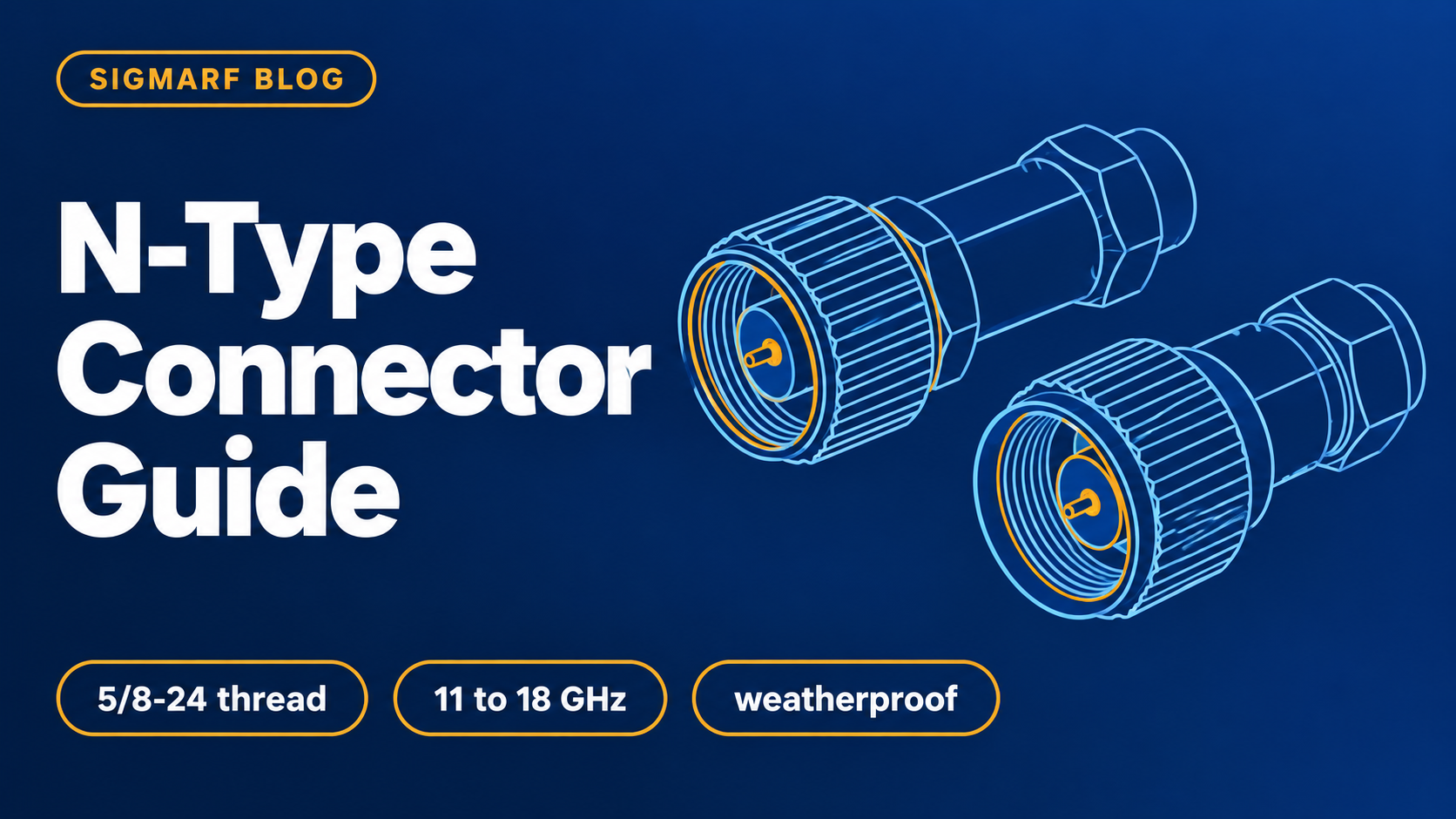
A rooftop antenna goes up in spring, tests perfectly, and by the next monsoon the VSWR is climbing. The crew blames the radio. The real fault is a connector chosen for the bench and installed in the weather, with no sealing and a cable it was never meant to carry.
The N-type is the connector that job needed. It is the standard threaded interface for outdoor antennas, base stations, low-loss feeder cable and medium-power RF. This guide covers the 5/8-24 thread, the real 11 GHz versus 18 GHz story, why the N-type seals and handles power better than SMA, which cables it fits, and how not to confuse it with a UHF connector.
On This Page
What an N-type connector is
The Type N is a 50 ohm threaded coaxial connector, one size up from SMA, with a 5/8-24 UNEF coupling thread. It was one of the first connectors designed to carry microwave frequencies, and it remains the default port on outdoor antennas, surge protectors, duplexers, filters, power amplifiers and feeder-grade coaxial cable. A 75 ohm variant exists with a reduced center contact; it is not intermateable with the 50 ohm version and forcing it damages both. The differences are laid out in N-type 50 ohm vs 75 ohm.
Like SMA, gender follows the center contact: pin is male, socket is female. The N plug carries the coupling nut; the N jack carries the external thread. For placing N among the other common series, use the RF connector identification chart.
N-type specifications that matter
| Property | Typical value | Why it matters |
|---|---|---|
| Impedance | 50 ohm (75 ohm variant exists) | 50 and 75 ohm N connectors are not intermateable |
| Frequency range | DC to 11 GHz standard; precision versions to 18 GHz | Enough for every common land-mobile, Wi-Fi and cellular band |
| Coupling thread | 5/8-24 UNEF | Robust coarse thread, tolerant of field handling |
| Coupling torque | About 1.7 to 2.3 N m (15 to 20 in lbf) | Torque compresses the interface seal and stabilizes RF contact |
| Nut size | 19 mm (3/4 in) hex | Standard wrench; keep a torque wrench for critical joints |
| Sealing | Interface gasket; weatherproof when mated and torqued | The mating face seals; the cable entry still needs its own protection outdoors |
| Mating cycles | Up to 500 | Adequate for installation and periodic maintenance, not daily bench swapping |
Key idea: The N-type earns its place outdoors and at power. If the port is inside a dry enclosure at low power, SMA is smaller and cheaper. If it lives on a mast, a wall or an amplifier output, the N-type is usually the right port.
11 GHz standard, 18 GHz precision
Standard N-type parts are specified to 11 GHz. Precision versions extend to 18 GHz. In the field, almost every N-type application sits far below both numbers: 400 to 900 MHz land-mobile links, 1.5 GHz GNSS, 2.4 and 5 GHz Wi-Fi and telemetry, and the sub-6 GHz cellular bands. At those frequencies a properly installed N-type is electrically transparent.
The frequency rating still matters in one common case: test setups that borrow a feeder cable. An 11 GHz N assembly borrowed for a quick 18 GHz measurement will pass signal and return garbage numbers. Match the connector grade to the measurement band, and use SMA or 2.92 mm above it. The direct comparison is in N-type vs SMA: power, frequency, durability.
Weatherproofing and outdoor use
The N-type interface carries an O-ring style gasket at the mating face. Fully threaded and torqued, the joint is weatherproof at the interface. That is the half people remember. The half they forget is the cable entry: water follows the cable jacket into an unsealed back end, wicks along the braid, and corrodes the termination from inside.
Outdoor installation checks
- ✓Full thread engagement, torqued to 1.7 to 2.3 N m so the face gasket actually compresses.
- ✓Self-amalgamating tape (or an equivalent weatherproofing kit) over the cable entry and the whole joint.
- ✓A drip loop below the connector so water falls off the cable before it reaches the joint.
- ✓Strain relief so wind load lands on the support, not the connector.
- ✓UV-rated cable jacket for the exposed run.
Power handling: N-type vs SMA
Connector power handling scales with the size of the center contact and dielectric path, and it falls as frequency rises. The N-type's larger interface carries substantially more average power than SMA at the same frequency, which is why amplifier outputs, combiners and antenna feeders standardize on it. There is no single wattage number: at 100 MHz an N-type on LMR-400 handles hundreds of watts; at 3 GHz the same assembly handles far less, and the cable often limits before the connector does.
For a working figure, compute from the cable's power rating at your frequency, then confirm the connector's own rating with the manufacturer for the specific part. Our power handling by frequency article shows how fast the numbers fall with frequency for the common cable families.
Need a feeder or antenna lead that survives the roof?
Send the band, power level, cable and length. SigmaRF builds and VNA-tests N-type assemblies on LMR-400, RG213 and other low-loss cables.
Cable pairings: LMR-400, RG213 and friends
| Cable | Typical N-type use | Notes |
|---|---|---|
| LMR-400 | Antenna feeders, tower runs | The standard low-loss pairing; crimp and clamp N bodies both exist |
| RG213 | Legacy feeders, higher power HF/VHF | Similar diameter class; braid construction differs from LMR |
| LMR-240 / RG8X | Shorter jumpers where LMR-400 is too stiff | Use the N body made for the smaller cable group |
| RG58 | Short equipment jumpers | Works, but an N on RG58 is usually a sign the port should have been SMA or BNC |
| LMR-600 | Long or lower-loss runs | Needs the correct large-cable N body; heavier and harder to route |
Each cable needs the N body built for its exact dimensions and shield construction. A crimp body for LMR-400 does not fit RG213 even though the cables are the same class. The termination itself is covered step by step in how to install an N-type on LMR-400.
N-type is not UHF / PL-259
The UHF connector (PL-259 plug, SO-239 jack) is also large, threaded and common on antennas, and the two get confused constantly. They do not mate. The differences that matter: the UHF connector has a non-constant impedance that degrades above roughly 300 MHz, no weatherproof interface seal, and a much sloppier mechanical fit. The N-type holds 50 ohms to 11 GHz and seals when torqued. If the antenna or radio has a UHF port, use UHF; anything designed in the last decades for VHF-and-up outdoor use will have N.
N-type mistakes that cost money
Avoid these
- ✗Hand-snugging an outdoor joint. A loose N leaks both water and RF performance. Torque it.
- ✗Sealing the front and forgetting the cable entry. Braid wicking kills more outdoor links than rain on the mating face.
- ✗Mating 50 ohm and 75 ohm N connectors. The contact diameters differ and the smaller pin gets damaged.
- ✗Using an N body from the wrong cable group. The crimp either will not close or will not hold.
- ✗Assuming N means 18 GHz. Only precision parts carry that rating; standard parts are 11 GHz.
- ✗Letting a heavy feeder hang off the connector. Strain-relieve the cable so the joint carries no mechanical load.
N-type questions
What is an N-type connector used for?
Outdoor antennas, base-station and repeater feeders, amplifiers, filters and test setups that need a threaded 50 ohm interface with weather sealing and more power capacity than SMA.
What frequency does an N-type connector go to?
DC to 11 GHz for standard parts, 18 GHz for precision grades. Most field applications run far below either limit.
Is an N-type connector waterproof?
The mated interface is weatherproof when fully torqued because of its face gasket. The cable entry is not sealed by the connector; outdoor joints still need tape or a weatherproofing kit.
What is the difference between N-type and SMA?
Size, power and sealing. N-type is larger, carries more power, and has a weatherproof interface; SMA is smaller and goes to higher frequency in standard grades. Full comparison: N-type vs SMA.
Will an N-type connector fit a PL-259?
No. N-type and UHF (PL-259/SO-239) are different threads and different interfaces. Adapters exist, but each adapter adds loss and a VSWR step.
What torque should an N-type connector be tightened to?
About 1.7 to 2.3 N m (15 to 20 in lbf) with a 19 mm wrench. See the full RF connector torque specs table.
Bottom Line
The N-type is the workhorse port for outdoor RF: threaded, sealed at the face, good to 11 GHz, and sized for real power. Torque it, seal the cable entry, support the feeder, and it will outlive the antenna.
Specify the cable group, connector genders, length, band and power, and buy the assembly tested. A swept LMR-400 jumper with proper N terminations costs less than one truck roll to a dead rooftop link.
Get N-type assemblies built and tested
Standard and custom N-type cable assemblies on LMR-400, RG213 and more, VNA-swept for VSWR and insertion loss before shipment.

Ed is a Sourcing & Marketing Expert at SigmaRF, writes content related to Technology and Engineering topics
- RF Transistor Frequency Response and Power Performance
- How Semiconductor Materials Affect RF Device Performance
- RFIC vs MMIC: Terminology, Integration and Selection
- What Is an MMIC? Inside a Monolithic Microwave Circuit
- What Are Microwave Vacuum Tubes and Where Are They Used?
- What Is a MESFET and How Is It Used in RF Circuits?
- What Is a Heterojunction Bipolar Transistor (HBT)?
- GaN vs GaAs RF Technology: Power, Noise and Design Trade-offs
- BJT vs MOSFET vs HEMT: RF Transistor Technologies Explained
- What Are RF Frequency Multipliers and How Do They Work?