RG6 vs RG59 vs RG11: Loss, Distance and Uses for 75 Ohm Coax
Published on 11/1/2026 • Updated on 11/1/2026
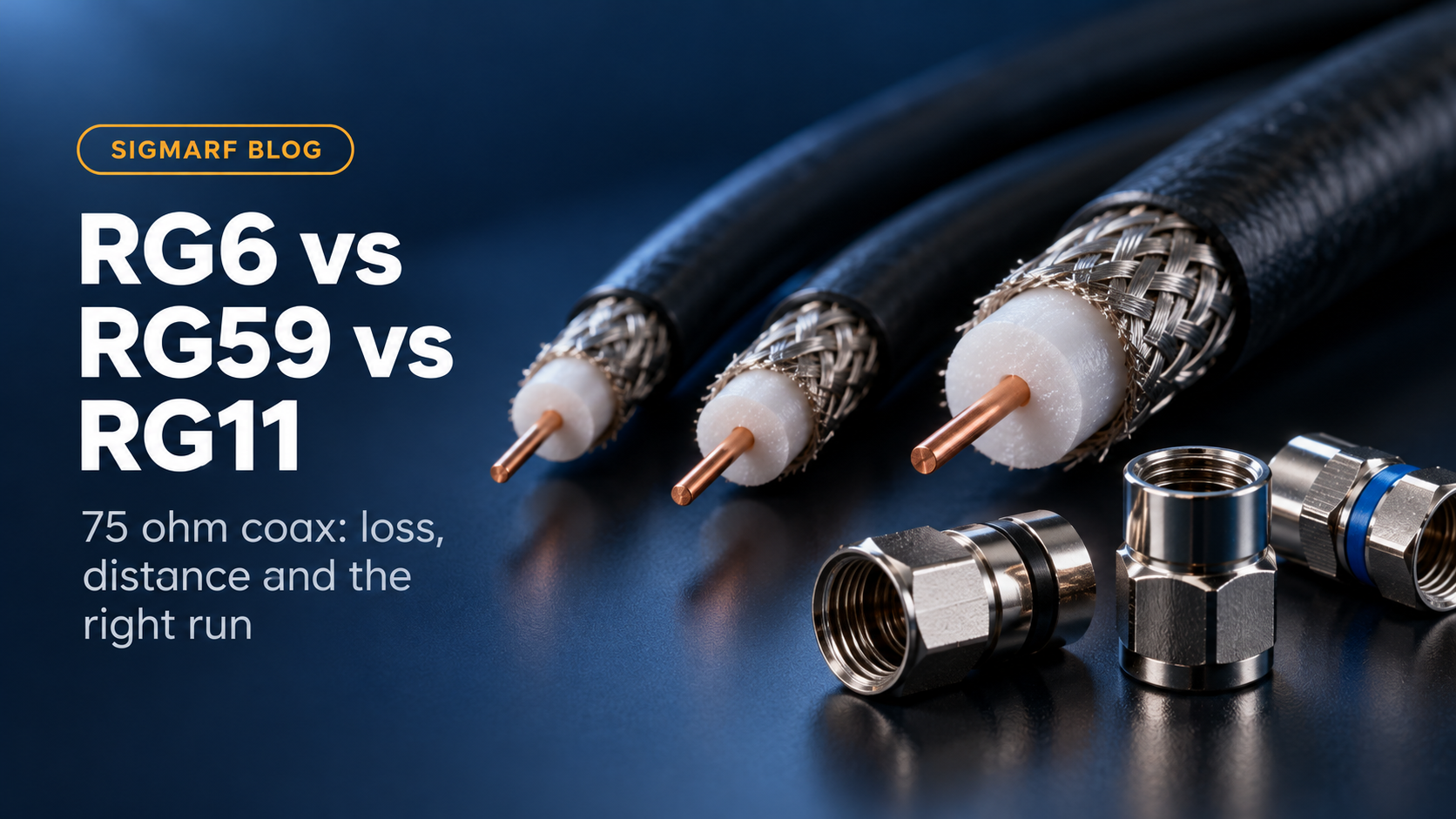
A camera retrofit is failing on two long runs, and the installer asks the usual question: can we just swap the RG59 for RG6? Sometimes yes, sometimes the run really needs RG11, and once in a while the cable was never the problem. These three 75 ohm cables look interchangeable at the F-connector end. Their loss per meter is not.
Short answer: RG59 is the thin legacy cable for short runs only. RG6 is the modern default for TV, satellite and camera work to 1 GHz and beyond. RG11 is the big low-loss trunk for runs where RG6 runs out of budget. All are 75 ohm; the difference is diameter, loss and how far each one can honestly go.
On This Page
RG6 vs RG59 vs RG11 at a glance
| Property | RG59 | RG6 | RG11 |
|---|---|---|---|
| Impedance | 75 ohm | 75 ohm | 75 ohm |
| Outer diameter | about 6.15 mm | about 6.9 mm | about 10.3 mm |
| Center conductor | about 0.58 mm, CCS or copper | about 1.0 mm (18 AWG), CCS | about 1.63 mm (14 AWG), CCS |
| Dielectric | Solid or foam PE | Foam PE | Foam PE |
| Shield options | Single braid | Dual or quad shield | Dual or quad shield |
| Typical use ceiling | below 500 MHz, short runs | 3 GHz satellite grades exist | long trunks to 1 GHz+ |
| Handling | Very flexible | Flexible | Stiff, wide bends |
Loss at real frequencies
Typical attenuation in dB per 100 m, planning figures consistent with published cable tables. Makers vary, so confirm the exact part:
| Frequency | RG59 | RG6 | RG11 |
|---|---|---|---|
| 50 MHz | 6.0 | 4.9 | 4.5 |
| 100 MHz | 7.5 | 6.4 | 6.5 |
| 400 MHz | 17.0 | 13.6 | 11.9 |
| 800 MHz | 25.0 | 20.2 | 17.9 |
| 1000 MHz | 28.5 | 22.9 | 20.1 |
At 100 MHz the three are close enough that connectors decide the outcome. At 400 MHz and above the gaps widen: over 50 m, RG59 gives up about 8.5 dB where RG11 gives up 6, and at 1 GHz the same 50 m costs RG59 over 14 dB against 10 for RG11. That is the difference between a camera picture with margin and one with noise.
Key idea: The 75 ohm world is a distance game. Cable TV and camera levels are engineered around a few dB of drop, so the cable upgrade that buys 3 dB often rescues the whole run.
Construction and shielding
RG59 is the oldest of the three: small 0.58 mm center, often a single braid with modest coverage, fine for baseband video in the CCTV era and lossy at modern RF frequencies. RG6 moved to a larger 18 AWG center conductor, foam dielectric and foil-plus-braid shields; dual shield suits indoor work, quad shield adds a second foil and braid for noisy RF environments and satellite IF up to 3 GHz. RG11 scales the same construction up to a 14 AWG center and 10.3 mm jacket, cutting loss roughly a third below RG6 at the cost of stiffness.
Most RG6 and RG11 use copper-clad steel centers. For video and RF that is fine - the signal rides the copper skin - but long runs that also carry DC power to a camera or amplifier should check the DC resistance, where CCS loses to solid copper.
Connectors for 75 ohm coax
The F connector owns this space: cheap, reliable, and the native interface on splitters, taps, amplifiers and set-top gear. Compression F fittings have replaced crimp and twist-on types for any run that matters, because they seal the joint and hold the foil shield properly. For professional video, 75 ohm BNC (and HD-BNC for 12G-SDI) is standard on patch panels and cameras; the BNC guide covers the 50 vs 75 ohm trap, because the two BNC versions intermate without complaint.
Connector variants are cable-specific here too: an RG6 compression plug does not fit RG59 or RG11. The connector-to-cable group chart maps the groups.
Long 75 ohm run to get right?
Send the length, frequencies and equipment. We will size the cable and build the assembly, swept before shipment.
Talk to an EngineerWhich cable for which run
| Run | Best choice | Why |
|---|---|---|
| Patch lead, rack to device, a few meters | RG59 | Thin, flexible, cheap; loss irrelevant at this length |
| Camera or TV drop to 30 m | RG6 | Standard, low loss, quad-shield grades for noise |
| Satellite LNB IF (to 3 GHz) | RG6 quad shield, satellite grade | Only grades swept for the band belong here |
| Trunk or riser 30 to 100 m | RG11 | Roughly a third less loss than RG6 |
| Underground or flooded runs | RG11 direct-bury grade | Sized for margin; get the right jacket |
| Baseband analog video, short | RG59 copper center | Legacy correct; do not extend to RF use |
For camera systems that mix coax and network, the CCTV coax and IP hybrid guide covers when to stay coax and when to pull network cable instead. The 50/75 ohm boundary tripwires are in RG6 vs RG58.
Worked example: a 60 m camera run
RG59 = 60 x 17.0 / 100 = 10.2 dB - too much, picture degrades
RG6 = 60 x 13.6 / 100 = 8.2 dB - marginal
RG11 = 60 x 11.9 / 100 = 7.1 dB - best margin
Decision: RG11 trunk or shorten the route; verify with the receiver spec
Selection mistakes
Avoid
- ✗Reaching for RG59 on a long RF run because it is already in the wall.
- ✗Twist-on F connectors outdoors; use compression fittings and seal the joint.
- ✗Mixing 50 ohm and 75 ohm hardware because the F and BNC shells mate.
- ✗Ignoring DC resistance on powered cameras when the center conductor is CCS.
- ✗Assuming quad shield fixes a bad route; shielding does not reduce attenuation.
RG6 vs RG59 vs RG11 questions
Can I replace RG59 with RG6?
Usually yes, and it is an upgrade: lower loss and better shielding at a slightly larger diameter. Check that the connectors and any tight conduits accept the bigger cable.
What is RG11 used for?
Long 75 ohm trunks: main feeds between buildings, risers, underground runs and any route where RG6 loss exceeds the budget. Its stiffness makes it a poor patch cable.
Is RG59 obsolete?
For RF distribution, mostly. It remains correct for short analog video patch runs and legacy CCTV, but anything over a few meters at hundreds of MHz belongs on RG6 or better.
Do I need quad-shield RG6?
Indoors with low RF noise, dual shield is fine. Near transmitters, in multi-tenant risers, or for satellite IF to 3 GHz, quad shield earns its cost.
Why is satellite cable swept to 3 GHz?
Satellite LNBs output intermediate frequencies from 950 MHz to about 2.2 GHz, and some systems stack higher. A cable and connector set verified only to 1 GHz can silently kill the top of the band.
Bottom Line
RG59 for short legacy patches, RG6 for almost everything else, RG11 when the run is long enough that decibels decide. Compare loss at your real frequency and length, use compression fittings that match the cable, and treat shielding and loss as separate specs. When the margin is thin, size the cable from the numbers, then have the assembly tested.
Get 75 ohm assemblies built and tested
Custom RG6, RG59 and RG11 assemblies with F or 75 ohm BNC terminations, verified before shipment.

Ed is a Sourcing & Marketing Expert at SigmaRF, writes content related to Technology and Engineering topics
- RF Transistor Frequency Response and Power Performance
- How Semiconductor Materials Affect RF Device Performance
- RFIC vs MMIC: Terminology, Integration and Selection
- What Is an MMIC? Inside a Monolithic Microwave Circuit
- What Are Microwave Vacuum Tubes and Where Are They Used?
- What Is a MESFET and How Is It Used in RF Circuits?
- What Is a Heterojunction Bipolar Transistor (HBT)?
- GaN vs GaAs RF Technology: Power, Noise and Design Trade-offs
- BJT vs MOSFET vs HEMT: RF Transistor Technologies Explained
- What Are RF Frequency Multipliers and How Do They Work?