What Is an RF Antenna and How Does It Work?
Published on 11/6/2026
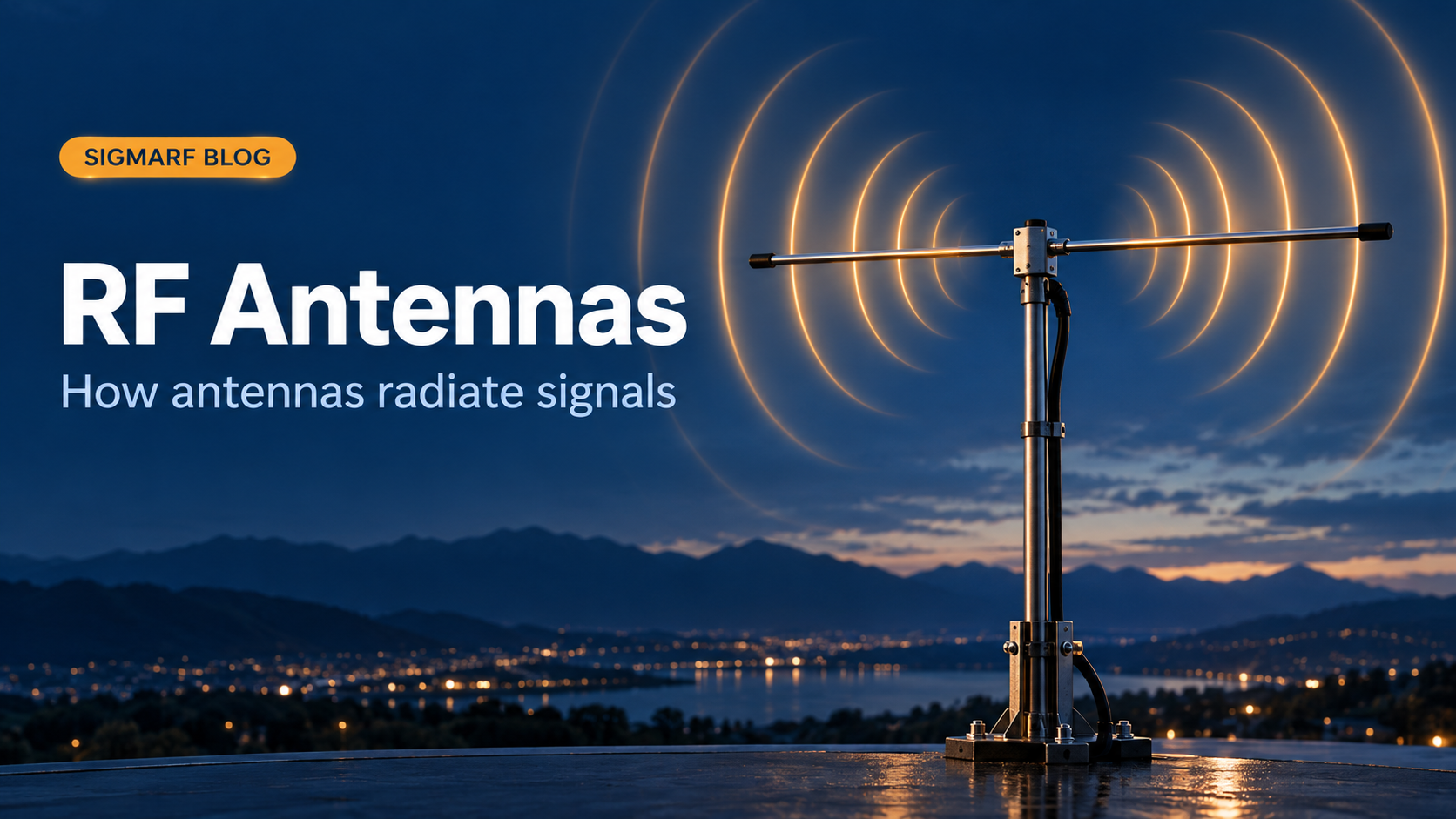
A 5 W radio with a good antenna reaches 50 km. The same radio with a mistuned, badly fed antenna barely covers a car park. The transmitter did not change; the boundary between the circuit and the sky did. That boundary is the antenna, and it is the single component that decides whether your RF energy becomes coverage or heat.
Antennas are so familiar that their actual job is rarely explained. This guide does that job: what an antenna is, how a voltage on a wire becomes a wave in space, the ideas of resonance, gain, polarization and reciprocity, and why the cable and connector feeding the antenna deserve as much attention as the antenna itself.
Key idea: An antenna is a transducer between guided electromagnetic waves on a transmission line and free waves in space. It works by resonance: at the right size, currents on its conductors add up in phase and launch energy efficiently instead of reflecting it back.
On This Page
The antenna as a transducer
Inside your radio, energy travels as a guided wave: voltage and current bound to wires, PCB traces and coaxial cable. In the air, energy travels as a free electromagnetic wave with a 377 ohm relationship between its electric and magnetic fields. The antenna is the impedance-matching transducer between those two regimes. On transmit, it takes the guided wave and launches a free wave. On receive, exactly the reverse. Everything else about an antenna, its size, shape and materials, follows from doing that conversion efficiently, in the directions you want, at the frequencies you need.
Resonance: why size follows wavelength
Antennas work by resonance. On a half-wave dipole, current flows to each end, reflects, and returns exactly in phase with the next cycle of the drive, so currents reinforce and the structure radiates strongly. That is why antenna dimensions track wavelength: at 900 MHz the wavelength is 33.3 cm and a quarter-wave whip is about 8 cm; at 2.4 GHz it shrinks to about 3 cm. A resonant antenna presents a comfortable resistive impedance, near 73 ohms for a half-wave dipole in free space. Detune it, make it electrically too short or too long, and the impedance goes reactive: part of your power reflects back down the feedline, which is exactly what a high VSWR reading is telling you.
Gain and radiation patterns
No antenna creates power. Gain describes focus: an antenna with 9 dBi of gain sends the same total power concentrated so that, in its best direction, it looks like an ideal radiator fed with 8 times (9 dB) more power. Every dB of gain in one direction is stolen from other directions, which is why high-gain antennas are physically large: a dish focuses with its aperture, a Yagi with its element array. The radiation pattern is the map of that focus, and the right pattern depends on the job: omni for coverage around a site, directional for a point-to-point link. We go deeper in antenna gain in dBi explained.
Polarization
The electric field of a radio wave has an orientation, and the antennas at both ends must agree on it. A vertical whip talks best to vertical whips; turn one antenna 90 degrees and the link can drop by 20 dB or more. Linear polarization (vertical or horizontal) covers most terrestrial links; circular polarization, where the field rotates as it travels, tolerates any orientation and is the standard for GNSS and satellite work. Indoors, reflections scramble polarization anyway, which is one reason a router works at odd angles.
Reciprocity: transmit equals receive
A deep and useful law: an antenna behaves identically in transmit and receive. Same gain, same pattern, same impedance, same polarization. An antenna that hears a weak beacon well will also deliver power to that direction well. Practically, reciprocity means you can test an antenna in whichever direction is convenient, and that a good receive antenna upgrade helps a transmit link equally.
The feedline: where good antennas go to die
Between the radio and the antenna sits the feedline, and it edits every number above. Coax loss converts transmit power into heat before it radiates and throws away received signal-to-noise you can never recover. A cheap 10 m run of thin coax at 2.4 GHz can eat 4 to 6 dB, more than the gain of a typical upgrade antenna. The fix is unglamorous: short runs, low-loss cable, properly installed connectors, weatherproofing. Our guides to connecting a Wi-Fi module to an antenna and antenna cable loss and LNA placement go deep on this, and our link budget worked example shows the full accounting.
Have an antenna underperforming in the field?
Share the radio, frequency, cable run and mount and we will help you find where the dB are going.
Talk to an EngineerWorked example: from 5 W to coverage
A 5 W LINK, WITH AND WITHOUT FEEDLINE CARE
Radio output:       5 W = +37 dBm

Careless install:   10 m thin coax, -5.0 dB
  antenna input:    1.6 W   dipole gain +2.15 dBi
  EIRP:             about 2.5 W equivalent

Careful install:    3 m low-loss coax, -0.9 dB
  antenna input:    4.1 W   dipole gain +2.15 dBi
  EIRP:             about 6.7 W equivalent

Same radio, same antenna: 4.1 dB of link difference,
more than doubling effective radiated power.
The antenna was never the bottleneck. The feedline was. This is why we insist that cable choice is antenna choice: the two form one system.
Antenna mistakes
Avoid
- ✗Chasing antenna gain while ignoring cable loss. A 5 dB feedline loss eats a 5 dBi upgrade whole.
- ✗Mounting near metal without re-tuning. Nearby conductors detune the antenna and distort its pattern.
- ✗Mixing polarizations across the link. Cross-polarized antennas can cost 20 dB before anything else goes wrong.
- ✗Assuming a longer whip means more range. Length only helps at resonance; an arbitrary length reflects power back.
- ✗Skimping on the connector and weatherproofing. Water in coax is a slow-motion link failure.
- ✗Judging by the S11 dip alone. A deep match can hide lossy matching networks; efficiency, not just match, sets radiated power.
Antenna questions
What is an RF antenna in simple terms?
A transducer that converts the guided electrical wave from a cable into a free electromagnetic wave in space, and back again on receive. It works by resonance at sizes related to the wavelength of the signal.
How does an antenna radiate?
Accelerating charges (the RF current) on the antenna conductors create changing electric and magnetic fields that detach and propagate as a wave. At resonance, currents add in phase so radiation is strong and efficient instead of reflecting back to the source.
What is antenna gain in dBi?
A measure of focus relative to an ideal isotropic radiator. 9 dBi means the antenna concentrates power so its best direction is 8 times stronger than the ideal would be with the same input. Gain is focus, not amplification.
Why does antenna size depend on frequency?
Antennas are resonant structures, and resonance happens at dimensions that are a fraction of the wavelength, commonly a quarter or half wave. Lower frequency means longer wavelength means a physically bigger antenna.
Does the coax cable to the antenna matter?
Enormously. Feedline loss subtracts transmit power before it radiates and destroys received signal-to-noise permanently. A few dB of cheap cable can cancel an entire antenna upgrade.
Can the same antenna be used for transmit and receive?
Yes. Reciprocity guarantees identical gain, pattern, impedance and polarization in both directions, which is why one antenna serves a two-way link.
Bottom Line
An antenna is the negotiated boundary between circuit and sky: a resonant transducer whose size follows wavelength, whose gain is focus rather than power, and whose polarization must match the far end. Treat the feedline as part of the antenna, because the link budget does.
Feed the antenna like it matters.
SigmaRF builds low-loss coaxial assemblies to 40 GHz, every one VNA-swept for VSWR and insertion loss before shipping, with lead times as short as 2 days.

Aadeshwar Modi is a marketing technical content writer who loves writing on technology and AI topics.
- RF Transistor Frequency Response and Power Performance
- How Semiconductor Materials Affect RF Device Performance
- RFIC vs MMIC: Terminology, Integration and Selection
- What Is an MMIC? Inside a Monolithic Microwave Circuit
- What Are Microwave Vacuum Tubes and Where Are They Used?
- What Is a MESFET and How Is It Used in RF Circuits?
- What Is a Heterojunction Bipolar Transistor (HBT)?
- GaN vs GaAs RF Technology: Power, Noise and Design Trade-offs
- BJT vs MOSFET vs HEMT: RF Transistor Technologies Explained
- What Are RF Frequency Multipliers and How Do They Work?