Antenna Connector Types: Wi-Fi, LTE, GPS and Vehicle Antennas
Published on 11/1/2026 • Updated on 11/1/2026
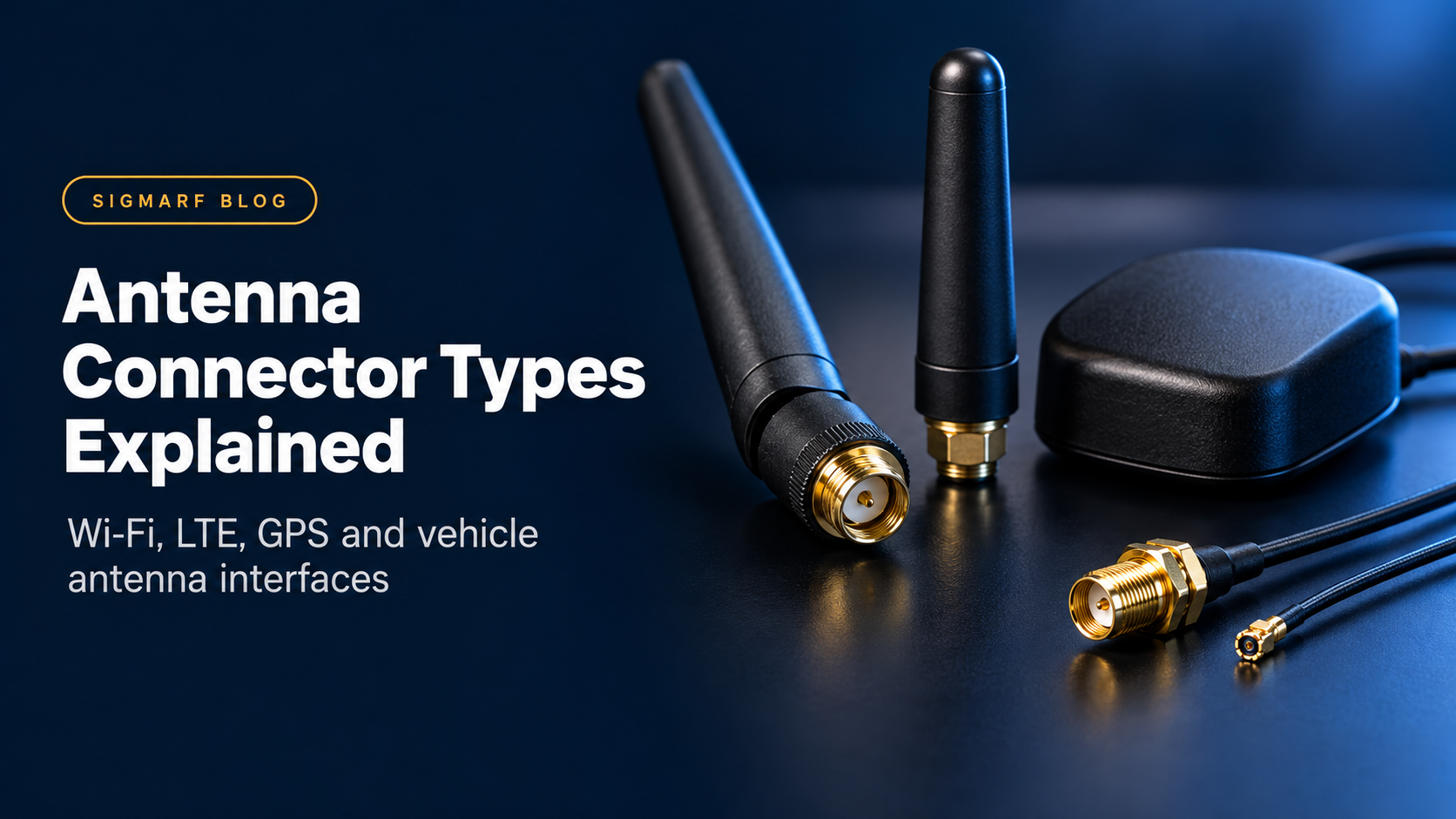
An antenna arrives with a connector, a radio arrives with a socket, and the two meet for the first time at installation. That is where the trouble starts: the router has RP-SMA, the LTE gateway has SMA, the outdoor panel antenna has N-type, and the module inside the product has a U.FL jack the size of a rice grain. This is the map of which antenna connector lives where, and why.
Short answer: Wi-Fi routers use RP-SMA, cellular and IoT gateways use SMA, outdoor and high-gain antennas use N-type, internal module pigtails use U.FL or MHF4, compact devices use MCX or MMCX, and vehicle antennas use FAKRA or FME. Match the connector, its gender and its impedance before you match anything else.
On This Page
- The antenna connector map
- Wi-Fi: RP-SMA and its gender trap
- LTE and 5G: SMA and N-type
- GPS and GNSS: small connectors, weak signals
- Inside the box: U.FL, MHF4, MCX, MMCX
- Vehicle antennas: FAKRA and FME
- The cable matters as much as the connector
- Antenna connector mistakes
- Antenna connector questions
- Bottom Line
The antenna connector map
| Application | Usual connector | Impedance | Typical cable |
|---|---|---|---|
| Wi-Fi router / access point | RP-SMA | 50 ohm | short pigtail inside, antenna direct |
| LTE / 5G router or gateway | SMA | 50 ohm | RG174/RG316 pigtail or direct |
| Outdoor panel / yagi / omni | N-type | 50 ohm | LMR-240 / LMR-400 feeders |
| GNSS timing and survey | TNC or SMA | 50 ohm | RG58 / low-loss |
| Vehicle telematics | FAKRA, FME | 50 ohm | RG174 class harness |
| Module-level internal | U.FL / MHF4 | 50 ohm | 1.13 mm micro-coax pigtail |
| Compact devices | MCX / MMCX | 50 ohm | RG174 / RG316 |
Wi-Fi: RP-SMA and its gender trap
Consumer Wi-Fi standardized on RP-SMA - reverse polarity SMA - where the body threads look like SMA but the center contact gender is swapped: the router jack has the pin, the antenna plug has the socket. The why routers use RP-SMA article covers the history, and the SMA vs RP-SMA identification guide shows the one reliable rule: read the pin, not the nut. Forcing SMA into RP-SMA destroys both contacts.
Band coverage matters as much as the connector. A 2.4 GHz antenna on a 6 GHz Wi-Fi 6E or 7 radio wastes the radio; the Wi-Fi antenna selection guide covers bands and gain honestly.
LTE and 5G: SMA and N-type
Cellular gateways, industrial routers and IoT modems put SMA jacks on the enclosure, one per antenna element - a 4x4 MIMO 5G router has four, and they are not interchangeable decorations: main, diversity and MIMO positions matter. Outdoor donor antennas for these systems step up to N-type for weather sealing and retention on masts, with a low-loss feeder between. The NB-IoT and LTE-M connection checklist covers the modem-side details.
GPS and GNSS: small connectors, weak signals
GNSS signals arrive below the noise floor, so the antenna chain is engineered around an active antenna with a built-in LNA, powered through the same coax. Timing receivers use TNC or SMA; compact trackers use MCX or MMCX internally. The loss budget is unforgiving because the LNA gain is fixed: the GNSS coax loss budget works the numbers, including why antenna cable length is not a free choice.
Inside the box: U.FL, MHF4, MCX, MMCX
Between the radio module and the enclosure antenna port lives a pigtail: 1.13 mm micro-coax with a U.FL or MHF4 plug on the module end and an SMA or RP-SMA bulkhead jack on the case. U.FL is rated for about 30 mating cycles - it is an install-once connector, not a service interface. The U.FL/IPEX/MHF4 guide and the module-to-antenna connection guide cover generations, mating and routing. MCX and MMCX serve compact ports and board pigtails; the four-way small connector comparison separates them.
Pigtails and antenna feeders, built to length
U.FL to SMA bulkhead pigtails, LMR feeders with N-type, sealed outdoor assemblies - swept before shipment.
Talk to an EngineerVehicle antennas: FAKRA and FME
Vehicle RF uses keyed, color-coded FAKRA housings for telematics, GNSS and radio, and slim FME barrels at the end of aftermarket antenna whips so the cable passes through body holes before the larger connector is fitted. FAKRA color codes are a language of their own; the FAKRA color code guide translates it.
The cable matters as much as the connector
Antenna connectors get the attention, but the cable sets the loss: 2 m of RG174 at 2.4 GHz costs about 3.4 dB, more than many antennas gain. Keep pigtails short, put feeders on LMR-class cable, and protect outdoor joints per the outdoor assembly spec. The LNA placement article explains where amplification belongs in the chain.
Antenna connector mistakes
Avoid
- ✗Forcing SMA into RP-SMA; the threads engage, the contacts do not survive.
- ✗Treating U.FL as a service connector; it is rated for about 30 cycles.
- ✗Long RG174 leads at 2.4 GHz that eat the antenna gain.
- ✗Swapping MIMO antenna positions and blaming throughput on the radio.
- ✗Unsealed outdoor N-type joints that wick water into the feeder.
- ✗Buying antenna and radio separately and discovering both are jack-gender.
Antenna connector questions
What connector do Wi-Fi antennas use?
Almost always RP-SMA on routers and access points. Enterprise and outdoor gear sometimes uses N-type. Check the pin, not the nut, to tell RP-SMA from SMA.
What connector do LTE routers use?
SMA, one jack per antenna element. Outdoor donor antennas for those routers usually terminate in N-type on low-loss feeder cable.
Can I connect an N-type antenna to an SMA radio?
Yes, with an N-to-SMA adapter or a feeder that transitions between them. Keep adapters few and short; each adds a little loss and a lot of leverage on the radio jack.
What is the small connector inside my device called?
Most likely U.FL (also sold as IPEX or MHF), a 30-cycle board connector on 1.13 mm micro-coax. The linked guide separates U.FL from IPEX4 and MHF4.
Are antenna connectors waterproof?
SMA, RP-SMA, U.FL and FAKRA are not. N-type seals only when properly mated and still deserves taped protection outdoors. FAKRA sealed variants exist for vehicle body penetration.
Bottom Line
Antenna connectors are application shorthand: RP-SMA for Wi-Fi, SMA for cellular, N-type outdoors, U.FL inside, FAKRA in vehicles. Verify gender and impedance before mating, keep pigtails short and feeders low-loss, and seal anything that lives outside. When the chain matters, order the pigtail or feeder built to length and swept.
Get antenna links built and tested
Pigtails, feeders and outdoor antenna assemblies with the right connector at each end, VNA-swept before shipment.

Alankar is a Technical Content Writer at SigmaRF, writes on various topics from Technology, Compliance and Business process
- RF Transistor Frequency Response and Power Performance
- How Semiconductor Materials Affect RF Device Performance
- RFIC vs MMIC: Terminology, Integration and Selection
- What Is an MMIC? Inside a Monolithic Microwave Circuit
- What Are Microwave Vacuum Tubes and Where Are They Used?
- What Is a MESFET and How Is It Used in RF Circuits?
- What Is a Heterojunction Bipolar Transistor (HBT)?
- GaN vs GaAs RF Technology: Power, Noise and Design Trade-offs
- BJT vs MOSFET vs HEMT: RF Transistor Technologies Explained
- What Are RF Frequency Multipliers and How Do They Work?