Prototype to Production: MOQs, Lead Times and Scaling Custom Cable Orders
Published on 10/25/2026
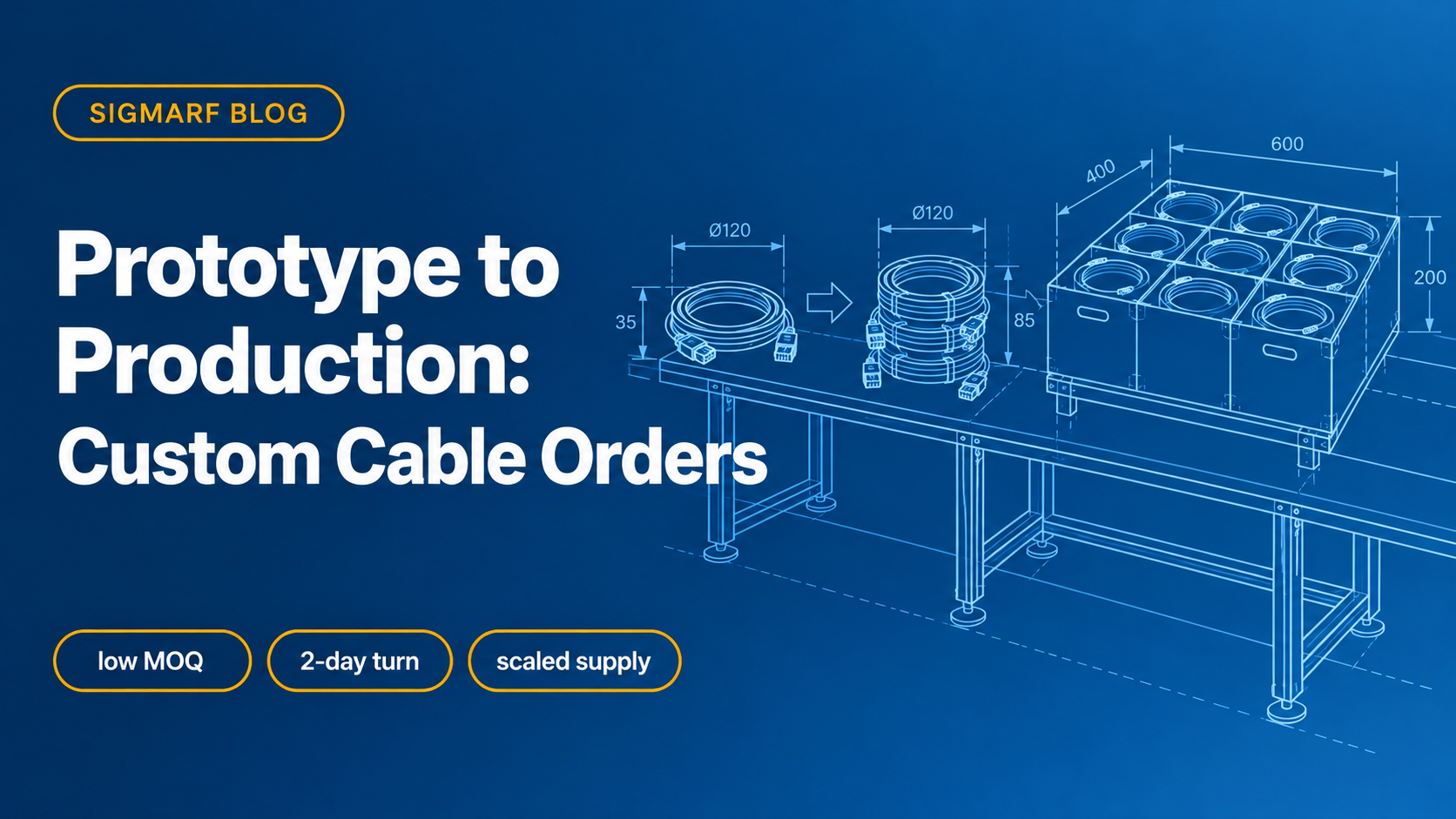
Custom Ethernet assemblies can be prototyped in days without tooling, because cutting, terminating and testing standard cable needs no custom machinery. Production lead time then depends on cable and connector stock, any custom tooling such as overmolds, and the agreed testing level. For standard configurations with stock on hand, SigmaRF can turn urgent builds in as little as two days.
Buyers planning a new product usually ask the same three questions: how few can I order, how fast can I get them, and what changes when I scale. This guide answers all three with the quantities and drivers that actually move the schedule.
On This Page
Prototypes: days, not weeks
An Ethernet assembly prototype is a manual build: cut the cable, terminate the plugs, fit the boots, label, test. None of that needs a mold or a programmed line, so small quantities carry no tooling charge and no tooling wait. The practical minimum is a handful of pieces; the cost per piece is higher than production, which is the honest price of speed and flexibility while the design is still moving.
Use the prototype round to validate the things a drawing cannot: the bend as the cable leaves the plug inside your enclosure, the latch clearance on a recessed jack, the label position after routing. Two or three iterations at this stage are normal and cheap compared with revising a production lot.
Order prototypes in the real configuration, not a convenient stand-in. A sample built with a different jacket or an unshielded plug tells you nothing about EMC behaviour or fit, and a misleading sample is worse than none. If the final cable is not yet chosen, order the short list: three candidate constructions, a few pieces each, tested side by side in the actual product.
What changes at 100, 1,000 and 10,000
| Quantity | What the build looks like | What to settle first |
|---|---|---|
| 5 to 25 | Manual prototype build, no tooling | Fit, routing and the test results on your bench |
| 100 | Pilot lot; process written down, test limits agreed | Final drawing revision, label format, packaging |
| 1,000 | Production batching; materials bought against the order | Price breaks, lead-time commitment, revision control |
| 10,000 | Scheduled releases against a blanket order | Stocking plan for cable and plugs, release schedule |
The jump from prototype to pilot is where most surprises live, because the pilot lot is the first time the part is built by process rather than by a technician reading a sketch. Freeze the drawing before it, and put the test level in writing. Our twelve-line specification guide gives you the checklist, and how assemblies are tested explains the levels you can ask for.
The four lead-time drivers
- Cable stock. Standard Cat5e and Cat6 in common jackets is shelf material. Unusual shielding constructions, colours or jacket compounds may be bought against your order, which adds their own supply lead time.
- Connector stock. Standard shielded and unshielded RJ45 plugs are stocked. Right-angle variants, specific boot styles and industrial connectors can add days if they are not on the shelf.
- Custom tooling. Overmolded strain reliefs or custom-molded parts need a mold, and molds take weeks, not days. If the schedule is tight, a standard boot gets you building now; the overmold can follow in a later revision.
- Testing level. Wiremap on every piece adds little time. Full category certification with per-piece reports adds test time per assembly, which is real but predictable and worth planning into the first lot.
One driver buyers rarely see is the test queue. Certification testing is instrument time, and a large lot of Cat6A cords with per-piece reports occupies a cable analyzer for hours. It is scheduled, not skipped, but it is one more reason the test level belongs in the quote conversation rather than added at the end.
Revision control is the quiet requirement underneath all of this. Once a part number ships in volume, any change, a different plug vendor, a jacket compound substitution, a label layout tweak, should move the drawing revision and trigger a conscious decision, not a surprise on the incoming-inspection bench. Agree the change-notification terms with your manufacturer at the pilot stage, when the stakes are still small.
Blanket orders and scheduled releases
Once a part is stable, the efficient structure is a blanket order with scheduled releases: one price and specification for the annual volume, shipments called off as your production needs them. The manufacturer can then hold cable and plug stock against the blanket, which turns each release into a short, predictable cycle instead of a fresh procurement event. It also smooths the price, since materials are bought in volume once rather than per shipment.
The structure also protects both sides when life changes. If your forecast slips, releases move; if a raw material tightens, the stocking plan absorbs it. For buyers comparing sourcing geographies, our Made-in-India sourcing guide covers how these logistics work from our Vadodara facility.
How to get a faster quote and build
Three habits shorten every round. First, send a complete spec the first time; the twelve lines remove the clarification loop. Second, say what is flexible: if colour or boot style can follow stock, say so, and the fastest buildable option comes back in the quote. Third, give a real needed-by date. Urgent builds in standard configurations are exactly the case where a two-day turn is possible, and a date lets the manufacturer tell you honestly whether yours qualifies.
Common questions
What is the minimum order quantity for custom Ethernet assemblies?
For standard constructions, prototype quantities of a few pieces are practical because no tooling is involved. Pricing per piece falls with volume, so the right minimum is an economic question, not a technical one: order what validates the design, then scale.
How long does a first production lot take?
With cable and plugs in stock and a frozen drawing, days to a couple of weeks depending on quantity and test level. Builds needing bought-in cable, special connectors or overmold tooling take longer, mainly on the material side.
Can the design change between prototype and production?
Yes, and it usually does. The important part is revision control: freeze a drawing revision for the production lot, and make sure both sides are building and testing against the same one.
Do repeat orders ship faster than the first?
Almost always. The drawing, test limits and packaging are already agreed, so a repeat is a scheduling exercise rather than an engineering one, especially under a blanket order with stocked materials.
Bottom Line
Prototyping a custom Ethernet assembly is fast because it needs no tooling; scaling is predictable once you know the four drivers: cable stock, connector stock, tooling and test level. Freeze the drawing at the pilot lot, and use blanket orders to make repeat supply a scheduling detail instead of a project.
Have a build to schedule?
Send your specification and quantities, from five prototypes to a scheduled production program. Standard configurations on stocked materials can turn in as little as two days.

Alankar is a Technical Content Writer at SigmaRF, writes on various topics from Technology, Compliance and Business process
- RF Transistor Frequency Response and Power Performance
- How Semiconductor Materials Affect RF Device Performance
- RFIC vs MMIC: Terminology, Integration and Selection
- What Is an MMIC? Inside a Monolithic Microwave Circuit
- What Are Microwave Vacuum Tubes and Where Are They Used?
- What Is a MESFET and How Is It Used in RF Circuits?
- What Is a Heterojunction Bipolar Transistor (HBT)?
- GaN vs GaAs RF Technology: Power, Noise and Design Trade-offs
- BJT vs MOSFET vs HEMT: RF Transistor Technologies Explained
- What Are RF Frequency Multipliers and How Do They Work?