How Ethernet Cable Assemblies Are Tested: Wiremap, Certification and 100% Testing
Published on 10/25/2026
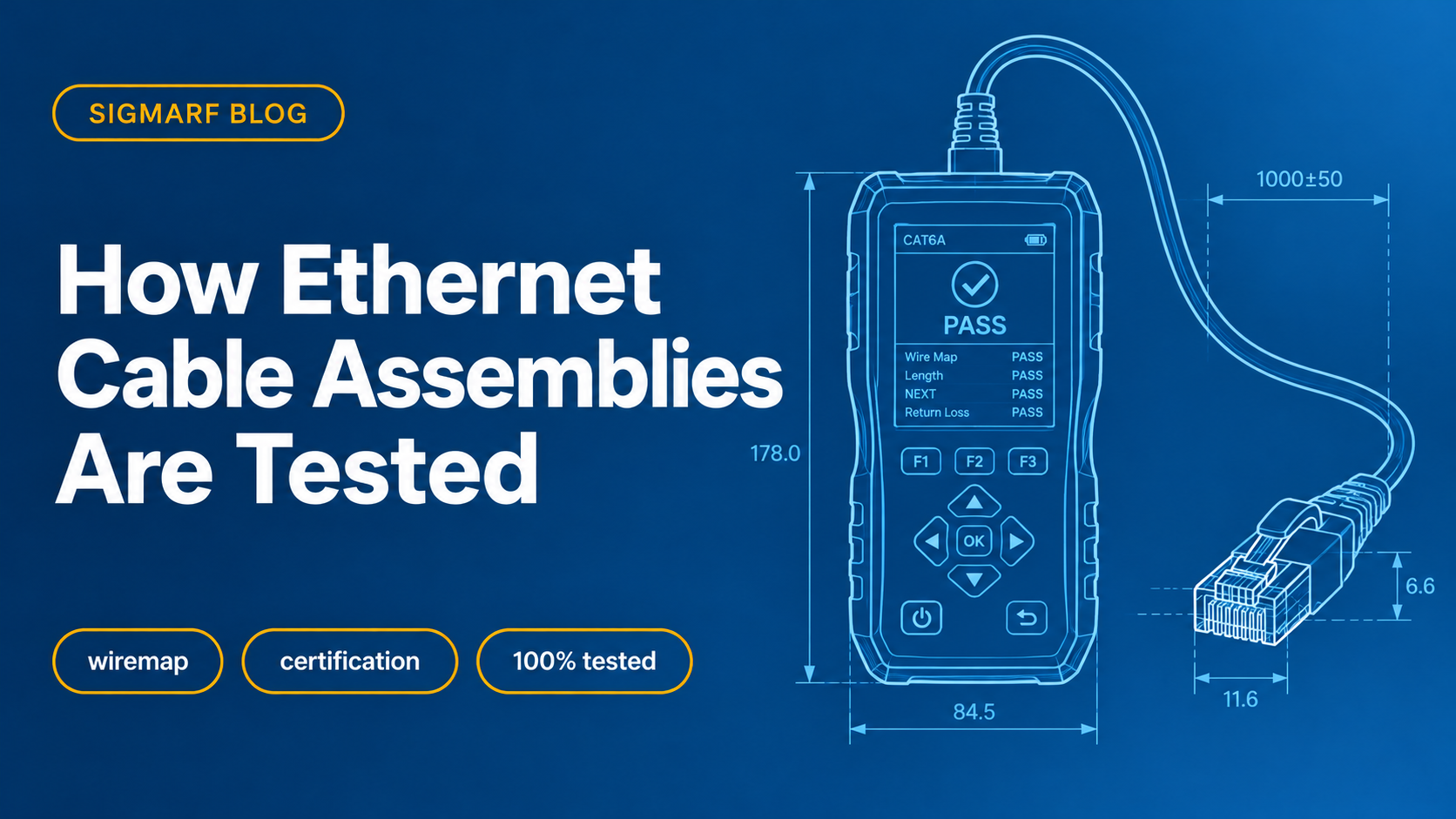
Ethernet cable assemblies are tested for wiremap, length, insertion loss, near-end crosstalk (NEXT) and return loss, with the depth of testing set by what the link must prove. A basic continuity check catches wiring mistakes; a certification test on a cable analyzer measures the full parameter set against published category limits.
Every assembly that leaves SigmaRF passes electrical test before it ships, and critical builds go out with digital test reports tied to each serialized cable. This guide explains what each test level actually measures, what the reported parameters mean, and how to use the results in your own quality records.
On This Page
Three levels of testing
Wiremap and continuity. The baseline. A wiremap test confirms that each of the eight conductors lands on the correct pin at both ends, with no opens, shorts, crossed pairs or split pairs. A split pair is the subtle one: continuity passes, but the pair twist is broken across the cable and crosstalk climbs. Wiremap testers catch it; a multimeter does not.
Qualification. A qualitative answer to "will this link carry the intended speed?" Qualification testers check whether the link can support, for example, 1000BASE-T or 10GBASE-T, without grading every parameter against the full category limit set. Useful for troubleshooting, but it is not a substitute for certification on a specified build.
Certification. The full measurement. A cable analyzer such as the Fluke Networks DSX series sweeps the assembly and compares every parameter against the limits for the category: Cat5e, Cat6 or Cat6A, patch cord or channel. The result is a pass or fail with margin data for each measurement, stored as a report per assembly.
The parameters and what they mean
| Parameter | What it measures | What a failure usually means |
|---|---|---|
| Wiremap | Correct pin-to-pin connections at both ends | Termination error; the pair order or pairing is wrong |
| Insertion loss | Signal power lost over the cable, in dB | Cable too long, too thin or damaged |
| NEXT (near-end crosstalk) | Signal leaking between pairs at the near end, in dB | Pairs untwisted too far at the plug |
| Return loss | Signal reflected back by impedance changes, in dB | Crushed sections, bad crimps, mismatched plug |
| Length | Electrical length from signal delay | Wrong cut length or a fault partway down the cable |
| Delay skew | Arrival-time difference between pairs | Pair lengths mismatched; matters for high-speed links |
Two patterns are worth knowing. NEXT failures cluster at the termination, which is why the untwist length at the plug is controlled during assembly. Return loss failures often trace to mechanical handling: a cable crushed by an over-tightened tie wrap shows up as a reflection at that point.
Attenuation scales with length and conductor gauge, so a thin stranded cord has its own, looser limits than solid horizontal cable; a good tester applies the right limit set to the cord type. If you are choosing between constructions, our solid vs stranded conductor guide explains the trade-offs the limits are written around.
Read the margin, not just the verdict. A certification report shows how far each parameter sat inside its limit. A cord that passes NEXT by 0.5 dB leaves little room for the installation abuse every real link suffers, while a 4 dB margin forgives tight bends and imperfect dressing. When two suppliers both say tested, the margin columns are where the difference lives.
What 100% tested means in practice
In our process, every assembly passes wiremap and continuity before packing; there is no sampling on that. Builds that need more, such as Cat6A links for 10 Gigabit equipment or assemblies bound for test and measurement racks, are certified on a cable analyzer, and the results ship with the order as digital reports. The test depth is agreed at quote time, so the certificate format and limits are settled before production starts.
This is worth asking about with any supplier. "Tested" without a level means little; the question to ask is which parameters, against which limits, with what record kept per assembly.
Sample testing is the other end of the spectrum, and it has a place: packaging checks, visual inspection, label verification. But electrical performance is cheap to test on every piece and expensive to miss once. A single failed cord that reaches a customer costs more in handling, shipping and confidence than testing the whole lot.
Using test certificates
A digital test report ties a serialized assembly to its measured results. In regulated equipment builds, that record feeds the device history file: the cable is no longer an anonymous consumable but a documented component. It also shortens failure investigations. When a link misbehaves in the field, the as-built results tell you whether the cable shipped inside limits, which changes where you look next.
Ask for the report format with your first samples and file one against your incoming inspection record. If your product already uses serialized assemblies, the pairing is automatic. Our guide to Ethernet cabling for test equipment shows how labs use serialized, certified links, and the specification guide covers how to state the test level in your RFQ.
One practical note on shielded builds: the shield itself is checked for continuity along with the conductors. A shield that is open at one end still passes data on the bench and fails later near interference, which is why the check belongs in the standard test sequence rather than in a visual once-over. Termination quality for the shield is covered in our guide to grounding shielded Ethernet cables.
Common questions
Is a wiremap test enough for Gigabit Ethernet?
Wiremap catches wiring errors, not signal quality. Most Gigabit links on a wiremap-passed assembly work, but marginal terminations and crushed cables pass wiremap while degrading the link. For critical builds, certification adds the measurements that predict real performance.
What is the difference between patch cord and channel testing?
A channel test grades the whole installed link, permanent cable plus cords, end to end. A patch cord test grades the cord alone against tighter limits. A factory assembly should be tested as a patch cord; the channel result depends on the installed parts around it.
What does a certification report show?
Each measured parameter with its limit, the worst-case margin, the overall pass or fail, cable and test details, and the tester identity. The margin matters: a pass near the limit leaves less room for installation abuse than a comfortable pass.
Do short custom jumpers need certification?
Very short cords are actually harder to pass on return loss, because there is little cable to average out the terminations. If the jumper feeds a 10 Gigabit link or a measurement instrument, certification is worth specifying regardless of length.
Bottom Line
Testing is a level, not a label: wiremap proves the wiring, certification proves the signal performance against category limits. Specify the level in your RFQ, ask for the report format up front, and every assembly arrives with evidence instead of assurances.
Want tested assemblies with documented results?
Tell us the category, length and test level your build needs. Every SigmaRF assembly is electrically tested before packing, with digital certification reports available for critical builds.

Ed is a Sourcing & Marketing Expert at SigmaRF, writes content related to Technology and Engineering topics
- RF Transistor Frequency Response and Power Performance
- How Semiconductor Materials Affect RF Device Performance
- RFIC vs MMIC: Terminology, Integration and Selection
- What Is an MMIC? Inside a Monolithic Microwave Circuit
- What Are Microwave Vacuum Tubes and Where Are They Used?
- What Is a MESFET and How Is It Used in RF Circuits?
- What Is a Heterojunction Bipolar Transistor (HBT)?
- GaN vs GaAs RF Technology: Power, Noise and Design Trade-offs
- BJT vs MOSFET vs HEMT: RF Transistor Technologies Explained
- What Are RF Frequency Multipliers and How Do They Work?