Solid vs Stranded Conductor Ethernet Cable: Flex Life, Attenuation and Where Each Belongs
Published on 10/25/2026 • Updated on 10/29/2026
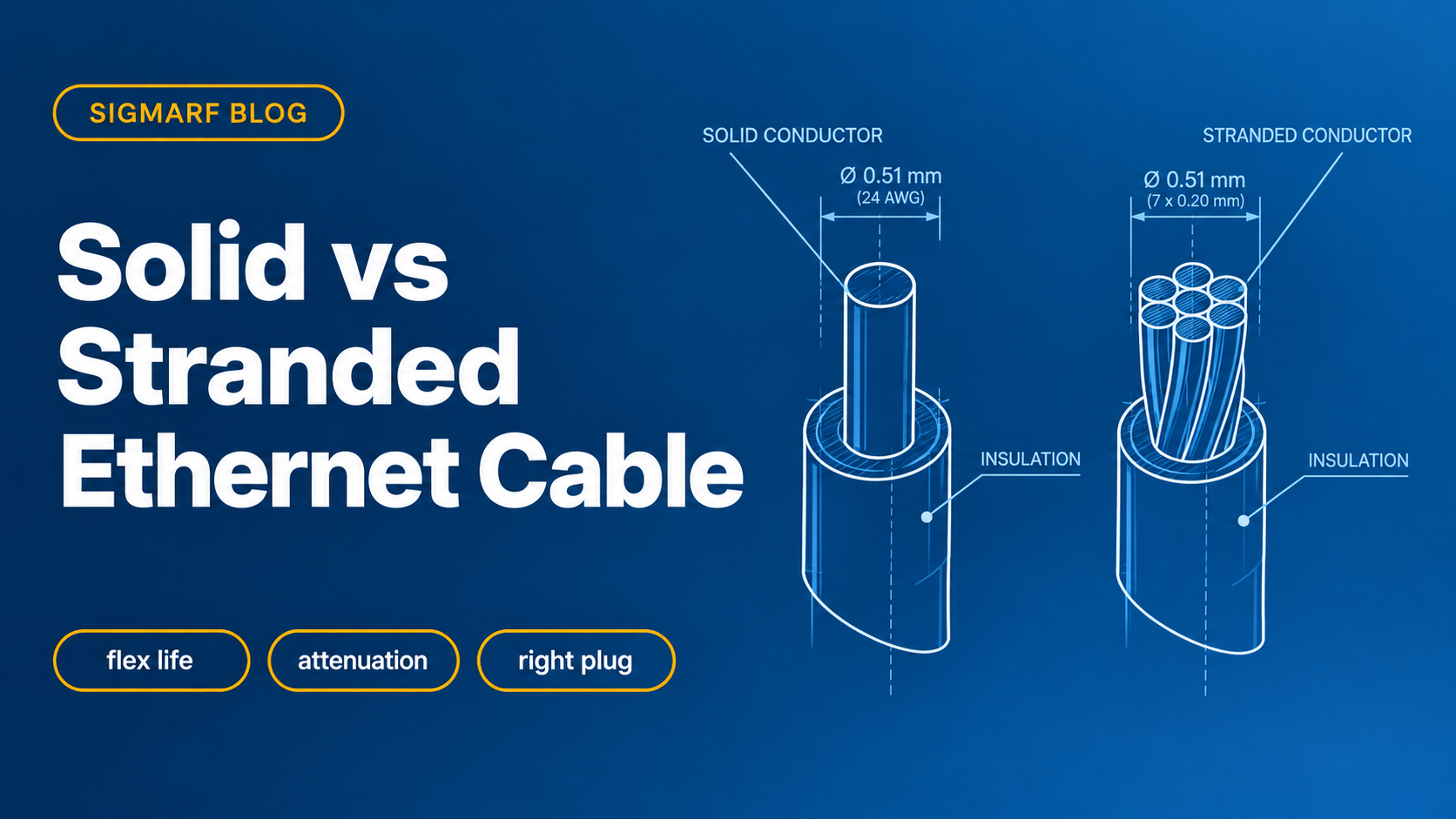
Solid conductors give lower loss and are the right choice for fixed runs that terminate into jacks and panels; stranded conductors survive flexing and handling and are the correct choice for patch cords and most custom equipment assemblies. The two are not interchangeable, and the plug must match the conductor type.
Ask for "Cat6 cable" and you have specified performance but not construction. The same category exists in solid and stranded forms, built for different jobs, and choosing wrong shows up as broken conductors, failed crimps or mystery attenuation. Here is the practical comparison and the decision rule for each location in a system.
On This Page
What the difference actually is
A solid conductor is a single wire per position: eight single copper wires in the cable. A stranded conductor is a bundle of fine wires twisted together to make up each of the eight positions, typically seven or nineteen strands per conductor. Same category rating, same pinout, different mechanical and electrical behaviour.
The convention in structured cabling follows the physics. Solid cable goes in walls and trays, where it is installed once and never moves, and it terminates into insulation-displacement contacts in jacks and patch panels. Stranded cable becomes patch cords and equipment assemblies, where it is plugged, unplugged, routed and re-routed for years.
The engineering comparison
| Property | Solid | Stranded |
|---|---|---|
| Attenuation | Lower; the reference for channel limits | Roughly 20 percent higher; standards de-rate cord lengths for it |
| Flex life | Poor; work-hardens and breaks after repeated bending | Good to excellent, depending on strand count |
| Termination style | Insulation-displacement jacks and panels | Crimped RJ45 plugs |
| Typical use | Horizontal runs in walls, trays and conduits | Patch cords, equipment jumpers, moving links |
| PoE heat behaviour | Better; solid copper sheds heat more predictably in bundles | Slightly worse per gauge; matters in large tight bundles |
The attenuation row is why very long cords misbehave. A 20 m stranded cord carries meaningfully more loss than the same length of solid cable, and standards bodies account for it by shortening the allowed permanent link when long cords are used. For the short jumpers inside equipment, the difference is negligible; for anything approaching building lengths, it is not. Our cable length limits guide works through the numbers.
Gauge interacts with both columns. Slim 28 AWG cords are always stranded; solid conductors that thin would snap in handling. At the other end, 23 AWG is the normal solid horizontal gauge. The cable anatomy guide maps how gauge, stranding, shielding and jacket stack into a complete construction.
Why plugs must match the conductor
RJ45 plug contacts are not universal. Plugs designed for solid conductors use contacts that straddle the single wire and bite it from two sides. Plugs for stranded conductors use contacts that pierce into the bundle and grip the strands. Use a solid-wire plug on stranded cable and the contact skates between strands: it may pass on the bench and open up months later as the strands relax. Use a stranded-wire plug on solid cable and the piercing contact can nick or cut the single wire.
This mismatch is a classic cause of intermittent links on hand-made cords, and it is invisible from outside. Shielded versions of both constructions exist and behave the same mechanically; the shield choice is independent of the conductor choice and follows the EMI environment instead.
Factory assemblies avoid it by pairing the plug to the specified cable construction and then proving the result with wiremap and performance testing on every piece, as covered in how assemblies are tested.
The reverse error also exists: punching stranded cord into a jack designed for solid wire. The insulation-displacement blades are sized to slice one solid conductor; on a stranded bundle they trap a few strands and leave the rest loose, which is a future intermittent fault hiding inside the wall.
One substitution to watch for when buying cable itself: CCA, copper-clad aluminum, sold in both solid and stranded forms at tempting prices. Aluminum's higher resistance raises attenuation and PoE heating, and the conductors are brittle at terminations. Standards-compliant horizontal cable and cords use bare copper. Whatever construction you choose, the conductor material should say copper, and certification testing will expose the difference quickly. When in doubt, weigh the reel: aluminum is conspicuously light.
Stranding counts and moving applications
Not all stranded conductors flex equally. A 7-strand conductor is the common patch-cord construction: flexible enough for routing and handling. A 19-strand conductor bends more smoothly and survives far more flex cycles, which is what cable carriers, robot arms and retractable service loops ask for. Beyond that, high-flex industrial cables pair fine stranding with jacket materials like PUR that tolerate millions of bend cycles.
If a section of cable in your product moves in service, say so on the drawing, including the bend radius and the expected cycles. Flex life is a specification, not a hope, and it changes both the cable and the jacket we propose. The environment side of that choice is covered in the jacket selection guide.
A practical rule for equipment builders: any cable that leaves the enclosure in the customer's hands should be stranded, because customers coil, kink and step on cables. Cables fully enclosed inside the product can be either, but stranded still wins on assembly line ergonomics and service access.
Common questions
Is stranded or solid better for patch cables?
Stranded, almost always. Patch cords are handled, bent and re-routed, and solid conductors work-harden and break under that treatment. Solid cable's lower attenuation matters at building lengths, not at cord lengths, so the flex life wins.
Can I crimp an RJ45 plug onto solid horizontal cable?
You can with a plug designed for solid conductors, and installers do it for direct-attach links. The result is stiff and fragile at the plug; for anything that will be handled, a factory-built stranded cord is the reliable answer.
Does stranded cable support the same speeds as solid?
Yes, within its length limits. Category ratings apply to both constructions; stranded cord limits are simply shorter because of the higher attenuation. At equipment and rack lengths, stranded Cat6 or Cat6A carries the full rated speed.
How do I tell solid from stranded cable without cutting it?
Flex it. Solid cable holds a bend and springs back with body; stranded cable drapes softly. The jacket printing often says so too. When in doubt, strip a short section: one wire per conductor is solid, a bundle of fine wires is stranded.
Bottom Line
Solid for fixed runs into jacks, stranded for anything that moves or gets handled, and always a plug designed for the conductor. State the construction on your assembly drawing along with any flex duty, and the cable will match the job instead of failing quietly at the crimp.
Need a cable that survives your application?
Tell us how the cable is routed, whether it flexes in service, and the link speed. We will match the conductor, stranding, plug and jacket to the duty and test every piece.

Ed is a Sourcing & Marketing Expert at SigmaRF, writes content related to Technology and Engineering topics
- RF Transistor Frequency Response and Power Performance
- How Semiconductor Materials Affect RF Device Performance
- RFIC vs MMIC: Terminology, Integration and Selection
- What Is an MMIC? Inside a Monolithic Microwave Circuit
- What Are Microwave Vacuum Tubes and Where Are They Used?
- What Is a MESFET and How Is It Used in RF Circuits?
- What Is a Heterojunction Bipolar Transistor (HBT)?
- GaN vs GaAs RF Technology: Power, Noise and Design Trade-offs
- BJT vs MOSFET vs HEMT: RF Transistor Technologies Explained
- What Are RF Frequency Multipliers and How Do They Work?