Ethernet Cable Length Limits: Why 100 m, and What Changes for Short Custom Jumpers
Published on 10/25/2026
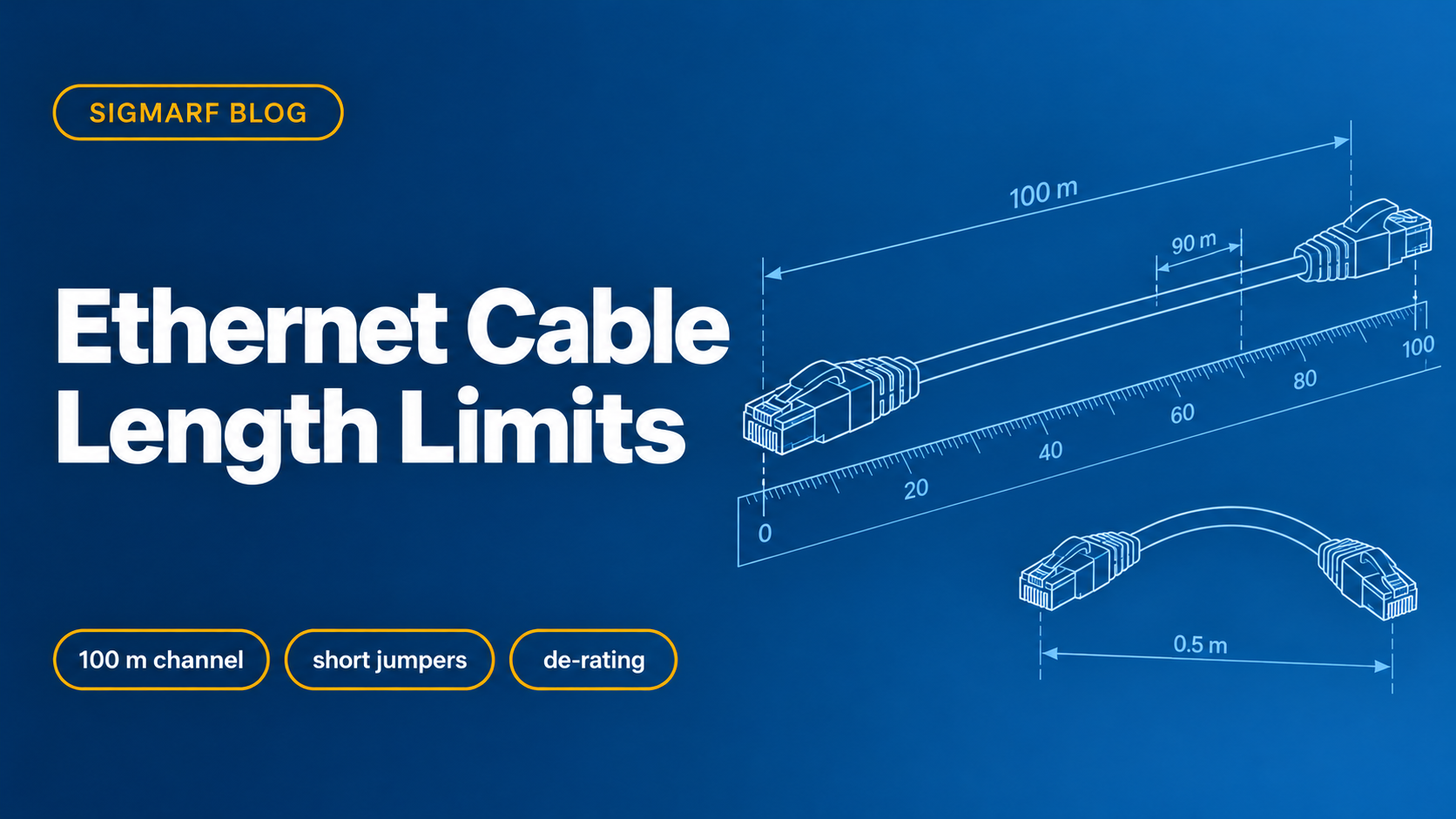
Ethernet channels are limited to 100 m by signal attenuation and timing; custom assemblies can be built to any length below that, including very short jumpers, provided return loss is controlled at the terminations. The limit splits into 90 m of fixed cabling plus up to 10 m of cords.
The 100 m number is quoted everywhere and understood less often. It is not a property of a cable reel but of the whole link, and it bends both ways: long runs fail on loss, while very short cords can fail certification on reflections. This guide explains where the number comes from and how it changes for custom lengths.
On This Page
Where the 100 m comes from
The 100 m channel in the TIA-568 and ISO/IEC 11801 cabling standards is a budget, not a hard cliff. It assumes up to 90 m of solid-conductor permanent link plus up to 10 m of stranded patch cords at the ends. Each element in that path attenuates the signal and adds delay, and the limit is set so that the signal arriving at the far end still meets what the Ethernet physical layer expects, with margin.
Exceed it and the symptoms are not instant death but erosion: links that train at a lower speed, drop under load, or accumulate errors that look like software problems. Cabling standards exist so that a compliant link works with any compliant equipment, which is why installers certify against the limit rather than testing "does it connect".
Why very short cables can fail
The surprising direction is the short one. Return loss measures how much signal reflects back from impedance discontinuities, and the largest discontinuities in a cord are the two plugs. In a long cable, the cable's own attenuation softens the reflection from the far plug. In a very short cord, both plugs' reflections arrive back at full strength and add up, so a short cord can fail return loss limits that an identical longer cord passes.
Good terminations are the fix: controlled untwist, correct plug for the conductor type, consistent crimp geometry. This is a manufacturing repeatability problem, which is why short custom jumpers benefit from factory termination and per-piece testing more than any other length. The measurement side is covered in how assemblies are tested.
There is also a length tolerance angle buyers miss: "1 m" retail cords vary noticeably around their nominal length. Inside a product that variation is slack you did not design for. Custom assemblies carry a stated tolerance, measured tip to tip, which is what lets an enclosure be designed tight. The specification side of this is in our drawing and RFQ guide.
De-rating: stranded cords and PoE heat
Two effects shorten the practical limits. First, stranded conductors attenuate roughly 20 percent more than solid, so standards shorten the allowed permanent link when long stranded cords are used; the familiar guidance keeps total stranded cordage around 10 m in a standard channel. Second, PoE (Power over Ethernet) warms cable bundles, and warmer copper has higher resistance and higher attenuation, so large tight bundles carrying high-power PoE get their own de-rating guidance.
Neither effect matters much at equipment-jumper lengths. Both matter for rack-to-rack runs inside facilities, which is where the cord construction choice intersects with length planning. The construction trade-offs are in our solid vs stranded guide.
One more adjustment hides in high-temperature spaces: cable in hot enclosures or ceiling voids attenuates more than the same cable on a cool bench, and standards guidance shortens allowed runs accordingly. If the run lives somewhere hot, plan the margin for it rather than discovering it in summer.
Where do service loops fit in the budget? A service loop is deliberate slack left at one end for future re-termination or equipment moves. In a 100 m channel that slack counts toward the limit like any other cable, so a 90 m permanent link with generous loops at both ends can quietly exceed the budget. Inside equipment, the cleaner habit is an assembly at the right length plus one labelled spare, rather than coiled excess. Your future self, tracing a fault at midnight, will thank you for both choices.
How category changes the distance question
The 100 m figure applies to Gigabit over Cat5e and to 10GBASE-T over Cat6A. Cat6 sits in between: it can carry 10GBASE-T only over shorter distances, roughly 37 to 55 m depending on how favourable the installation is to alien crosstalk. The safe planning rule is Cat6A for any 10 Gigabit link where the full 100 m channel is in play; the detailed decision framework is in our Cat6 vs Cat6A guide.
At the short end, category matters less than termination quality: a 300 mm jumper in any modern category is electrically easy, and what separates a good one from a bad one is how it is made. That is the home ground of a custom assembly: exact length, measured and labelled, so the link fits the routing instead of the routing absorbing the slack.
A note on measurement method: cable length on a certification report is electrical length derived from signal delay, not a tape measure reading. The two agree closely but not exactly, because signals travel slower than light in a cable's insulation. Testers know the velocity factor of standard constructions, so the reported length is the practical reference for limit checks.
Common questions
What is the maximum length for an Ethernet cable?
100 m for the complete channel under TIA-568 and ISO/IEC 11801: up to 90 m of fixed solid-cable run plus up to 10 m of cords. Longer links need a switch, extender or fiber segment in the middle.
Is there a minimum Ethernet cable length?
No electrical minimum for the link itself; back-to-back devices work fine. The short-cable issue is certification: cords under a metre or two can fail return loss limits if termination quality is poor, because both plugs' reflections arrive undiminished.
Does a longer cable slow down the network?
Within the 100 m limit, no: propagation delay over 100 m is about half a microsecond, irrelevant to applications. Beyond limits, the symptom is not slowness but errors and retraining, which show up as slowness.
Can I coil spare cable length inside an enclosure?
You can, but coils near power supplies or motor wiring invite noise onto the link, and tight coils stress the cable. An assembly cut to the actual length removes the question entirely and keeps the enclosure cleaner.
Bottom Line
The 100 m limit is a link budget: 90 m of fixed cable plus 10 m of cords, adjusted down for stranded cords, PoE heat and higher speeds on Cat6. Below that limit, any length is buildable, and the quality risk moves to the terminations, which is exactly what factory assembly and testing control.
Need cables at the exact length your design wants?
From 100 mm jumpers to full channel-length cords, we cut, terminate, label and test every assembly to your drawing. Send the lengths and quantities for a quote.

Alankar is a Technical Content Writer at SigmaRF, writes on various topics from Technology, Compliance and Business process
- RF Transistor Frequency Response and Power Performance
- How Semiconductor Materials Affect RF Device Performance
- RFIC vs MMIC: Terminology, Integration and Selection
- What Is an MMIC? Inside a Monolithic Microwave Circuit
- What Are Microwave Vacuum Tubes and Where Are They Used?
- What Is a MESFET and How Is It Used in RF Circuits?
- What Is a Heterojunction Bipolar Transistor (HBT)?
- GaN vs GaAs RF Technology: Power, Noise and Design Trade-offs
- BJT vs MOSFET vs HEMT: RF Transistor Technologies Explained
- What Are RF Frequency Multipliers and How Do They Work?