How to Specify a Custom Ethernet Cable Assembly: Drawing and RFQ Checklist
Published on 10/25/2026 • Updated on 10/25/2026
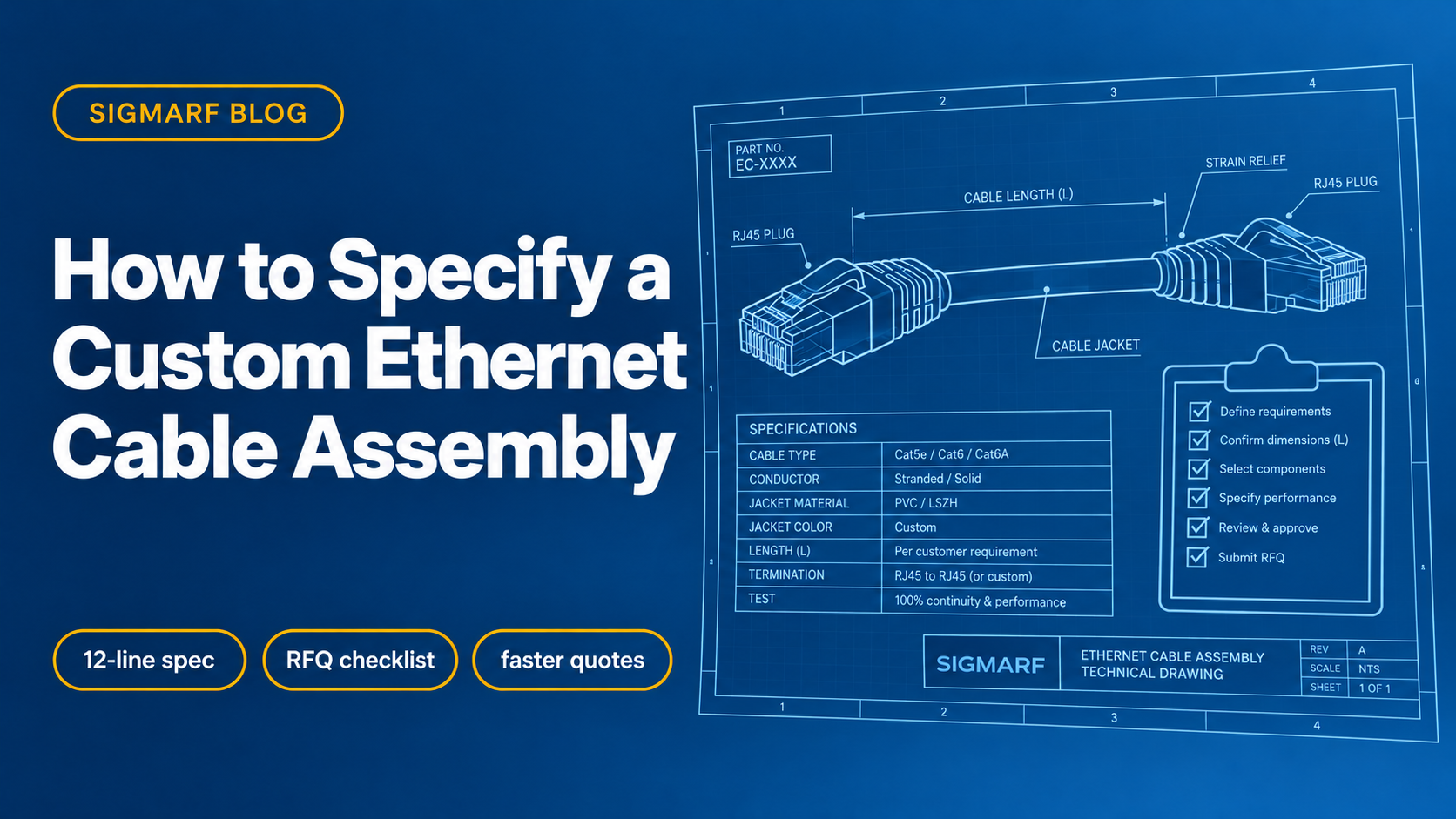
To specify a custom Ethernet cable assembly, state the category, shielding, conductor gauge, jacket, length with tolerance, connectors and their orientation, pinout, colour, labelling, quantity and required testing. Twelve short lines cover all of it, and a manufacturer can quote from those lines without a single follow-up call.
Most slow quotes and wrong first samples come from the same cause: the drawing or RFQ assumed something the manufacturer could not see. This guide gives you the complete twelve-line specification, explains the choices behind each line, and lists the omissions that most often delay quotes. Copy the block at the end straight into your next RFQ.
On This Page
Why quotes stall
A cable assembly looks simple from the outside: a length of cable with a plug on each end. But every part of that sentence is a decision. "Cat6 cable, RJ45 both ends, one metre" still leaves the shielding, the conductor stranding, the jacket material, the plug style, the boot, the pinout, the label and the test level open. Two manufacturers reading that sentence will quote two different parts, and both will be reasonable guesses.
The fix is not a longer document. It is a complete one. Twelve lines, each a single decision, turn a vague request into a buildable part. Most of them take one word.
The twelve-line specification
These are the twelve decisions, in the order most drawings list them, with the options buyers most often choose for equipment builds.
| Line | Decision | Typical options |
|---|---|---|
| 1 | Category | Cat5e, Cat6, Cat6A |
| 2 | Shielding | U/UTP, F/UTP, S/FTP (see our shielding types guide) |
| 3 | Conductor | Gauge (23 to 26 AWG common) and solid vs stranded |
| 4 | Jacket | PVC, LSZH, PUR or TPE, plus colour |
| 5 | Length and tolerance | Tip to tip, with the measurement method stated |
| 6 | Connector, end A | Plug type, shielded or not, straight or right-angle |
| 7 | Connector, end B | Same detail as end A; ends are often different |
| 8 | Boot and strain relief | Boot style, colour, latch protection |
| 9 | Pinout | T568A or T568B, straight-through or crossover |
| 10 | Labelling | Text, position, durability against cleaning or heat |
| 11 | Quantity | Prototype count, pilot lot and annual volume estimate |
| 12 | Test level | Wiremap only, or full category certification with reports |
The lines that carry the most risk
Length and tolerance. State how the length is measured: tip of plug to tip of plug is the convention. A drawing that says "300 mm" without a method invites parts that differ by the length of a plug body. Add a tolerance that matches the routing; tight bends into a fixed port may need plus or minus 5 mm, while a slack service loop tolerates far more.
Connector orientation. For right-angle plugs, define the cable exit direction viewed from the latch side. "Right-angle plug" alone has four possible builds, and three of them will not fit your panel. A one-line note or a photo of the installed space removes the ambiguity.
Test level. Basic wiremap confirms the pairs land on the right pins. Category certification on a cable analyzer measures insertion loss, NEXT, return loss and delay skew against published limits. The two cost different amounts and catch different problems. Our guide to how Ethernet cable assemblies are tested walks through what each level proves.
Omissions that delay quotes
The requests that stall in a manufacturer's inbox share the same gaps:
- No quantity. Tooling, setup and packaging change completely between ten pieces and ten thousand. Even a rough annual estimate unlocks a real price.
- No environment. "Goes inside a machine" hides the detail that selects the jacket: temperature range, oils, cleaning agents, flexing.
- No pinout. T568A and T568B perform identically, but a mixed installation causes faults that look like cable failures. If you are unsure, our T568A vs T568B guide covers which to pick and why consistency matters.
- No target date. A needed-by date changes the answer from "no" to "yes, if we substitute this plug" more often than buyers expect.
One more line worth adding when the assembly goes into a regulated product: the documentation trail. State whether you need a certificate of conformance with each lot, per-piece test reports, or material declarations such as RoHS. These are normal requests, but they change how the manufacturer packs and records the order, so they belong in the RFQ rather than in a follow-up email after production has started.
What a good manufacturer asks back
Expect two or three questions even on a complete drawing. A manufacturer who builds for equipment makers will usually confirm how the cable is dressed inside the product, whether any section flexes in service, and what happens on the ends: does the plug latch into a recessed jack, and is there room for a boot? These questions are a good sign. They mean the quote you get back is for the part you actually need.
Keep the agreed specification in your own document system, not just in email threads. When the first samples arrive, check them against the twelve lines and record the manufacturer's part number alongside yours. That habit pays off the first time a reel of raw cable changes or a plug is substituted, because both sides are then comparing against the same written baseline.
If you are moving from a first article to volume, the conversation shifts to repeatability: agreed test limits, packaging, and how revisions are handled. Our guide to prototype-to-production lead times covers that path.
Common questions
Do I need a formal engineering drawing to get a quote?
No. A clear table with the twelve lines is enough for most assemblies, and a photo of the routing or a marked-up sketch helps for right-angle plugs and tight spaces. Formal drawings become valuable once a part number goes into production and revisions need tracking.
What tolerance should I put on cable length?
As tight as the routing needs and no tighter. Short jumpers under 500 mm often carry plus or minus 5 to 10 mm; longer cords can relax to one or two percent. Overly tight tolerances add inspection cost without improving fit.
Can one drawing cover several lengths of the same cable?
Yes. A family drawing with a length table works well when everything else is identical. Give each length its own part number or dash number so ordering, labelling and test records stay unambiguous.
What if I do not know which shielding or jacket to choose?
Describe the environment instead: what the cable runs next to, the temperature range, and whether it is cleaned or flexed. A manufacturer can translate that into a construction. Guessing at a construction you are unsure of risks paying for a spec that does not fit.
Bottom Line
A quotable Ethernet cable assembly spec is twelve lines: category, shielding, conductor, jacket, length with tolerance, both connectors, boot, pinout, labelling, quantity and test level. Write those lines once, reuse them on every RFQ, and the answers you get back will be prices instead of questions.
Ready to spec your assembly?
Send the twelve lines from this guide, or your drawing, and our engineers will quote it. We build, label and test every assembly in-house, from prototypes to production volumes.

Aadeshwar Modi is a marketing technical content writer who loves writing on technology and AI topics.
- RF Transistor Frequency Response and Power Performance
- How Semiconductor Materials Affect RF Device Performance
- RFIC vs MMIC: Terminology, Integration and Selection
- What Is an MMIC? Inside a Monolithic Microwave Circuit
- What Are Microwave Vacuum Tubes and Where Are They Used?
- What Is a MESFET and How Is It Used in RF Circuits?
- What Is a Heterojunction Bipolar Transistor (HBT)?
- GaN vs GaAs RF Technology: Power, Noise and Design Trade-offs
- BJT vs MOSFET vs HEMT: RF Transistor Technologies Explained
- What Are RF Frequency Multipliers and How Do They Work?