T568A vs T568B Wiring: Which Pinout Should Your Custom Assembly Use?
Published on 10/25/2026
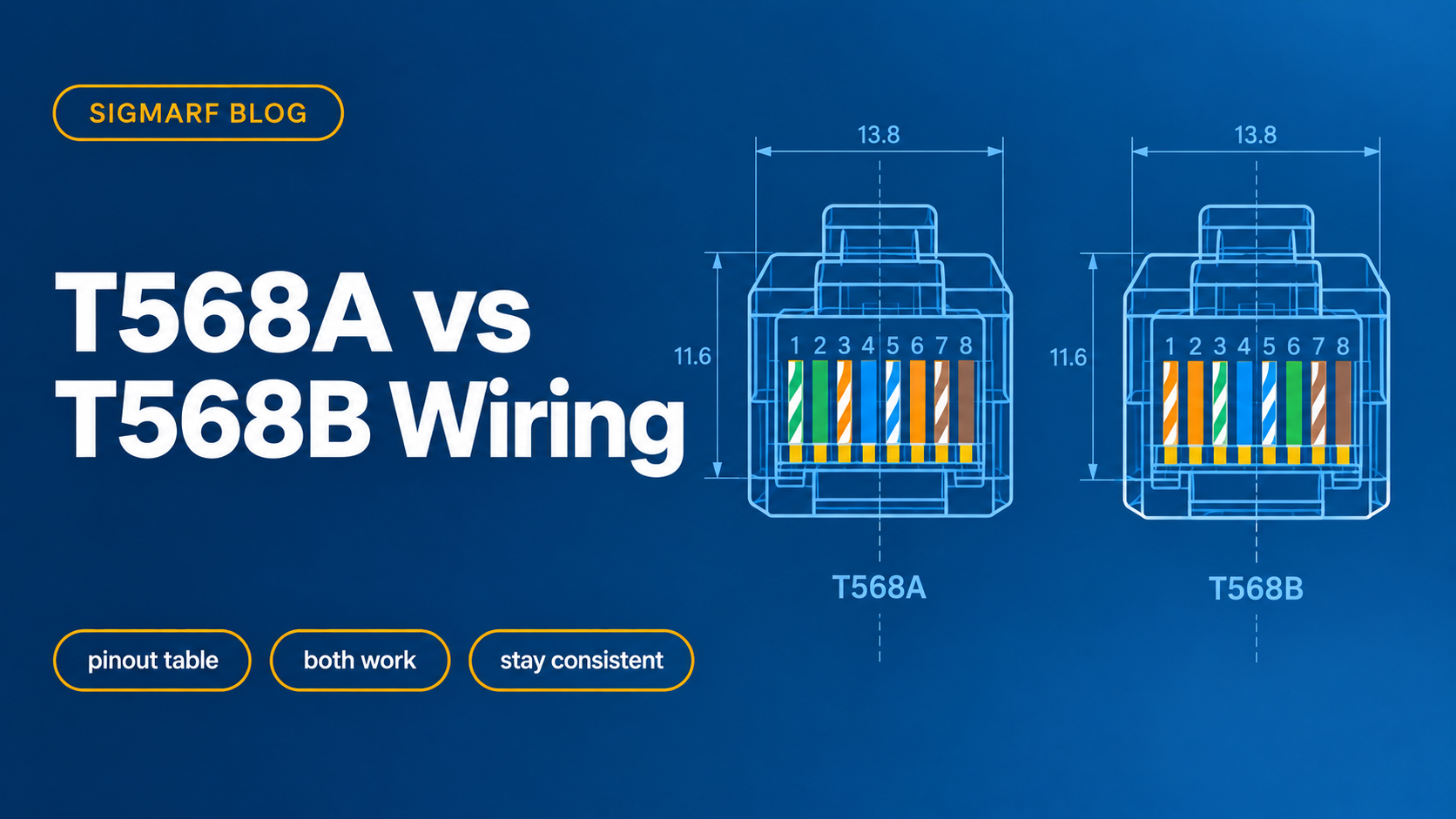
T568A and T568B differ only in the positions of the green and orange pairs on the eight RJ45 pins; both perform identically, so pick one standard and keep it consistent across the installation. T568B dominates commercial equipment, while T568A appears in some government and legacy installations.
Few topics generate more unnecessary debate per wire than this one. The two pinouts are electrically equivalent, the hardware cannot tell them apart, and yet mixed installations keep producing links that test open, cross or intermittent. Here is the actual difference, the decision rule, and how to state it on an assembly drawing so nobody guesses.
On This Page
The two pinouts side by side
Both standards map the four pairs onto the same eight pins of the RJ45. The only difference is that the orange pair and the green pair swap positions. The blue and brown pairs sit identically in both.
| Pin | T568A | T568B |
|---|---|---|
| 1 | White-green | White-orange |
| 2 | Green | Orange |
| 3 | White-orange | White-green |
| 4 | Blue | Blue |
| 5 | White-blue | White-blue |
| 6 | Orange | Green |
| 7 | White-brown | White-brown |
| 8 | Brown | Brown |
The pairs themselves never change. Pair 2 is always the orange wires, pair 3 the green; only which pins they land on differs. Pins 1 and 2 are always one pair, 3 and 6 another, 4 and 5 the third, 7 and 8 the fourth, in both standards.
Why both work electrically
Ethernet signals care about pairs, not colours. As long as each twisted pair connects to the correct two pins at both ends, the link performs identically whether the orange pair sits on pins 1-2 or 3-6. There is no speed, noise or distance advantage to either standard, and no test instrument that reports one as better.
What does break links is inconsistency. A cable terminated A at one end and B at the other is a crossover cable: perfectly valid for a few legacy uses, wrong for almost everything modern. The failure reports we see on returned field-made cords are dominated by exactly this mistake, which is why every assembly we build is wiremap tested against the specified pinout.
The historical reason there are two standards at all is backwards compatibility with older telephone wiring schemes. T568A preserves the pair layout that matched earlier USOC (Universal Service Ordering Code) voice wiring, which is why it lingers in government documents and older buildings. T568B matches the AT&T 258A layout that most commercial data cabling settled on. Neither heritage makes a difference to a modern Ethernet signal.
Which one to choose
Match what is already there. If the installation, the patch panels and the existing cords are B, stay with B. If you are supplying into a US federal government contract or a legacy site documented to T568A, use A. For a new product or a new installation with no heritage, T568B is the pragmatic default: it is what most commercial cords, panels and equipment documentation assume, so the next person to touch the system is most likely to expect it.
Unless a drawing tells us otherwise, we build straight-through assemblies to T568B. Crossover and T568A builds are normal order items; they just need to be stated. If your equipment has unusual requirements, our specification guide shows where the pinout line sits among the twelve decisions.
A note for procurement teams: "Cat6 cable" does not imply a pinout. Category describes performance; T568A or B describes arrangement. Quotes that specify one but not the other still leave a real decision open, and it surfaces at the worst time, on the bench with a tester in hand.
One caution on mixed estates: if your equipment ships to customers, you do not control the site convention. The safe design choice is to make the product indifferent to it, which modern Auto MDI-X ports mostly achieve, and to document the pinout of every cord you supply so an installer can identify it in seconds. Our cable anatomy guide covers the physical side those installers will be looking at.
A related question we hear: does the pinout choice interact with Auto MDI-X, the feature that lets modern ports swap transmit and receive pairs automatically? Auto MDI-X fixes crossover mistakes, not A-versus-B consistency questions inside a structured plant. Panels, jacks and cords still need one documented convention, because the person certifying the link later needs to know which colour order to expect on the tester.
Specifying pinout on a drawing
One line does it: "T568B both ends, straight-through." That is complete and unambiguous. For anything else, say it explicitly per end: crossover builds, A-to-B transitions, or rolled cables for console ports all exist and all get built, but none of them should ever be a surprise discovered by a wiremap tester.
Labelling closes the loop. A crossover assembly that is not labelled as one will eventually be installed as a straight cord, and the fault will look intermittent and mysterious. We label non-standard pinouts on the cable by default, and your drawing can specify the exact text and position.
If you inherit an installation with no documentation, spend an hour mapping it before ordering anything. Note the pinout at the panels, the jacks and a sample of cords. That hour is cheaper than the week spent chasing a phantom fault that turns out to be one crossover cord in a straight-wired building.
Common questions
Which is better, T568A or T568B?
Neither. They differ only in which pins the green and orange pairs occupy, and both perform identically. The only meaningful rule is consistency: match the existing installation, and use T568B when there is no existing convention to match.
What happens if one end is A and the other is B?
You have built a crossover cable. Modern Gigabit ports usually negotiate around it with Auto MDI-X, so the link may still come up, but it is an undocumented crossover in a straight-cable world. Build crossovers deliberately and label them, never accidentally.
Does T568A vs T568B affect PoE?
No. Power over Ethernet (PoE) delivery depends on the pairs and conductor gauge, not on which colour sits on which pin. Both standards put the same pairs on the same pins in the same pairing; only the pair positions 1-2 and 3-6 swap.
How do I find out which standard my site uses?
Look at an existing jack or patch panel; the colour code is usually printed beside the contacts. Failing that, hold an existing cord's plugs side by side, contacts up, latches down, and read the colour order on pin 1: white-orange means B, white-green means A.
Bottom Line
T568A and T568B are the same performance in two colour arrangements. Match your site, default to B when there is no site to match, write the choice on the drawing, and label anything that deviates. Pinout should be a one-line decision, not a field fault.
Need assemblies wired exactly to your standard?
Tell us A, B, straight or crossover, and we will build, wiremap test and label every piece to match. Standard, crossover and rolled pinouts are all routine builds.

Aadeshwar Modi is a marketing technical content writer who loves writing on technology and AI topics.
- RF Transistor Frequency Response and Power Performance
- How Semiconductor Materials Affect RF Device Performance
- RFIC vs MMIC: Terminology, Integration and Selection
- What Is an MMIC? Inside a Monolithic Microwave Circuit
- What Are Microwave Vacuum Tubes and Where Are They Used?
- What Is a MESFET and How Is It Used in RF Circuits?
- What Is a Heterojunction Bipolar Transistor (HBT)?
- GaN vs GaAs RF Technology: Power, Noise and Design Trade-offs
- BJT vs MOSFET vs HEMT: RF Transistor Technologies Explained
- What Are RF Frequency Multipliers and How Do They Work?