Anatomy of an Ethernet Cable Assembly: Conductors, Pairs, Shield, Jacket, Plug and Boot
Published on 10/25/2026
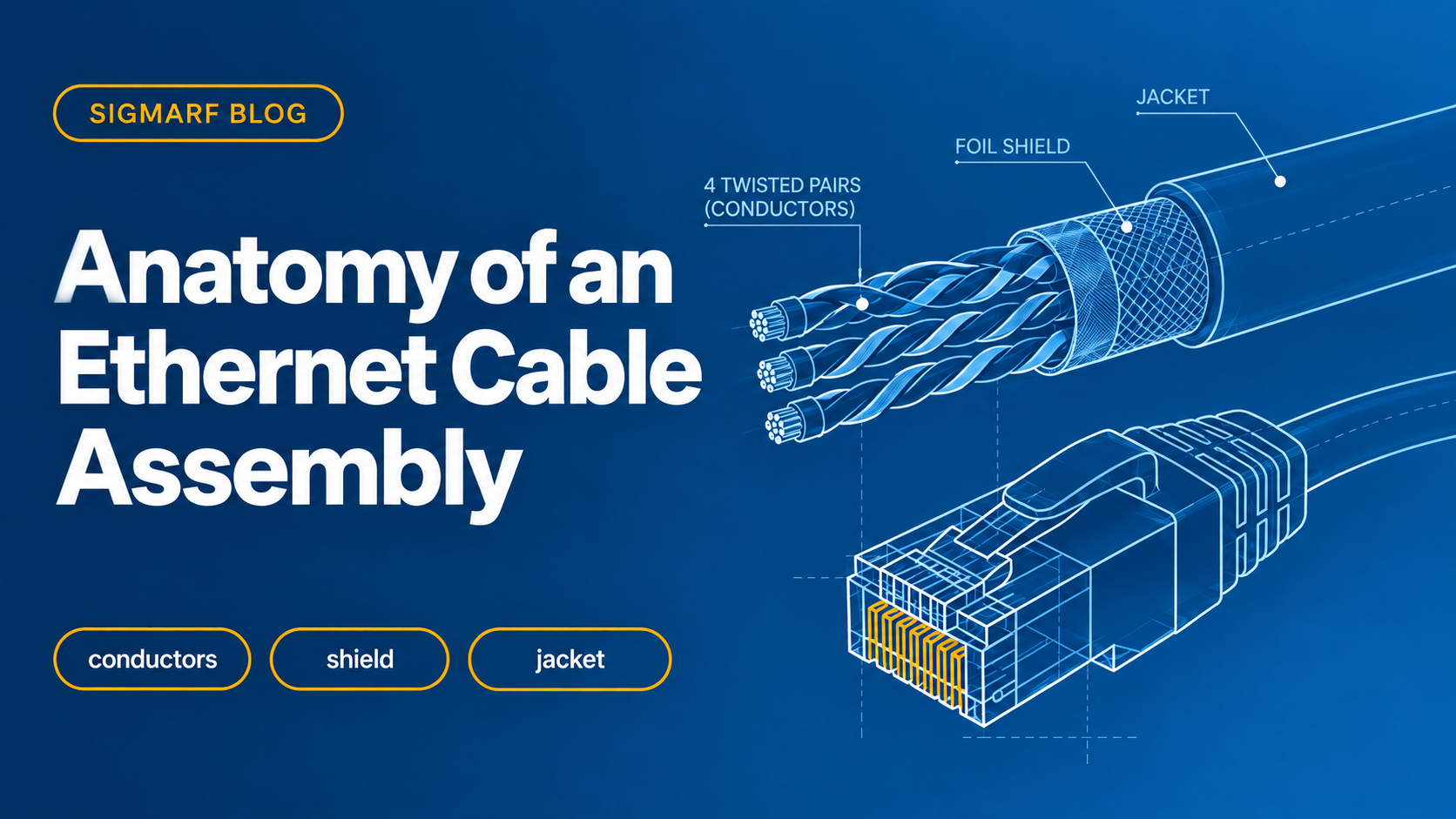
An Ethernet cable assembly consists of four twisted pairs of copper conductors, an optional foil or braid shield, an outer jacket, and RJ45 plugs with strain-relief boots at each end. Every element has a specific job in signal integrity, EMI control or mechanical life, and each one is a specification choice.
Cut an assembly open and the parts look simple. The engineering is in how they interact: the twist rates set crosstalk, the shield termination decides whether the shield helps or just adds cost, and the boot decides how the cable survives its thousandth bend. This guide walks the assembly element by element, from the copper out to the boot.
On This Page
The elements, from copper to boot
| Element | What it is | What it controls |
|---|---|---|
| Conductors | Eight copper wires, solid or stranded, 22 to 28 AWG | Attenuation, flex life, termination compatibility |
| Twisted pairs | The eight wires paired with controlled twist rates | Crosstalk between pairs and noise rejection |
| Shield (optional) | Foil or braid around all pairs, per pair, or both | EMI immunity and emission control |
| Drain wire | Bare wire in contact with a foil shield | Carries the shield connection to the plug shell |
| Jacket | PVC, LSZH, PUR or TPE outer layer | Flame and smoke behaviour, chemical and abrasion resistance |
| RJ45 plug | 8-position modular plug, shielded or unshielded | Electrical contact quality and shield continuity |
| Boot and strain relief | Molded or slip-on cover over the plug rear | Bend control and pull protection at the crimp |
Conductor gauge: the AWG trade-offs
AWG is the American Wire Gauge system, and it runs backwards: a smaller number is a thicker conductor. Horizontal building cable is usually 23 AWG solid. Patch cords run 24 to 26 AWG stranded, and slim high-density cords go to 28 AWG.
The trade is attenuation and heat against flexibility and bulk. Thinner conductors lose more signal per metre and run warmer under PoE (Power over Ethernet) load, which is why standards bodies de-rate allowed lengths for 28 AWG cords. For short equipment jumpers the trade is usually worth it: a 26 AWG stranded cord bends tighter, routes cleaner and survives handling better than a 23 AWG solid one. Our solid vs stranded guide covers the mechanical side of the choice.
Stranded conductors bundle several fine wires into each of the eight conductors, trading a little attenuation for a large gain in flex life. The stranding count matters too: 7-strand conductors are common in cords, while 19-strand versions bend more smoothly and last longer in cable carriers and on moving arms.
Why the twists matter
Each pair carries a balanced signal: the two wires carry equal and opposite currents, so external noise lands on both and cancels at the receiver. The twist keeps the two wires coupled tightly enough for that cancellation to work, and each of the four pairs twists at a different rate so the pairs do not couple to each other. That is where crosstalk performance comes from.
Category ratings are largely twist engineering plus material control: moving from Cat5e to Cat6A means tighter, more consistent twists, better pair separation and tighter tolerances on the whole construction.
The twist also explains the cardinal rule of termination: untwist as little as possible at the plug. Every millimetre of untwisted pair is a section where cancellation stops, and crosstalk measurements see it directly. This is why assembly instructions cap the untwist length and why per-piece testing catches sloppy terminations; how assemblies are tested shows what the analyzer reports.
Shield termination at the plug
A shield only earns its cost when it is terminated properly. The right way is a 360-degree termination: the foil or braid makes contact with the plug's metal shell all the way around its circumference, and the drain wire reinforces that bond. The wrong way is a long pigtail of drain wire twisted onto a tab, which adds inductance that high-frequency noise simply bypasses.
Watch for the shortcut in budget assemblies: a shielded cable crimped into an unshielded plug. The foil ends at the rear of the plug with nowhere to go, the shield floats, and the buyer pays for metal that does nothing. A shielded construction needs shielded plugs and shielded jacks to be a system, which is why the choice belongs on the assembly drawing rather than left to the cable alone.
This is the same physics our coaxial work lives on: a shield is a transmission-line element, not a wrapper, and its termination geometry decides its effectiveness. Our braid and foil shielding guide covers the underlying principles, and grounding shielded Ethernet covers the system side: plugs, jacks and ground loops.
The jacket is worth a second look because it is the only element that touches the world. PVC is the default for benign spaces; LSZH (low smoke zero halogen) trades a little flexibility for safer smoke behaviour in enclosed or occupied spaces; PUR and TPE add oil, abrasion and repeated-flex resistance for industrial duty. The trade-offs per environment are mapped in our jacket selection guide, and the connector end has its own options covered in RJ45 plug types.
A word on conductor material: proper Ethernet cable uses bare copper. Budget market cable sometimes uses CCA, copper-clad aluminum, which is lighter and cheaper but has higher resistance, worse PoE heating and brittle conductors that fail at terminations. CCA is not compliant with TIA and ISO cabling standards for structured cabling, and it is a material we do not use. If a reel price looks too good, the conductor material is the first thing to check.
Common questions
How many wires are inside an Ethernet cable?
Eight, arranged as four twisted pairs. Gigabit and faster Ethernet uses all four pairs bidirectionally; 10 and 100 Mb links use two pairs, which is why cheap two-pair cords exist but are not suitable for modern links.
What is the drain wire for?
Foil shields tear too easily to terminate on their own, so a bare drain wire runs in contact with the foil and carries the shield connection to the plug shell. It is a termination aid, not a signal conductor.
Does a thicker cable always perform better?
Thicker conductors attenuate less, but construction quality matters as much as gauge: twist control, shield coverage and termination. A well-built 26 AWG cord outperforms a poorly made 23 AWG one at equipment lengths.
What does the boot actually protect?
The boot controls the bend radius right at the plug body, the point where pulling and bending stress concentrates on the crimped contacts. It also shields the latch from snagging. A missing boot rarely fails today; it fails after months of handling at the plug.
Bottom Line
An Ethernet assembly is a small system: conductors and twists for the signal, shield and drain for EMI, jacket for the environment, plug and boot for the mechanical life. Once you can name the elements, every line of a cable specification becomes a concrete choice instead of jargon.
Want each element chosen for your product?
Tell us the environment and the link speed, and we will propose the construction: gauge, stranding, shield, jacket and plugs, then build and test it to your drawing.

Alankar is a Technical Content Writer at SigmaRF, writes on various topics from Technology, Compliance and Business process
- RF Transistor Frequency Response and Power Performance
- How Semiconductor Materials Affect RF Device Performance
- RFIC vs MMIC: Terminology, Integration and Selection
- What Is an MMIC? Inside a Monolithic Microwave Circuit
- What Are Microwave Vacuum Tubes and Where Are They Used?
- What Is a MESFET and How Is It Used in RF Circuits?
- What Is a Heterojunction Bipolar Transistor (HBT)?
- GaN vs GaAs RF Technology: Power, Noise and Design Trade-offs
- BJT vs MOSFET vs HEMT: RF Transistor Technologies Explained
- What Are RF Frequency Multipliers and How Do They Work?