RJ45 Boots, Latch Protectors and Strain Relief: Small Parts That Prevent Field Failures
Published on 10/28/2026 • Updated on 10/28/2026
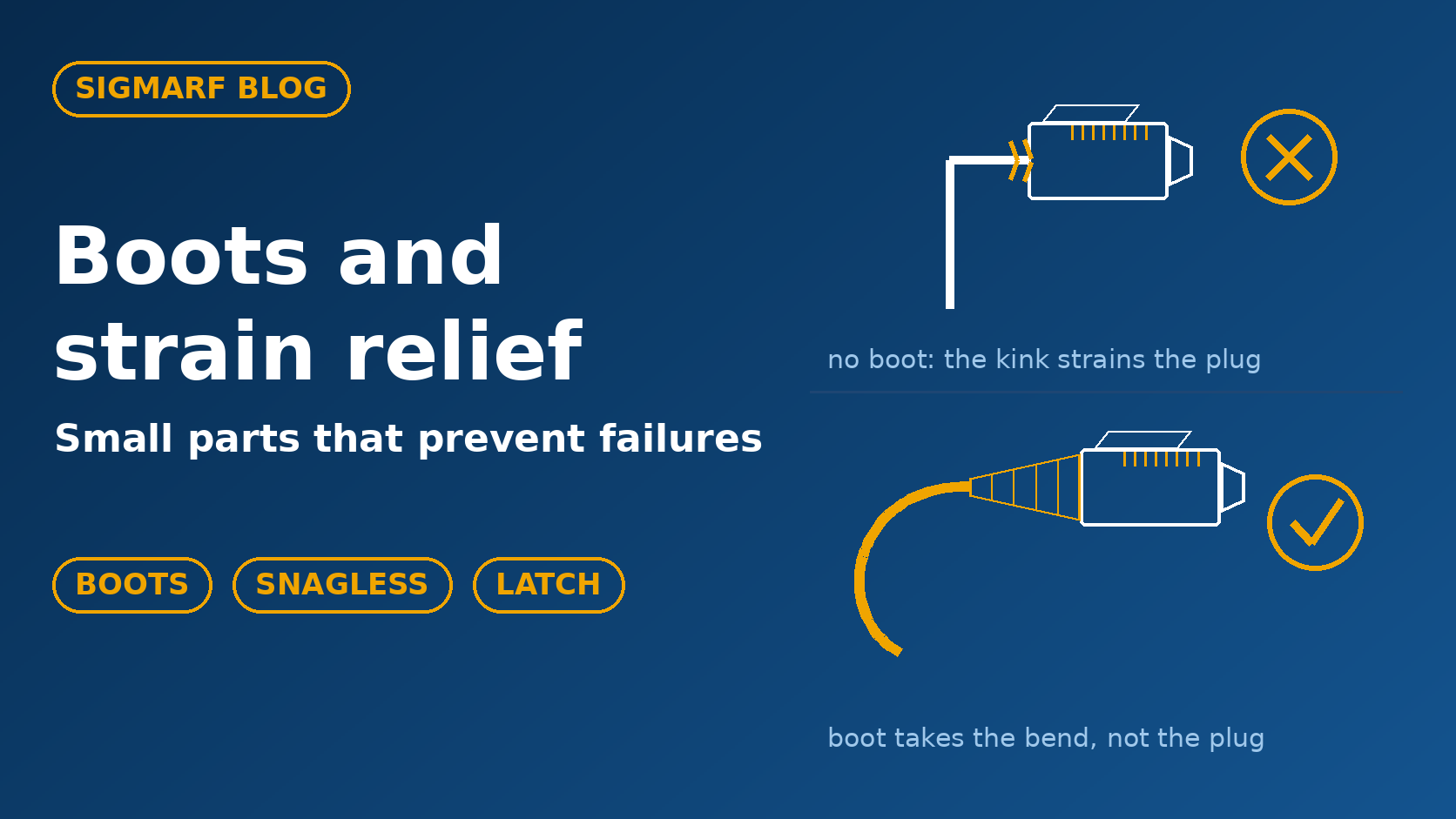
A molded strain-relief boot spreads bending stress away from the RJ45 termination and protects the latch, which is the most common failure point on handled cables. Boot style, material and colour are free choices on a custom assembly, and they prevent the failures that generate service calls.
Why do RJ45 cables fail at the plug?
Because that is where the mechanical abuse concentrates. The flexible cable meets the rigid plug in a few millimetres, and every bend, pull and snag loads that junction. The plastic latch that locks the plug into the jack sticks up exactly where hands, cable ties and neighbouring cords catch it. Field returns for "bad cables" are very often good cable attached to a damaged plug.
None of this is exotic, and none of it requires exotic materials to fix. It requires the small parts that commodity cords skimp on: a boot that supports the cable, a latch that survives handling, and a termination that holds its crimp under load.
The three failure modes boots address
Broken latches. The locking tab snaps off after repeated snagging, and the plug then backs out of the jack under its own cable weight, causing intermittent links that defy diagnosis.
Pulled plugs. A yank on the cable transfers straight into the crimped contacts. Without strain relief, conductors tear loose from the insulation-displacement contacts inside the plug, one pair at a time.
Conductor fatigue at the plug. Repeated tight bending right at the plug body work-hardens the conductors until they fracture. This is the classic failure on carts, arms and any cable that moves daily.
Molded vs slip-on boots, and snagless designs
A slip-on boot is a loose sleeve pushed over the cable before termination. It adds some bend support and costs almost nothing, but it can slide back along the cable and it does not lock to the plug. A molded boot is formed directly onto the plug and cable in one operation: it cannot migrate, it grips the jacket, and it extends the bend radius over a long, supported taper.
Snagless designs enclose or shroud the latch so cords slide past each other without catching. For any cable that is handled repeatedly, moved between ports, or pulled through bundles, a molded snagless boot is the durable choice. For a fixed internal link that is plugged once and forgotten, a simpler boot may be all the drawing needs.
| Boot type | Bend support | Latch protection | Best use |
|---|---|---|---|
| No boot | None | None | Fixed links in protected cabinets |
| Slip-on boot | Moderate | Partial | Light-duty patch cords |
| Molded boot | High, fixed taper | Good | Equipment harnesses, routine handling |
| Molded snagless boot | High, fixed taper | Full shroud | Frequent moves, dense patching, service ports |
Boot style, colour and material are line items on our assembly drawings. Specify them once and every unit matches.
Specify boot style in your RFQPull-force expectations and retention testing
A good assembly holds its plug under a defined axial load without contact damage. There is no single universal number that fits every design, since retention depends on cable diameter, jacket material and plug type; what matters is that the requirement is stated and verified. On our builds, plug retention is checked as part of the assembly inspection, and every assembly is 100% tested electrically before it ships, with digital test certificates available on critical builds.
If your product's cable will be pulled, stepped on or rolled over by a cart, say so on the drawing. The boot material, overmold hardness and even the plug selection change with the expected abuse, and those choices are cheap when made at design time.
Colour-coded boots for port identification
Boots can be produced in distinct colours without changing the cable jacket, giving a cheap identification layer: red for the primary link, blue for the backup, yellow for the service port. In a dense cabinet, coloured boots cut patching errors and make fault-finding faster, and they survive where adhesive labels peel off.
Colour schemes work best when they are documented once and reused across the product line. Our custom patch cable guide covers labelling and colour practice for dense racks in more depth.
Specifying boots on a custom assembly
Four lines on the drawing cover it: boot type (slip-on, molded or molded snagless), boot material and hardness where it matters, boot colour, and any latch or orientation requirement such as a right-angle plug. Pair that with the expected handling, and the assembly arrives ready for the life it will actually live. The RJ45 plug types guide covers the plug side of the same decision.
Service math: a molded snagless boot adds a small cost per assembly. One avoided site visit for an intermittent link pays for a large batch of them.
Boots for special cases: right-angle and panel-mount plugs
Right-angle plugs change the bending picture: the cable exits sideways, so the boot supports a turn rather than a straight taper. They save depth in tight enclosures but concentrate stress differently, and the boot design must match the orientation. Panel-mount and bulkhead jacks remove handling stress entirely by fixing the interface to the enclosure, letting a replaceable cord take the wear.
These variants are all selectable on a custom drawing. The right-angle and low-profile RJ45 guide covers orientation choices, and the boot conversation follows directly from them.
Common questions
What does an RJ45 strain relief boot do?
It supports the cable where it enters the plug, spreading bending stress over a taper instead of concentrating it at the crimp. This prevents conductor fatigue and keeps pulls from tearing contacts loose, the two most common plug-end failures.
What is a snagless Ethernet cable?
A cable whose plug has a boot that shrouds the locking latch, so the latch cannot catch on other cables when the cord is pulled through a bundle. Snagless designs survive repeated handling and re-patching far better than exposed-latch plugs.
Molded boot or slip-on boot: which is better?
Molded, for anything that gets handled. A molded boot is fused to plug and cable, so it cannot slide back and it gives a consistent supported bend. Slip-on boots are acceptable for light-duty cords that are plugged once and left alone.
How much pull force can an RJ45 connection take?
It depends on the plug, cable and boot design, so there is no honest universal figure. State the expected load on your drawing and have the assembly verified to it; retention can then be checked as part of batch inspection.
Can I get coloured boots to match my product?
Yes. Boots can be moulded in standard and custom colours independently of the jacket colour, which makes them a cheap port-identification and branding layer on custom assemblies.
Bottom Line
Latches, pulls and conductor fatigue kill cables at the plug, and boots are the cheap cure. Choose molded snagless boots for handled cables, state the pull requirement on the drawing, and use boot colour as a free identification system.
Boots, latches and strain relief built into your assembly
Send the handling conditions, boot style, colour and quantity. We build and test the complete assembly.
Custom Ethernet cable assemblies | Talk to SigmaRF
Ed is a Sourcing & Marketing Expert at SigmaRF, writes content related to Technology and Engineering topics
- RF Transistor Frequency Response and Power Performance
- How Semiconductor Materials Affect RF Device Performance
- RFIC vs MMIC: Terminology, Integration and Selection
- What Is an MMIC? Inside a Monolithic Microwave Circuit
- What Are Microwave Vacuum Tubes and Where Are They Used?
- What Is a MESFET and How Is It Used in RF Circuits?
- What Is a Heterojunction Bipolar Transistor (HBT)?
- GaN vs GaAs RF Technology: Power, Noise and Design Trade-offs
- BJT vs MOSFET vs HEMT: RF Transistor Technologies Explained
- What Are RF Frequency Multipliers and How Do They Work?