LMR-400 vs RG213 vs LMR-240: Loss, Power and Handling Compared
Published on 11/1/2026 • Updated on 11/1/2026
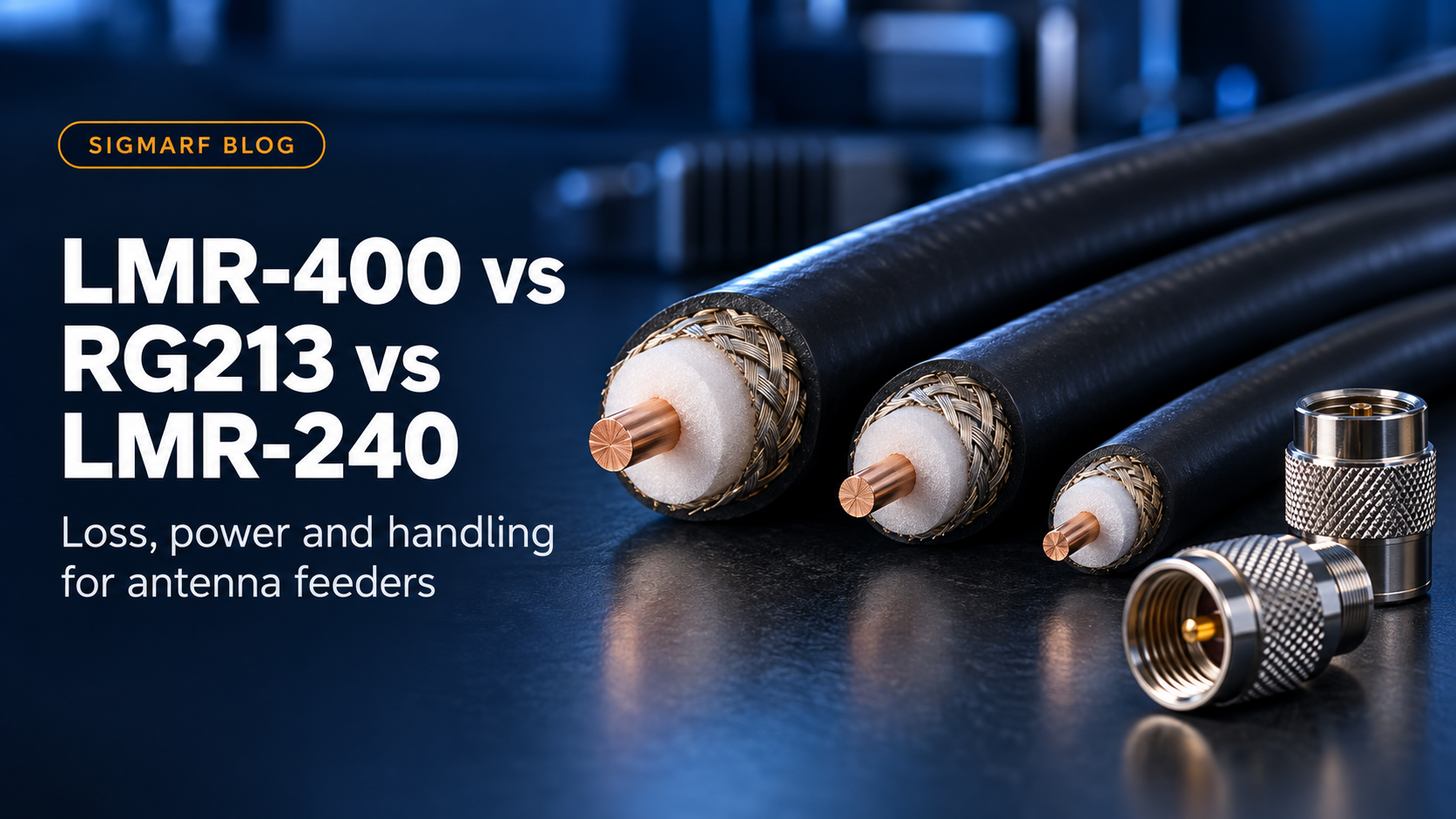
Two 10 mm cables sit on the shelf for the same antenna feeder job: RG213, the solid-PE veteran, and LMR-400, the foam low-loss challenger. LMR-240 waits nearby for anyone who wants an easier pull through the wall. The datasheets all say 50 ohm. The losses, power ratings and connector drawers say three different cables.
Short answer: at VHF and above, LMR-400 loses roughly half of what RG213 loses over the same run, and LMR-240 about twice what LMR-400 loses. At HF with high power, RG213 fights back with a sturdier solid dielectric and well-known power handling. Pick by frequency, power and routing, not by habit.
On This Page
LMR-400 vs RG213 vs LMR-240 at a glance
| Property | LMR-400 | RG213 | LMR-240 |
|---|---|---|---|
| Impedance | 50 ohm | 50 ohm | 50 ohm |
| Diameter | 10.29 mm | 10.3 mm | 6.10 mm |
| Dielectric | Foam PE | Solid PE | Foam PE |
| Shield | Aluminum tape + tinned copper braid | Single 95% bare copper braid | Aluminum tape + tinned copper braid |
| Velocity factor | 84% | 66% | 83% |
| Center conductor | Solid copper-clad aluminum | 7-strand bare copper, 13 AWG | Solid bare copper |
| Weight (approx.) | about 100 kg/km | about 155 kg/km | about 55 kg/km |
| Installation bend radius | 25.4 mm | 100 mm (published reference) | 19 mm (published class data) |
| Connector group | Dedicated LMR-400 parts | Standard RG8/RG213 group | Dedicated LMR-240 parts |
Figures are from the published cable datasheets and reference constructions; the LMR selection guide and the RG213/RG214 guide cover each family in more depth.
Loss at the same frequency
Typical cable-only attenuation in dB per meter, from published data, matched conditions:
| Frequency | LMR-400 | RG213 | LMR-240 |
|---|---|---|---|
| 50 MHz | about 0.021 | 0.043 | about 0.045 |
| 150 MHz | 0.050 | about 0.075 | 0.099 |
| 450 MHz | 0.089 | about 0.14 | 0.173 |
| 900 MHz | 0.128 | about 0.23 | 0.248 |
| 1500 MHz | 0.168 | about 0.32 | 0.324 |
| 2500 MHz | 0.222 | not practical | 0.424 |
Below 100 MHz the gap is small and RG213 is a perfectly rational choice. By 450 MHz LMR-400 saves roughly 0.5 dB every 10 m, and by 900 MHz the saving approaches 1 dB every 10 m. Above about 1 GHz the solid-PE RG213 leaves the conversation; the site attenuation chart stops listing it at 2.4 GHz for a reason.
Key idea: Velocity factor is a hidden spec: 84% vs 66% means RG213 is electrically about 27% longer than its physical length. In phased or matched-length systems, cut by electrical length, not by the tape measure.
Power handling and heating
This is where RG213 answers back. Published cable figures for the RG213 reference construction list roughly 750 W at 100 MHz and 330 W at 400 MHz under stated conditions; its solid PE dielectric and all-copper conductors tolerate transmit heating well. LMR-400 handles similar average power at low frequency, but its foam dielectric softens at a lower temperature and its copper-clad aluminum center conductor carries heat less happily at HF. LMR-240, being half the diameter, is a signal and moderate-power cable.
⚠️ Every power number here is cable-only, matched-load, room-temperature data. A 2:1 VSWR, summer roof temperature, coiled slack or altitude can halve the safe figure, and the connector often limits the assembly before the cable does. Derate, and treat published tables as starting conditions, not permissions.
Mechanical, weather and termination
RG213 is tougher in the ways that matter outdoors: solid dielectric resists crush and kink damage, the PVC jacket is proven over decades, and the standard RG213 connector group (N, UHF, 7/16) is cheap and everywhere. LMR-400 is lighter for the same diameter, bends tighter without damage, and its foil-plus-braid shield gives better screening, but it needs dedicated LMR-400 connector variants; the N-type on LMR-400 installation guide shows the prep. LMR-240 pulls through conduit and wall cavities that the 10 mm cables simply will not fit.
For outdoor runs, jacket choice and joint sealing matter more than the cable family; the outdoor assembly specification covers UV, ingress and grounding.
Send the run, get the cable
Frequency, length, power and route. We will pick the cable, terminate it correctly and sweep the finished assembly before shipment.
Talk to an EngineerWhich cable for which job
| Job | Best choice | Why |
|---|---|---|
| HF station feeder, high power | RG213 | Solid dielectric, proven power handling, cheap connectors |
| VHF/UHF antenna run, 15 m or more | LMR-400 | About half the loss of RG213 at the same length |
| 900 MHz and above, any length | LMR-400 | RG213 is lossy and off its published map |
| Short runs, tight conduit, indoor | LMR-240 | Half the diameter, acceptable loss over a few meters |
| Buried or harsh conduit | RG213 or direct-bury variants | Solid construction tolerates abuse; check jacket rating |
| Matched-length or phased runs | LMR-400 | Higher velocity factor, tighter electrical length control |
Worked example: a 30 m feeder
RG213 = 30 x about 0.07 = 2.1 dB | LMR-400 = 30 x 0.046 = 1.4 dB
Saving 0.7 dB - LMR-400 nice, RG213 acceptable
Case B: 900 MHz, 30 m
RG213 = 30 x 0.23 = 6.9 dB | LMR-400 = 30 x 0.128 = 3.8 dB
RG213 throws away 4 of every 5 watts - choose LMR-400
Selection mistakes
Avoid
- ✗Choosing RG213 for a 900 MHz link because it worked at 28 MHz.
- ✗Putting RG58-group or RG213-group connectors on LMR-400; the foam dimensions need dedicated parts.
- ✗Ignoring velocity factor when cutting phased or repeater duplexer jumpers.
- ✗Coiling excess LMR-400 tightly behind the radio and exceeding the bend radius.
- ✗Comparing cables by price per meter only, then buying an amplifier to fix the loss.
LMR-400 vs RG213 vs LMR-240 questions
Is LMR-400 better than RG213?
On loss and weight above VHF, yes. On high-power HF duty, crush resistance and connector cost, RG213 still makes sense. They are different generations of 10 mm 50 ohm cable, not a good and a bad one.
Can I use RG213 connectors on LMR-400?
No. LMR-400 has a foam dielectric of 7.24 mm and a foil-plus-braid shield; use connector variants listed for LMR-400. The fit, ferrule and crimp die all differ.
What is the LMR-240 equivalent in RG sizes?
Nothing exact. Electrically it sits between RG58 and RG213 on loss at about 6.1 mm diameter. Compare it by numbers, not by RG name; the RG58 vs LMR-240 comparison does exactly that.
How much loss is acceptable in an antenna feeder?
A common planning limit is 1 to 3 dB depending on the link budget. Every 3 dB costs half your power in both directions, so price the cable against the power you paid for.
Does LMR-400 work for HF?
Electrically yes, but RG213 is usually the better HF cable: cheaper connectors, tougher dielectric and comfortable power handling. LMR-400 earns its keep from VHF upward.
Bottom Line
Below 100 MHz and at power, RG213 holds its ground. From VHF upward, LMR-400 wins on loss and keeps winning as frequency rises; LMR-240 trades some loss for half the diameter on short, tight runs. Compare at your frequency and length, respect the connector groups, and get the finished assembly swept.
Get the feeder built and tested
Standard and custom assemblies on LMR-400, LMR-240, RG213 and more, each one VNA-swept for VSWR and insertion loss before shipment.

Aadeshwar Modi is a marketing technical content writer who loves writing on technology and AI topics.
- RF Transistor Frequency Response and Power Performance
- How Semiconductor Materials Affect RF Device Performance
- RFIC vs MMIC: Terminology, Integration and Selection
- What Is an MMIC? Inside a Monolithic Microwave Circuit
- What Are Microwave Vacuum Tubes and Where Are They Used?
- What Is a MESFET and How Is It Used in RF Circuits?
- What Is a Heterojunction Bipolar Transistor (HBT)?
- GaN vs GaAs RF Technology: Power, Noise and Design Trade-offs
- BJT vs MOSFET vs HEMT: RF Transistor Technologies Explained
- What Are RF Frequency Multipliers and How Do They Work?