RG58 vs RG174 vs RG316: Loss, Size, Temperature and Uses
Published on 11/1/2026 • Updated on 11/1/2026
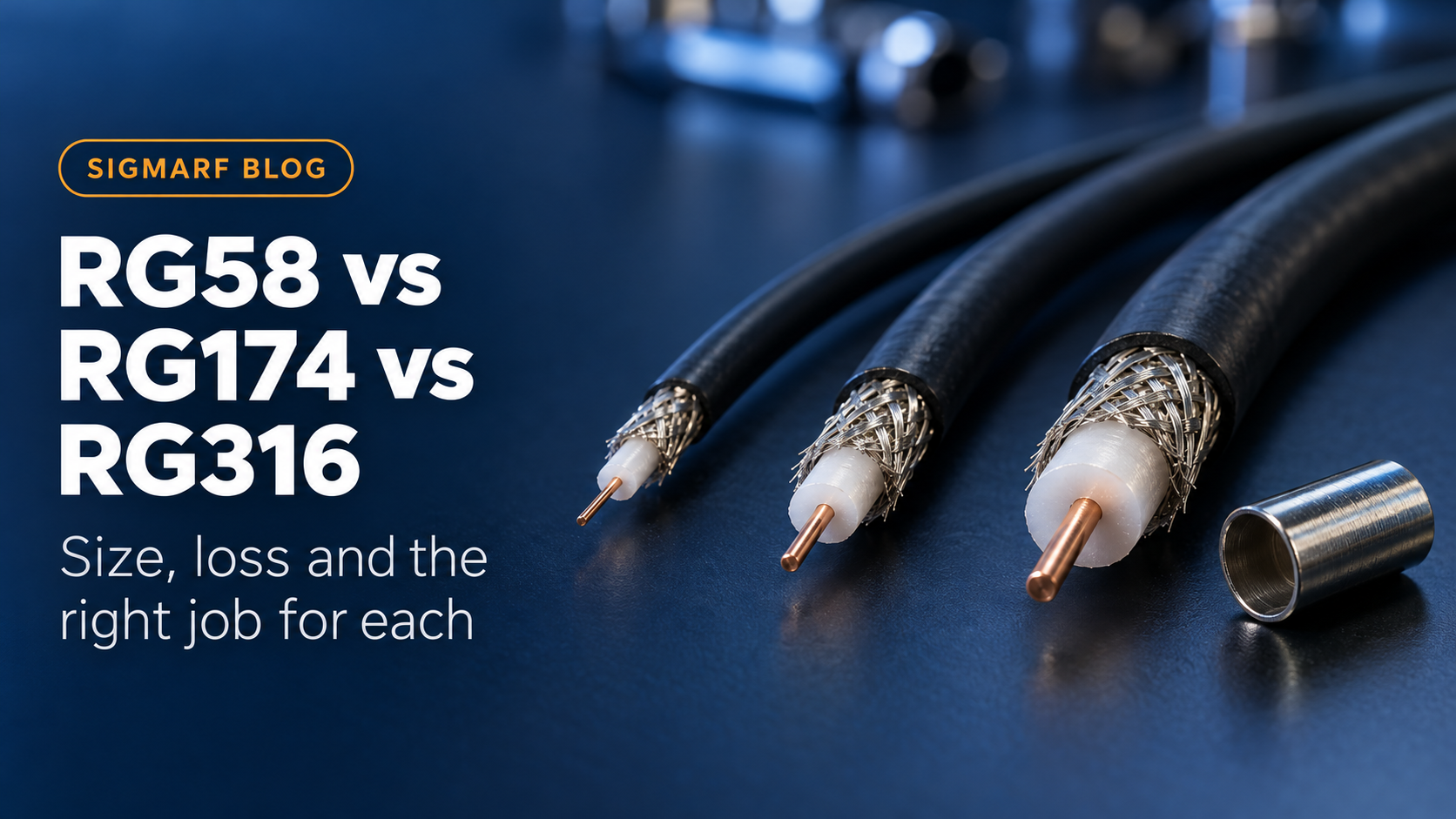
Three cables cover most small 50 ohm coax work: RG58, RG174 and RG316. They share the same job and none of the same trade-offs. One is cheap and tough, one bends around anything, and one survives heat that melts the other two. Picking between them is a five-minute decision if you compare the right numbers.
Short answer: RG58 (4.95 mm, solid PE) is the general-purpose choice to about 1 GHz. RG174 (2.8 mm, solid PE) is the flexible short-jumper cable with roughly twice the loss. RG316 (2.5 mm, PTFE) costs more, loses slightly less than RG174, and works from -55 to +200 °C. All three are 50 ohm, and none of them belongs on a long 2.4 GHz run.
On This Page
RG58 vs RG174 vs RG316 at a glance
| Property | RG58 | RG174 | RG316 |
|---|---|---|---|
| Impedance | 50 ohm | 50 ohm | 50 ohm |
| Outer diameter | 4.95 mm | 2.8 mm | 2.5 mm |
| Dielectric | Solid polyethylene | Solid polyethylene | PTFE |
| Jacket | PVC | PVC | FEP |
| Velocity factor | 66% | 66% | about 70% |
| Center conductor | Stranded or solid bare/tinned copper | Stranded copper-clad steel, 7 x 0.16 mm | Silver-plated copper-clad steel, 7 x 0.17 mm |
| Temperature range | about -40 to +80 °C | about -40 to +85 °C | -55 to +200 °C |
| Practical frequency ceiling | about 1 GHz | about 1 GHz | about 3 GHz |
| Relative cost | Lowest | Low | Highest of the three |
Diameters and materials come from published cable datasheets; individual makers vary slightly, so confirm the exact part before committing a connector. For a wider set of cables, the coaxial cable types master table covers the full range.
Loss compared at real frequencies
Attenuation in dB per meter, typical planning figures that match both published datasheets and the site attenuation chart:
| Cable | 100 MHz | 400 MHz | 1 GHz | 2.4 GHz |
|---|---|---|---|---|
| RG58 | 0.16 | 0.37 | 0.72 | 1.2 |
| RG174 | 0.30 | 0.60 | 1.05 | 1.7 |
| RG316 | 0.30 | 0.55 | 0.90 | 1.4 |
Two things stand out. RG174 and RG316 are nearly equal in loss despite the price gap; you buy RG316 for temperature and stability, not for lower attenuation. And all three get expensive in decibels at 2.4 GHz: a 3 m RG174 lead at 2.4 GHz burns about 5 dB, more than half your power, before the antenna sees anything.
RG58 = 2 x about 0.5 = 1.0 dB
RG174 = 2 x about 0.8 = 1.6 dB
RG316 = 2 x about 0.7 = 1.4 dB
Add 0.1 to 0.2 dB per connector pair, then 10 percent margin
Key idea: Doubling the cable diameter roughly halves the loss. When RG58 is not low enough, the next step is not a thicker RG cable but a foam low-loss type like LMR-240; see the RG58 vs LMR-240 comparison.
Construction, temperature and flex
The dielectric decides the personality of each cable. RG58 and RG174 use solid polyethylene with PVC jackets: cheap, easy to strip, fine indoors, and limited to about +80 °C. RG316 uses PTFE dielectric with an FEP jacket and silver-plated conductors: it solders without the dielectric shrinking back, shrugs off +200 °C, and stays stable over temperature. The silver-plated copper-clad steel center conductor is stiff for its size, which is why RG316 holds its shape in tight routing.
For repeated flexing, RG174 is the friendliest of the three; its stranded conductor and soft jacket tolerate constant movement, which is why it appears inside equipment and on GPS antenna leads. RG316 handles moderate flexing, RG58 the least. Bend radius rules for the small cables are in the bend radius guide.
Power handling and voltage
Power follows size and dielectric. RG58, with its larger cross-section, carries the most of the three: think hundreds of watts at HF and low VHF, falling fast with frequency. RG174 and RG316 are signal cables, comfortable at a few watts to a few tens of watts depending on frequency. RG316 tolerates a higher working voltage for its size (about 900 V RMS per MIL-C-17/113) than RG174, and PTFE handles the heat that transmit duty creates better than polyethylene. For real numbers by frequency, use the power handling guide rather than a rule of thumb.
⚠️ Cable power ratings assume matched load, room temperature and still air. A 2:1 VSWR, a hot enclosure or a coiled cable can cut the safe power in half. Derate, or ask for the assembly conditions to be checked.
Connectors and cable groups
Connectors are cable-specific: an SMA crimp plug for RG58 is a different part from one for RG316, even though both say SMA. RG174 and RG316 share the same dielectric diameter (1.52 mm), so many connector bodies serve both, but the ferrules and crimp dies differ with the outer diameter. Common pairings: SMA, MCX and MMCX on RG174/RG316; SMA, BNC, TNC and N on RG58. Strip dimensions and die sizes are in the SMA crimping guide, and the connector side of the choice is in the connector selection guide.
Not sure which cable your run needs?
Send the frequency, length and connectors. We will recommend the cable and build the assembly, swept on a VNA before shipment.
Talk to an EngineerWhich one for which job
| Job | Best of the three | Why |
|---|---|---|
| General lab leads, antennas to 1 GHz | RG58 | Lowest loss per dollar, easy connectors |
| Short internal jumpers, GPS leads | RG174 | Smallest and most flexible |
| Hot environments, engine bays, reflow-adjacent | RG316 | PTFE/FEP to +200 °C |
| Dense routing that must hold shape | RG316 | Stiff CCS conductor, small OD |
| Continuous flex (robot arms, doors) | RG174 | Softest, most forgiving |
| Anything long at 2.4 GHz and up | None of these | Step up to LMR-240/LMR-400 class |
Selection mistakes
Avoid
- ✗Buying RG316 for lower loss; its advantage is temperature and stability, not attenuation.
- ✗Running RG174 more than a meter or two at 2.4 GHz and wondering where the range went.
- ✗Assuming RG174 and RG316 connectors interchange completely; ferrules and dies differ.
- ✗Coiling spare RG58 in a tight loop inside a hot enclosure and cooking the PE dielectric.
- ✗Specifying by the RG name only; makers vary 10 to 20 percent on loss, so cite the datasheet construction.
RG58 vs RG174 vs RG316 questions
Is RG316 better than RG174?
Electrically they are within about 15 percent of each other on loss. RG316 earns its price with PTFE construction: +200 °C operation, no dielectric shrink-back when soldering, and better dimensional stability. RG174 is cheaper and more flexible.
Can RG58 be used at 2.4 GHz?
It works, but at about 1.2 dB per meter the bill adds up fast: 5 m costs 6 dB. Keep RG58 at 2.4 GHz to short jumpers, or move to a low-loss foam cable.
What is the difference between RG316 and RG316D?
RG316D adds a second shield braid for better screening at a slightly larger 3.0 mm diameter. The full comparison is in the linked RG316 vs RG316D article.
Why does RG174 use a steel center conductor?
Copper-clad steel adds tensile strength to a very small conductor and costs less. The skin effect keeps RF on the copper surface, so the RF penalty is small at these frequencies.
Are RG58 and RG58C/U the same?
RG58C/U is the common military-designation variant of RG58 with a stranded conductor; in buying terms the names are used interchangeably. Check the construction, not just the name.
Bottom Line
RG58 for general work, RG174 for short flexible jumpers, RG316 for heat and stability. Compare loss at your actual frequency, respect the connector cable groups, and step up to a low-loss foam cable when the run gets long. Then have the finished assembly swept, because the cable you picked only performs as well as its terminations.
Get the right cable, built and tested
Assemblies on RG58, RG174, RG316 and low-loss alternatives, each one VNA-swept for VSWR and insertion loss before shipment.

Ed is a Sourcing & Marketing Expert at SigmaRF, writes content related to Technology and Engineering topics
- RF Transistor Frequency Response and Power Performance
- How Semiconductor Materials Affect RF Device Performance
- RFIC vs MMIC: Terminology, Integration and Selection
- What Is an MMIC? Inside a Monolithic Microwave Circuit
- What Are Microwave Vacuum Tubes and Where Are They Used?
- What Is a MESFET and How Is It Used in RF Circuits?
- What Is a Heterojunction Bipolar Transistor (HBT)?
- GaN vs GaAs RF Technology: Power, Noise and Design Trade-offs
- BJT vs MOSFET vs HEMT: RF Transistor Technologies Explained
- What Are RF Frequency Multipliers and How Do They Work?